
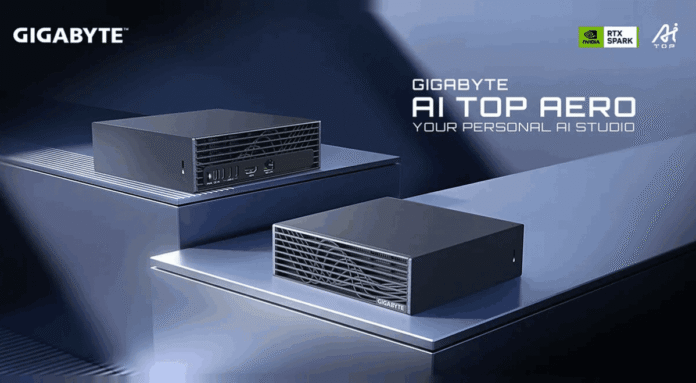
Gigabyte AI TOP AERO is the company’s latest attempt to bring powerful AI computing into a compact desktop. Built around Nvidia’s RTX Spark platform, the new workstation combines a 20 core Arm based processor, Blackwell architecture graphics and up to 128GB of unified LPDDR5X memory in a remarkably small form factor.
The system is designed for users who want to run AI workloads locally without depending entirely on cloud services. Gigabyte is positioning it as a Personal AI Studio, targeting AI developers, content creators and even gamers who need considerable computing power in a small Windows 11 desktop.
However, there is one important detail missing from the announcement. Despite introducing the AI TOP AERO with a stated launch date, Gigabyte has yet to reveal its pricing, regional configurations or actual availability. That makes it difficult for potential buyers to determine whether this compact AI workstation will be worth considering.
The timing is also interesting because Nvidia’s Spark based systems are already attracting attention, but their high prices and limited availability could make them difficult to purchase.
Gigabyte AI TOP AERO brings Nvidia Blackwell power to a compact desktop
The biggest attraction of the Gigabyte AI TOP AERO is its hardware configuration. The company has managed to package Nvidia’s RTX Spark platform into a desktop measuring roughly one litre in volume.
At its core is Nvidia’s 20 core Arm based Grace CPU, paired with a GPU based on the Blackwell architecture. The workstation supports up to 128GB of unified LPDDR5X memory and offers up to a 4TB PCIe Gen5 SSD.
This combination is aimed at demanding workloads, particularly local AI development and applications that benefit from having large amounts of memory available.
Running AI models locally can offer several advantages. Users can experiment with models, process information and develop applications without constantly sending requests to external cloud services. It can also provide greater control over development environments and data.
Gigabyte is promoting the AI TOP AERO as a versatile machine rather than a workstation built exclusively for developers. Its intended uses include AI development, content creation and gaming.
The company also highlights support for popular software platforms such as LM Studio, Ollama and ComfyUI. Nvidia’s Nemotron models are part of the broader software ecosystem being promoted for the system.
Connectivity is another important part of the package. Gigabyte lists USB Type C, 10GbE networking and Wi Fi 7 support, although the company has not yet provided a complete port breakdown or detailed physical specifications.
There is still plenty of information missing. Gigabyte has not confirmed the workstation’s exact dimensions, weight or detailed configuration options.
AI TOP AERO and AI TOP ATOM serve different purposes
Gigabyte already has experience with Nvidia’s Spark hardware, and the AI TOP AERO is not its first compact AI workstation.
The company also offers the AI TOP ATOM, which is based on Nvidia’s DGX Spark platform and uses the GB10 chip.
Although the two systems share a similar overall goal, their software environments and intended use cases are different.
The AI TOP ATOM runs Nvidia’s Linux based DGX OS, while the new AI TOP AERO uses Windows 11. This distinction could make the AERO more appealing to users who prefer Microsoft’s desktop operating system and want to work with familiar applications.
Another difference concerns networking and multi system configurations. Gigabyte previously announced a 64GB version of the AI TOP ATOM that supports connecting up to four units through its built in ConnectX 7 networking.
The AI TOP AERO announcement does not mention comparable clustering hardware.
Nvidia’s specifications for the desktop N1X list 6,144 CUDA cores, 20 CPU cores and a 140W thermal design power. However, Gigabyte has not provided these specific figures in its own product announcement.
The two machines are therefore best understood as different implementations of Nvidia’s compact AI computing platform rather than identical products with different operating systems.
For developers, the choice could come down to software preferences, memory requirements and whether they need a multi system setup.
Gigabyte has not revealed the AI TOP AERO price or availability
The biggest unanswered question surrounding the AI TOP AERO is how much it will cost.
Despite its announced launch timeline, Gigabyte has not published an official price, confirmed regional configurations or provided a clear purchasing option.
This is particularly frustrating because the Nvidia Spark market is already dealing with high prices and limited stock.
For comparison, Gigabyte’s 64GB AI TOP ATOM with a 2TB SSD starts at $4,999.
Other Nvidia Spark based systems are similarly expensive. MSI’s EdgeMesa N AI+ launched in the US with a 64GB memory configuration and 1TB storage for $4,699. Its higher end version, featuring 128GB memory and a 4TB SSD, costs $7,999.
However, availability has also become a concern. The 128GB MSI configuration was reportedly out of stock when checked on November 11.
Microsoft’s 128GB Surface RTX Spark Dev Box is listed at $5,999, while the 128GB Surface Laptop Ultra has reportedly experienced delivery delays extending into late December.
Nvidia’s own 128GB DGX Spark has also seen its price increase to $6,950, highlighting how expensive high capacity AI hardware has become.
Buyers looking for more memory could also consider AMD based alternatives. GMKtec’s EVO X5 Pro, powered by AMD’s Gorgon Halo platform, launched at $6,399 with 192GB of memory. Up to 160GB can be allocated to graphics.
These prices demonstrate that compact AI workstations are currently positioned well above conventional mini PCs.
Memory capacity is a particularly important factor because local AI workloads can consume substantial amounts of system memory. However, having 128GB available does not automatically guarantee that every application can use the entire capacity in the same way.
Can the AI TOP AERO become a practical local AI workstation?
Gigabyte’s new workstation has an interesting hardware configuration, but its real world performance will depend on more than its specifications.
One important question concerns cooling. Packing hardware with a reported 140W power envelope into a chassis of approximately one litre could create thermal challenges.
The cooling system will need to maintain stable performance during extended AI workloads without excessive heat or noise.
Memory management is another area worth watching. Although the system supports up to 128GB of unified LPDDR5X memory, how Windows applications and AI workloads access that capacity will influence the overall experience.
The price will also determine whether the machine makes sense for individual developers and smaller creative studios.
For now, Gigabyte has introduced a promising addition to Nvidia’s growing Spark ecosystem, but buyers still need answers about availability, configurations and cost.
Until the company publishes those details, the AI TOP AERO remains an impressive hardware announcement rather than a workstation that customers can confidently order.
Follow TechBSB For More Updates