
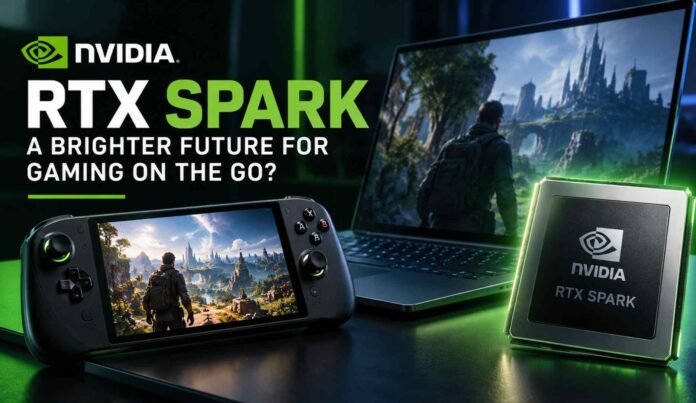
Nvidia RTX Spark has turned out to be much more interesting for gaming than I initially expected. After getting some hands on time with an RTX Spark powered laptop at Gamescom 2026, I came away convinced that Nvidia’s new ARM based platform could have a much bigger role in portable gaming than its creator focused pitch initially suggested.
The most interesting part is that RTX Spark is not being positioned purely as a gaming chip. Nvidia has designed it as a compact superchip for Windows on ARM systems, with a strong emphasis on AI and creative workloads. That makes it particularly well suited to thin laptops and compact PCs where manufacturers want serious performance without building around a traditional desktop class processor and discrete graphics card.
But gaming is where RTX Spark really caught my attention.
RTX Spark surprised me in Borderlands 4
I got to try an RTX Spark powered HP OmniBook Ultra 16 at Gamescom, with Borderlands 4 running on the system. That is a useful test because Gearbox’s latest Borderlands game has hardly been an easy title for PC hardware.
The game had a difficult launch, with performance issues affecting even powerful gaming systems. Things have improved considerably since then, but it remains the sort of title that can expose weaknesses in a machine.
On the RTX Spark laptop, however, performance felt remarkably smooth. I could tell the game was running above 60 frames per second, with Nvidia’s Frame Generation x2 helping to push the frame rate higher.
Frame Generation still divides PC gamers. Some people dismiss generated frames as artificial and argue that they do not represent genuine performance. I have never found that argument particularly convincing when the technology is implemented well.
More importantly, I did not notice the kind of distracting latency that can make Frame Generation feel uncomfortable. Controls remained responsive, and the overall experience felt much closer to what I would expect from a proper gaming laptop than what I had anticipated from an integrated graphics solution.
I did not have enough time with the system to perform a full suite of benchmarks, so I would not treat this as a definitive assessment of RTX Spark’s gaming performance. Still, the demonstration was encouraging.
Other RTX Spark systems at Nvidia’s booth were also running games including 007 First Light and Arc Raiders. Both appeared to maintain smooth frame rates, reinforcing the idea that RTX Spark is not simply a platform designed to look impressive in a productivity demo.
The real opportunity could be handheld gaming
The part that interests me most is not necessarily the laptop market. It is handheld gaming.
Nvidia already has some experience in this area through the Nintendo Switch 2, which uses a Tegra processor and benefits from Nvidia’s DLSS technology. That experience demonstrates just how useful sophisticated upscaling can be when hardware has to deliver good visuals within a tight power budget.
I asked Nvidia at Gamescom whether RTX Spark could eventually find its way into handheld gaming PCs. The answer was essentially that Nvidia is open to manufacturers exploring the idea.
That could be a very big deal.
Today’s handheld gaming PCs are largely built around AMD and Intel hardware. Both companies have made considerable progress in delivering strong gaming performance from relatively compact processors. But Nvidia brings something different to the table.
DLSS could be particularly valuable on a handheld.
A device such as a Legion Go or MSI Claw has a much smaller display than a conventional gaming laptop. That gives manufacturers more freedom to use aggressive upscaling without necessarily sacrificing too much perceived image quality.
DLSS Super Resolution can reconstruct a higher quality image from a lower internal resolution, which means the GPU does not have to render every frame at the display’s native resolution. On a handheld screen, where pixel density and viewing distance can work in your favor, that could be an extremely effective way of gaining performance.
Frame Generation could add another layer to that equation.
Instead of trying to squeeze every possible frame from the underlying hardware, a handheld could use Nvidia’s technologies to balance visual quality, responsiveness and power consumption. That is exactly the kind of workload where clever software can make relatively modest hardware feel considerably more capable.
There is still one major problem
There is a catch, and it is a fairly obvious one.
Price.
RTX Spark laptops are expected to arrive later this year, but pricing remains one of the biggest unanswered questions. The hardware is sophisticated, and the current memory market is not exactly helping manufacturers keep costs under control.
That creates a difficult equation.
A handheld manufacturer could build an RTX Spark device with impressive graphics performance and excellent upscaling, but none of that matters if the final product costs substantially more than competing AMD or Intel based machines.
Battery life will also be critical.
Handheld gaming is not simply about performance. A machine that delivers excellent frame rates but drains its battery rapidly is not going to be particularly useful when you are travelling. Nvidia and its hardware partners will therefore need to find the right balance between performance, efficiency and thermals.
That is why I am more interested in what RTX Spark could become than what it is today.
The laptop demonstrations suggest Nvidia has built something genuinely capable. The possibility of putting that technology into handheld gaming PCs is even more exciting.
Whether we actually see that happen will depend on manufacturers being willing to take the risk. If they do, RTX Spark could give the handheld market a very different option, combining ARM efficiency with Nvidia’s graphics technology and DLSS.
For now, I am cautiously optimistic. RTX Spark has already made a stronger impression on me as a gaming platform than I expected. Now I want to see what it can do when someone builds a handheld around it.
Follow TechBSB For More Updates