
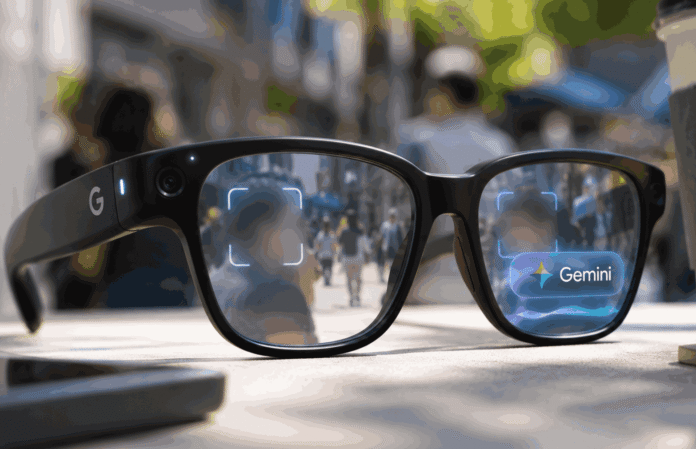
Google Android XR smart glasses are getting several important privacy protections designed to address one of the biggest concerns surrounding wearable cameras: recording people without their knowledge or consent.
As smart glasses become more popular, privacy is turning into a major issue for technology companies. Devices such as Meta’s Ray Ban smart glasses have already attracted criticism over the possibility of people secretly recording others or using facial recognition to identify strangers.
Google wants to avoid similar problems with its upcoming Android XR eyewear. The company has outlined a series of safeguards that will automatically blur faces before images are sent to Gemini for analysis, prevent third party applications from accessing certain camera capabilities and make it harder for users to disable recording indicators.
The announcement is particularly important because Google’s upcoming smart glasses are being developed with Samsung, Warby Parker and Gentle Monster. With the first models approaching their launch, the company is making privacy a central part of its wearable technology strategy.
Here is what Google’s new privacy measures mean for users and the people around them.
Android XR glasses will automatically blur faces before Gemini processing
One of Google’s most significant privacy measures involves how Android XR smart glasses handle images captured through their cameras.
According to Shahram Izadi, Google’s Vice President and General Manager of Android XR, the glasses will automatically blur identifiable faces before images are sent to Google’s servers for Gemini processing.
This protection applies whenever users ask Gemini questions about their surroundings using the camera.
For example, someone wearing the glasses could ask Gemini to translate a restaurant menu, identify an object or provide information about something they are looking at. The camera captures the relevant scene, but faces belonging to people appearing in the image will be automatically obscured before the visual information reaches Google’s servers.
Interestingly, the protection also extends to the person wearing the glasses.
If someone points their camera towards a mirror or accidentally captures their own face while taking a picture or video, Google says the wearer’s face will also be blurred before the image is submitted to Gemini.
This approach is intended to allow users to benefit from visual AI assistance without unnecessarily exposing the identities of people appearing in their surroundings.
Google has also clarified how it handles images and videos submitted through Gemini requests.
According to the company, this visual information will not be saved in Gemini’s history. It will also not be used to train Google’s AI models, personalise advertisements or deliver targeted advertising.
These protections could make Android XR glasses more appealing to people concerned about how wearable cameras collect and process personal information.
However, Google has not claimed that its face blurring system is completely foolproof. The company has not explained whether there could be circumstances in which an unblurred image reaches its servers.
Third party apps will not get access to facial recognition or live streaming
Google is also placing restrictions on what developers can do with the cameras built into Android XR smart glasses.
According to the company’s announcement, third party applications distributed through the Play Store will not be allowed to use the glasses’ cameras for real time facial recognition or live streaming.
This is an important distinction because smart glasses can become significantly more problematic when developers gain unrestricted access to their camera hardware.
For instance, an application capable of identifying strangers through facial recognition could create serious privacy concerns in public spaces. Similarly, unrestricted live streaming could make it easier to record and broadcast people without their knowledge.
By restricting these capabilities, Google wants to maintain greater control over how its wearable cameras are used.
The company is also introducing safeguards for the front facing privacy LED indicator.
This small light is designed to alert people nearby whenever the glasses are recording. Google says developers will not be permitted to disable, modify or interfere with the indicator.
There is an additional hardware protection in place, too. If someone covers or disables the privacy light, the camera will stop recording.
Each pair of glasses will also include a dedicated physical switch that allows users to quickly turn the device off when it is not being used.
Together, these measures are intended to make covert recording more difficult and give people nearby a clearer indication of when the glasses are actively capturing footage.
Google wants to avoid the privacy problems surrounding Meta’s smart glasses
Privacy has become one of the biggest obstacles facing the smart glasses industry.
Meta’s Ray Ban smart glasses have attracted considerable attention because of their ability to capture photographs and videos from the wearer’s perspective. While these features can be useful, they also raise concerns about how easily someone could record others without their consent.
There have even been reports of modified Meta smart glasses being used for experimental real time facial recognition. One example involved a Harvard student who demonstrated how the hardware could be adapted into a system capable of identifying people.
Such demonstrations highlight why camera restrictions and privacy indicators matter.
Google appears keen to prevent Android XR from becoming another platform that raises similar concerns.
Its approach combines software restrictions, automatic face blurring and physical hardware safeguards. Rather than relying entirely on users to behave responsibly, Google is attempting to build privacy protections directly into the glasses.
Still, there are questions that remain unanswered.
Google has not explained whether every possible camera related activity will receive the same face blurring treatment or how the system will handle unusual recording situations. It has also not provided a guarantee that every potential misuse of the hardware can be prevented.
Even so, the announced protections represent an important part of Google’s strategy for making intelligent eyewear more acceptable in everyday environments.
Samsung and Warby Parker Android XR glasses are coming soon
Alongside its privacy announcement, Google has shared more details about the first generation of Android XR smart glasses.
The initial Intelligent Eyewear models are being developed by Samsung in partnership with Warby Parker. Gentle Monster is also involved in Google’s broader smart eyewear plans.
The first Samsung and Warby Parker glasses will feature a 12MP ultrawide camera, integrated speakers and microphones. Google says the devices will offer up to nine hours of battery life, with the charging case providing additional power when needed.
Compatibility is another important consideration.
The glasses will work with Google Pixel and Samsung Galaxy smartphones running Android 17 or One UI 9. They will also support Apple’s iPhone devices.
Preorders have already opened, with prices starting at $395. The first models are scheduled to begin shipping in the United States and South Korea on December 10, 2026.
The launch will give Google an opportunity to demonstrate how Gemini can work beyond smartphones and become a more useful everyday assistant.
However, the success of Android XR glasses will depend on more than their AI capabilities. People need to feel comfortable wearing them in public, and those around them need confidence that their privacy is being respected.
Google’s decision to introduce automatic face blurring, restrictions on third party camera access and tamper resistant recording indicators suggests that the company understands these concerns.
Whether these protections are enough to establish trust remains to be seen. But as smart glasses become more capable, privacy could become just as important as battery life, camera quality and AI performance.
Follow TechBSB For More Updates