
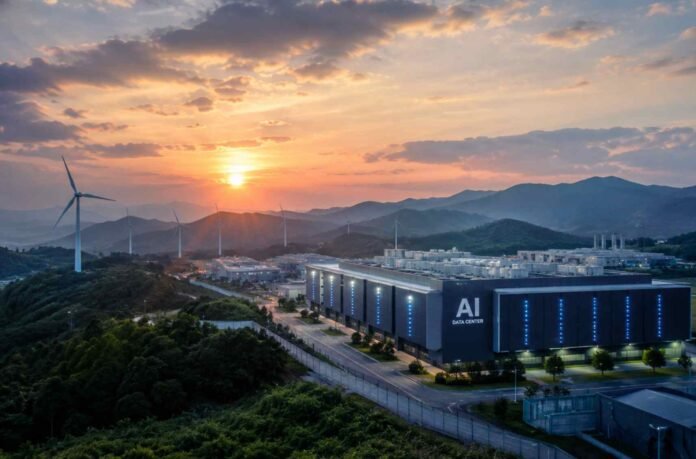
- China is moving more AI data centers into rural regions where land and electricity are cheaper.
- Guizhou and Inner Mongolia offer renewable energy, cooler conditions and space for large facilities.
- Data centers can improve infrastructure but may create fewer long term jobs than local governments expect.
- China sees computing capacity as strategic infrastructure and expects its data center capacity to grow sharply.
China is rapidly expanding its data center infrastructure as the artificial intelligence boom creates a huge appetite for computing power. But instead of concentrating every new facility around its major coastal technology hubs, the country is increasingly turning to less developed regions where land, electricity and renewable energy are easier to secure.
The strategy is part of a broader national effort to move computing resources closer to areas with plentiful energy. China formally established its Eastern Data Western Computing strategy in 2021, encouraging data intensive workloads to move away from heavily populated eastern regions toward areas with greater power availability.
The shift is becoming increasingly important as AI companies and technology providers require enormous amounts of electricity to train and operate increasingly capable models.
Why China is moving data centers inland
China’s western and central regions offer several advantages for large scale computing facilities. Guizhou and Inner Mongolia, for example, have significant amounts of available land, growing renewable energy capacity and, in some areas, cooler conditions that can reduce the cost of cooling servers.
Guizhou has become one of the most visible examples of this approach. The province has attracted major technology companies and data center investment, helping turn previously overlooked areas into important computing locations.
Renewable energy is another major factor. China has been expanding its solar and wind generation capacity at a rapid pace, and large data centers can provide a steady source of demand for electricity that might otherwise be curtailed when renewable generation exceeds what the grid can immediately absorb.
The government has also set ambitious targets for the use of renewable electricity in new data center projects. New facilities are expected to increasingly rely on renewable sources, making regions with large solar and wind resources particularly attractive.
For China, this is about more than reducing operating costs. Computing capacity is increasingly being treated as strategic infrastructure, much like transport networks, electricity grids and telecommunications systems.
Rural investment does not automatically mean rural prosperity
The economic argument for building data centers in less developed regions is straightforward. Large infrastructure projects bring construction activity, investment and new demand for services. They can also encourage improvements in roads, electricity infrastructure and telecommunications.
But the benefits for local residents are less certain.
Data centers are highly automated facilities and generally do not employ large numbers of people once construction is complete. That means a region can receive a substantial investment without seeing a comparable increase in long term employment.
Guizhou provides an interesting example. The province has recorded strong economic growth during a period of significant investment in data centers and digital infrastructure. Yet wage growth has not necessarily kept pace with that expansion.
Researchers have questioned whether data centers can create the kind of broad economic transformation that local governments often expect. The facilities may support surrounding businesses and improve infrastructure, but their direct contribution to employment can remain relatively limited.
There are signs of local development around some major projects, however. Guian New Area, which hosts one of Huawei’s major data center facilities, has experienced changes including new roads, increased commercial activity and additional services.
The arrival of universities and other institutions has also contributed to the area’s development, although it remains difficult to determine how much of this growth can be directly attributed to the data center investment.
China is betting on computing as strategic infrastructure
The economic tradeoff has not slowed China’s data center expansion.
The country’s growing AI industry requires vast quantities of computing power, while traditional technology hubs face increasingly difficult questions around electricity availability, land costs and infrastructure capacity.
Moving some computing workloads to regions with cheaper land and abundant energy offers a way to ease those pressures.
It also fits into China’s wider effort to build a national computing network. Instead of treating data centers as isolated facilities, policymakers are attempting to connect computing resources across different regions and make them available as part of a larger national infrastructure system.
That approach could become even more important as AI workloads continue to grow. Training large models requires enormous amounts of computing power, while running those models for millions of users creates another persistent demand for electricity and server capacity.
Industry estimates suggest China’s total data center capacity could nearly double over the next five years. If that happens, the country’s rural computing hubs are likely to become an increasingly important part of its digital infrastructure.
A different approach to the global data center problem
China’s strategy stands in contrast to the growing resistance faced by data center projects in parts of Europe and the United States.
In many Western communities, proposed facilities have triggered debates over electricity consumption, water use, land requirements, noise and the environmental impact of large computing operations. Some projects have faced delays or opposition from residents and local authorities.
China faces many of the same underlying resource challenges, but its centralized planning system allows the government to direct infrastructure investment toward locations it considers strategically important.
That does not eliminate the challenges. Rural data centers still require enormous amounts of electricity, transmission infrastructure and capital. Renewable generation also needs reliable grid connections, while the economic benefits for surrounding communities remain difficult to guarantee.
There is also the question of public debt. Guizhou has carried a significant debt burden after years of infrastructure spending and development programs. Large technology projects can help modernize a region, but they can also increase the financial pressure on local governments if investment fails to generate sufficient returns.
China’s decision to push AI computing into rural regions therefore represents a calculated tradeoff. The country is prioritizing access to electricity, land and renewable energy while accepting that the local economic payoff may take years to become clear.
For Beijing, the bigger objective is ensuring that a shortage of computing power does not become a constraint on AI development.
Follow TechBSB For More Updates

