
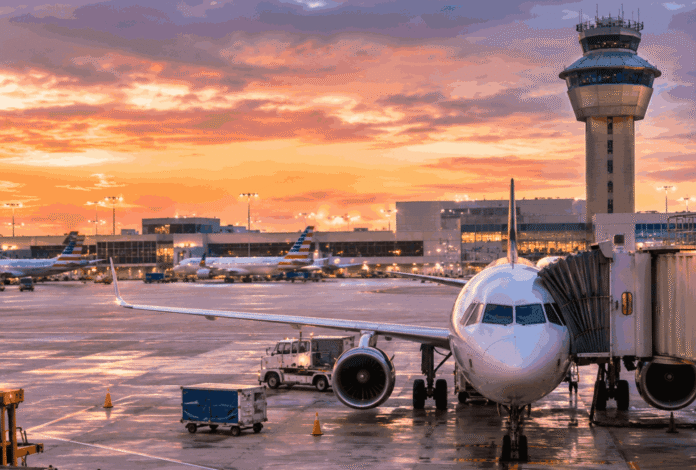
FAA nationwide flight ground stop has caused major disruption across the United States after a telecommunications outage affected air traffic control operations. The Federal Aviation Administration (FAA) issued an extraordinary order stopping flights at airports across the country, citing safety concerns and difficulties with communication systems.
The unprecedented move has raised questions about the reliability of America’s aviation infrastructure, particularly as officials investigate what caused the disruption. Although the US government says there is currently no evidence of a deliberate attack, authorities have not completely ruled out the possibility of a cyberattack.
The disruption comes amid growing concerns about the security of critical infrastructure and follows a major Microsoft Outlook outage a day earlier. However, officials have rejected suggestions that the two incidents are connected.
For travellers, the immediate advice is to check airline apps and flight status updates before heading to the airport. With air traffic controllers reportedly struggling with overwhelmed communication systems, the disruption could take considerable time to resolve.
FAA issues nationwide ground stop after communication systems fail
The FAA’s decision to ground flights across the United States is an extremely unusual measure. According to the report, this is only the third time in 25 years that the agency has issued a nationwide ground stop affecting all US air traffic.
The emergency alert was reportedly issued at around 4:30 PM Eastern Time. It instructed aircraft operators that all airports were being grounded because of extraordinary circumstances and safety concerns.
The immediate problem appears to involve telecommunications infrastructure used by air traffic control centres across the country.
These systems play an essential role in keeping aircraft moving safely through American airspace. Controllers need to communicate with pilots and coordinate with neighbouring control centres as aircraft travel between different regions.
When those communication channels become unreliable, managing aircraft movements becomes considerably more difficult.
The Department of Homeland Security’s Markwayne Mullin confirmed that a telecommunications outage was responsible for the disruption. He described the situation as a technical issue rather than an immediate threat to national security.
However, officials have not provided a detailed explanation of which specific systems failed or how widespread the underlying technical problem might be.
According to Mullin, air traffic controllers and pilots can still communicate at certain levels, but some communication systems have become overwhelmed.
As a result, authorities are handling aircraft movements on a case by case basis, particularly when managing landings and other operations that require immediate coordination.
Officials investigate possible cyberattack but find no evidence so far
One of the biggest questions surrounding the incident is whether the telecommunications outage was caused by a cyberattack.
At this stage, US officials say there is no indication that the disruption was the result of a deliberate or malicious attack. However, they are not ruling out that possibility while the investigation continues.
Mullin explained that investigators must consider cyber threats whenever critical infrastructure experiences a major technical failure.
He emphasised that assuming a potential cyberattack is part of the investigation process, rather than confirmation that one has taken place.
This distinction is important because the failure of a nationwide aviation communication network could have serious consequences, regardless of whether the cause is technical or malicious.
The timing has also attracted attention because Microsoft experienced a major Outlook outage the previous day.
However, officials have pushed back against suggestions that the two incidents are connected. Microsoft also stated that it had no indication that its services were responsible for the FAA’s nationwide ground stop.
The report also mentions the FAA’s recently announced AI powered SMART system, which is designed to improve airspace routing and trajectory management.
Its rollout began in September, but there is currently no evidence linking the new technology to the telecommunications disruption.
For now, investigators are focusing on identifying the source of the communication failure rather than attributing responsibility to a particular company, system or cyber threat.
Flights diverted as airlines ask passengers to check travel updates
The impact of the FAA’s decision quickly became visible across American airspace.
Flight tracking data showed a dramatic change in aircraft movements, with what initially appeared to be a normal day of air travel turning into a chaotic situation.
Some aircraft that had already taken off were reportedly redirected towards their nearest suitable airports. Others faced restrictions on departing, while airlines and airport operators worked to understand the extent of the disruption.
Flight tracking services provided a clear picture of how quickly the situation developed. Aircraft movements that would normally follow established routes became increasingly difficult to coordinate.
Airlines also began responding to the situation.
Delta Air Lines displayed a notice on its website advising passengers to check the Delta app for updated flight information.
American Airlines and JetBlue had not displayed similar notices on their websites at the time covered by the report.
Passengers should avoid relying entirely on airport departure boards or previously issued flight schedules during an incident of this scale. Flight timings can change quickly when air traffic control operations are disrupted.
The problem could also affect flights beyond the initial period of the ground stop. Aircraft and crews may end up in the wrong locations, creating scheduling problems even after normal operations resume.
Aviation expert and pilot Scott Manley suggested that the problem could involve communication between different en route air traffic control centres.
As aircraft travel across the country, responsibility for monitoring them is transferred between controllers. These handovers require reliable communication and the exchange of flight information.
If the systems responsible for coordinating those transfers stop working properly, the entire process can become difficult to manage.
This explanation offers a possible technical reason for the disruption, although officials have not confirmed it as the cause.
When will flights return to normal?
The biggest concern for travellers is how long the disruption will continue.
Although some aircraft operations are still being managed, the overwhelmed communication systems mean that the FAA cannot simply resume normal traffic without ensuring that controllers can safely coordinate flights.
Even after the original technical problem is resolved, airlines could face further delays while aircraft, pilots and cabin crews are repositioned.
The disruption could therefore continue affecting passengers well beyond the initial ground stop.
The report suggests that restoring normal operations and clearing the resulting backlog could take a day or more.
There are also broader questions about the resilience of the technology supporting America’s aviation network.
Air traffic control depends on several interconnected systems, including communications infrastructure, flight information exchanges and coordination between regional control centres.
A failure affecting one part of that network can create problems across a much wider area.
The incident highlights why reliable backup systems and strong cybersecurity protections are essential for critical infrastructure.
For now, the cause of the outage remains under investigation. Officials have not confirmed a cyberattack, and there is no established connection to Microsoft’s recent service disruption or the FAA’s AI powered SMART system.
Travellers should continue checking their airline apps and official flight updates before making their way to airports.
The immediate priority for the FAA remains restoring reliable communications and ensuring that aircraft can operate safely. Until that happens, passengers across the country may have to deal with cancellations, diversions and extended delays.
Follow TechBSB For More Updates