
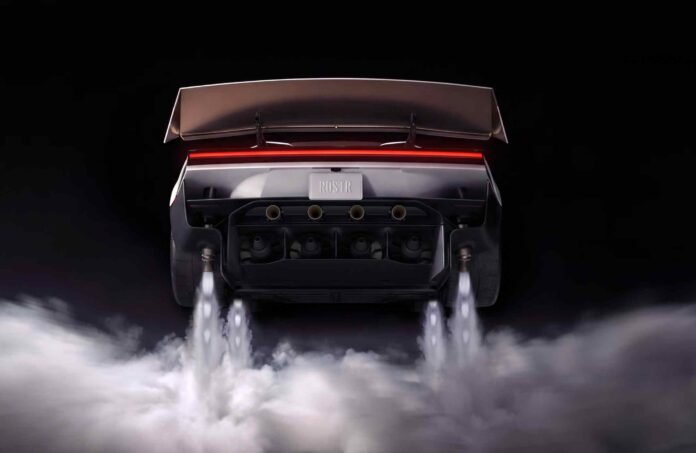
For years, Elon Musk has built his reputation on making ambitious technological promises. Some have helped reshape entire industries, while others have taken far longer than expected to materialise. The Tesla Roadster sits somewhere between those two realities, and its latest flying car concept has brought that debate back into the spotlight.
First introduced in 2017, the next generation Tesla Roadster was presented as an electric sports car capable of delivering extraordinary performance. Tesla promised blistering acceleration, impressive top speeds and a driving experience that would challenge conventional supercars. The possibility of incorporating rocket technology soon became part of the conversation, turning an already ambitious vehicle into something that seemed to belong in a science fiction film.
Now, the prospect of a rocket assisted Roadster has returned with even more spectacular claims. Videos circulating online show a redesigned vehicle climbing a steep incline, launching into the air, performing a flip and landing back on its wheels. If the demonstrations accurately represent the technology being proposed, they certainly make for an unforgettable spectacle.
But there is a difference between creating something that looks extraordinary and building something that can be used safely and reliably. That distinction is particularly important when the product in question is a car that appears capable of leaving the ground.
Rocket Technology Comes With Real Limitations
The most intriguing part of the proposed flying Roadster is its use of SpaceX inspired propulsion technology. Rather than relying on its electric motors to generate lift, the concept reportedly uses cold gas thrusters to produce short bursts of force.
Cold gas propulsion works by releasing highly pressurised gas through specially designed nozzles. It can provide precise bursts of thrust without conventional combustion, making it useful for certain spacecraft control applications. However, adapting such a system to a road vehicle introduces a different set of engineering challenges.
According to the reported specifications, the system would use large compressed gas tanks, including containers with capacities of approximately 200 litres and 400 litres. Those figures raise immediate questions about packaging, pressure management, structural integrity and what could happen in a serious collision.
A vehicle weighing around a tonne requires considerable force to lift, even before engineers account for stability, directional control and the energy needed to bring it safely back to the ground. Briefly demonstrating a jump or a controlled manoeuvre is not the same as developing a practical flying car that can operate in a range of conditions.
There is also the question of regulation. Musk has reportedly indicated that the rocket equipped Roadster would not be intended for ordinary public roads. That admission matters because it places the vehicle closer to an experimental engineering platform or an exclusive technological showcase than a genuine alternative to conventional transport.
Even if the system works as demonstrated, its limitations would make widespread adoption difficult. Safety standards, operational restrictions, maintenance requirements and the consequences of equipment failure would all need to be addressed before such a vehicle could be considered practical.
Spectacle Is Not the Same as Progress
There is no denying the appeal of a car that can seemingly fly. The idea captures the imagination because it offers something that conventional vehicles cannot. For automotive enthusiasts and technology fans, the possibility of seeing a production car perform rocket assisted manoeuvres is undeniably exciting.
Yet the more spectacular the demonstration becomes, the more important it is to ask what the technology actually achieves.
A flying Roadster would almost certainly be expensive, difficult to maintain and useful to only a small number of people. If it cannot be driven legally on public roads while using its propulsion system, its appeal will largely depend on private demonstrations, controlled environments and the novelty of owning something few others can access.
That does not automatically make the project worthless. Experimental engineering can lead to discoveries that eventually benefit other products. A demonstration vehicle can also help engineers explore new approaches to propulsion, control systems and vehicle dynamics.
However, those potential benefits need to be distinguished from the marketing spectacle surrounding the vehicle. A dramatic launch does not, by itself, establish that the underlying technology will deliver meaningful improvements to everyday transportation.
Tesla has spent years attracting attention with promises surrounding the next generation Roadster. The long wait has made the latest developments particularly significant, but it has also created understandable questions about delivery timelines, production readiness and whether the final product will match the extraordinary expectations.
For prospective buyers, the central issue is not simply whether the Roadster can perform an astonishing stunt. It is whether Tesla can deliver a finished, dependable vehicle that justifies its price and its years of anticipation.
Elon Musk’s Public Image Shapes the Reaction
The debate surrounding the flying Roadster is not purely about engineering. It is also shaped by the changing public perception of Elon Musk.
There was a time when Musk’s ambitious announcements were widely associated with the promise of a more technologically advanced future. His work across electric vehicles, spaceflight and energy storage helped establish him as a leading figure in modern innovation. For many observers, the willingness to pursue ideas that seemed unrealistic was part of his appeal.
That enthusiasm has become more complicated. Musk’s acquisition of Twitter, its transformation into X and his increasingly prominent involvement in American politics have changed how many people view his businesses and public statements.
Supporters continue to see a visionary willing to challenge established industries. Critics increasingly question whether the attention surrounding his projects serves a meaningful public purpose or primarily reinforces his personal brand.
Those competing interpretations inevitably influence the reception of a product as extravagant as a flying sports car. Some will celebrate it as evidence that conventional engineering boundaries can be pushed further. Others will see it as an expensive distraction at a time when the world faces more immediate challenges involving housing, healthcare, energy and public infrastructure.
Both the excitement and the scepticism are understandable. Technological ambition deserves room to flourish, but ambitious claims should also be examined critically, particularly when safety and substantial financial commitments are involved.
Ultimately, the Tesla Flying Roadster could become a fascinating demonstration of what modern propulsion technology can achieve. What remains uncertain is whether it can offer anything beyond a memorable spectacle.
A car that briefly takes to the air might capture headlines around the world. Building vehicles that are affordable, dependable, safe and genuinely useful would be a much more consequential achievement. For Tesla, that distinction may prove more important than any stunt the Roadster can perform.
Follow TechBSB For More Updates