
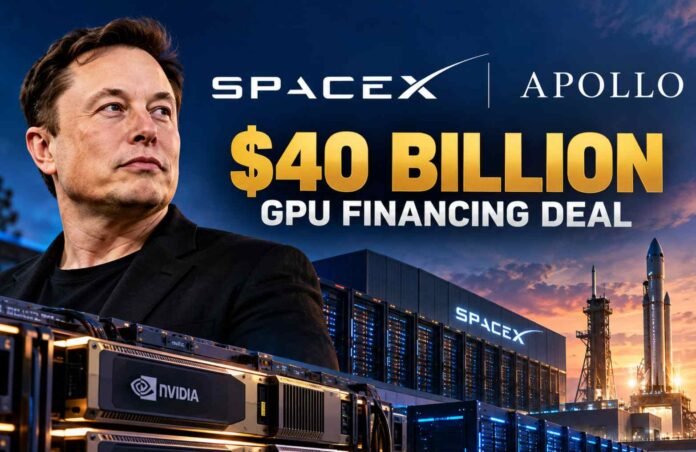
- SpaceX has secured a binding commitment for around $40 billion in GPU and data centre equipment financing from an Apollo managed entity.
- Apollo will purchase Nvidia chips and related server hardware before leasing the equipment to SpaceX for approximately five years.
- The deal will support SpaceX’s expanding AI operations, including Grok and cloud computing, as capital expenditure continues to rise.
- Elon Musk says companies without diversified revenue streams could face increasing financing pressure as lenders become more cautious about AI infrastructure investments.
SpaceX secures $40 billion in GPU financing from Apollo
SpaceX has secured a major financing commitment worth approximately $40 billion from an entity managed by Apollo Global Management, marking a significant step in its plans to expand its artificial intelligence infrastructure. The agreement will help the company acquire advanced graphics processing units (GPUs) and related data centre equipment without having to fund the entire purchase through conventional borrowing.
The arrangement follows a period of rapid growth in SpaceX’s AI operations, which have become an increasingly important part of the company’s business alongside Starlink satellite internet services and rocket launches.
Under the agreement, Apollo’s managed entity will purchase the chips and associated server hardware before leasing the equipment to SpaceX. The leases are expected to run for approximately five to five and a quarter years, with the term for each batch beginning when the equipment is delivered.
SpaceX expects the transaction to close by the end of 2026, subject to the completion of the necessary conditions. Lease arrangements are expected to begin during the first half of 2027 as the equipment arrives.
The company has described the arrangement as the largest committed GPU financing deal of its kind. For SpaceX, the agreement provides another way to secure the computing resources needed to support its expanding AI ambitions while spreading the financial commitment over time.
Nvidia’s next generation chips will support SpaceX’s AI plans
The financing is expected to help SpaceX acquire Nvidia’s next generation Vera Rubin chips, along with the server infrastructure required to operate them. Apollo said the equipment would support SpaceX’s terrestrial computing expansion.
Advanced GPUs have become essential for companies developing AI models, running chatbots and providing cloud computing services. However, building the infrastructure needed to support these workloads requires substantial upfront investment in processors, servers, networking equipment, power systems and cooling facilities.
By using a leasing arrangement, SpaceX can access expensive computing hardware without purchasing all of it directly at the outset. Apollo will finance the equipment acquisition, while SpaceX will pay to use the hardware over the lease period.
SpaceX chief financial officer Bret Johnsen said the agreement would diversify the company’s funding sources and cover a notable portion of the capital required to support its growth plans.
Johnsen also highlighted the returns SpaceX is seeing from its AI infrastructure investments, saying the company was experiencing payback periods of less than one year as it expands computing capacity for Grok and its cloud services.
That claim suggests SpaceX believes demand for its AI computing services can justify the significant investment required to build and operate the infrastructure. However, actual returns will depend on factors such as equipment utilisation, operating expenses, customer demand and the pace at which new computing capacity becomes productive.
SpaceX AI revenue grows as capital spending accelerates
The financing comes as SpaceX increases spending to support its expanding AI business. According to the figures outlined in the company’s recent earnings disclosures, its AI segment generated approximately $7.6 billion in revenue during the third quarter of 2026, contributing to total company revenue of $14.6 billion.
The AI segment includes the Grok chatbot, the Cursor coding tool and the company’s cloud computing operations. Its reported performance exceeded investor expectations, highlighting how AI has become a major contributor to SpaceX’s overall business.
The figures also underline a broader change in SpaceX’s financial profile. While Starlink and rocket launches remain important sources of revenue, the company is investing heavily in computing infrastructure to compete in the fast growing AI market.
Capital expenditure reached nearly $20 billion during the third quarter, compared with $6.9 billion in the same period a year earlier. Johnsen also said during the company’s October 20 earnings call that SpaceX expected to spend between $35 billion and $40 billion in the fourth quarter alone.
Such spending reflects the scale of the infrastructure race underway across the technology industry. Companies seeking to develop and operate advanced AI systems need access to increasingly powerful chips, while demand for computing capacity continues to grow.
However, heavy investment also brings financial risks. Equipment must generate sufficient revenue over time to justify its cost, and rapid advances in chip technology could create additional pressure to upgrade infrastructure before existing assets have reached the end of their useful lives.
The Apollo agreement gives SpaceX another financing option as it attempts to balance these costs with its broader expansion plans.
Elon Musk warns of growing pressure on AI infrastructure companies
The deal arrives amid increasing scrutiny of the financing models used by businesses focused primarily on renting computing power to AI customers.
AI infrastructure companies, often known as neocloud providers, have invested heavily in GPUs and data centres to meet demand from developers and enterprises. Many rely on external financing to purchase equipment before generating enough revenue to cover their investment.
That approach can become more difficult when lenders grow concerned about rising capital expenditure, uncertain profitability and the long term value of computing hardware.
Elon Musk used the SpaceX financing announcement to highlight the difference between his company and businesses that depend almost entirely on AI data centre revenue.
Musk pointed to SpaceX’s investment grade status and its established revenue streams from Starlink and rocket launches. He argued that companies without significant income outside AI infrastructure could face greater difficulty accessing debt markets as financing conditions tighten.
He also predicted that more than 200 neocloud companies could face widespread consolidation, with only a smaller number surviving the financial pressure.
His comments reflect a wider concern within the industry: demand for AI computing may be growing rapidly, but that does not guarantee that every company investing in the infrastructure will generate sustainable returns.
Companies with diversified revenue streams may have more options when raising capital, while those relying on a single business model could be more vulnerable to changing investor sentiment.
For SpaceX, the Apollo agreement offers a way to finance a substantial portion of its planned computing expansion through equipment leasing. The company will still need to meet its lease obligations and ensure that its AI services generate enough revenue to support the investment.
The deal also illustrates how financing structures are evolving to meet the enormous costs of the AI boom. Rather than relying solely on conventional loans or direct equipment purchases, major technology companies are increasingly looking at alternative arrangements to secure the hardware needed for expansion.
Whether this strategy delivers lasting benefits will depend on how efficiently SpaceX deploys the new equipment and whether demand for its AI and cloud computing services continues to grow.
For now, the $40 billion commitment gives SpaceX a substantial source of equipment financing as it pushes ahead with its AI ambitions. It also highlights a growing divide in the market between companies with multiple established revenue streams and those whose fortunes depend primarily on the economics of AI computing.
Follow TechBSB For More Updates