
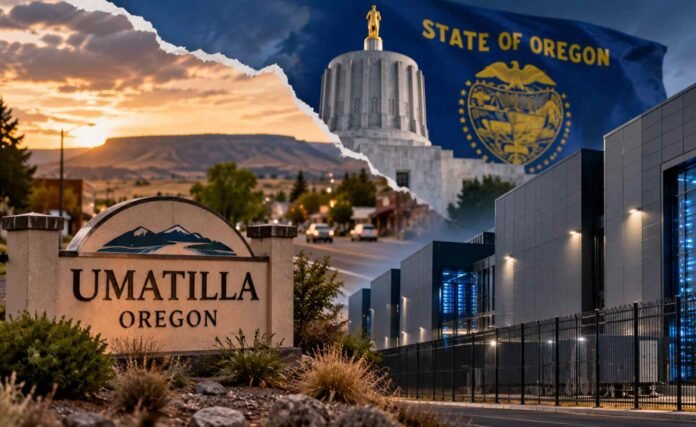
Umatilla, Oregon, has declared a state of emergency after new state restrictions on data center development put around $6 million in anticipated municipal revenue at risk. The city says the measures could also delay essential infrastructure projects, affect employment opportunities and discourage billions of dollars in planned private investment.
The declaration follows Oregon Governor Tina Kotek’s decision to suspend new pollution permits for data centers while state officials assess the environmental implications of further development. The restrictions are expected to remain in place until July 2027, potentially leaving projects awaiting regulatory approval in limbo for more than two years.
For Umatilla, the issue goes beyond the technology industry’s expansion. City officials had incorporated expected data center payments into future financial plans, including funding for a new police station and improvements to the municipal water system. With those revenues now uncertain, local leaders are warning that planned projects could face delays or require a fresh look at their funding arrangements.
The emergency declaration does not mean the city is already facing a budget shortfall. Instead, it is intended to address the financial risks associated with a policy change that officials say could disrupt long term development plans.
Umatilla warns that infrastructure projects could face delays
Umatilla has become an important location for data center development, hosting facilities operated by major industry players, including Amazon Web Services and Sabey Data Centers.
According to the city’s estimates, Umatilla currently has four operational data centers, another facility under construction and two additional developments awaiting completion. The local industry has helped support construction activity, investment and demand for related services.
However, the state’s permitting restrictions have introduced uncertainty around future projects and the revenue they could generate.
City manager Dave Stockdale warned that the potential loss of expected payments could force officials to reconsider the timing of infrastructure improvements already included in municipal plans. The proposed police station is among the projects at risk, alongside several million dollars’ worth of planned water infrastructure upgrades.
These projects depend, in part, on the city’s ability to secure anticipated revenue from data center development. If the money fails to arrive on schedule, officials may have to revise their plans, seek alternative funding or postpone some improvements.
Stockdale argued that the consequences could extend beyond individual companies, affecting the wider community through reduced investment and fewer employment opportunities.
The city has stressed that existing services and financial obligations remain unaffected for now. The disputed revenue has not yet been received or spent, meaning the emergency declaration concerns future financial exposure rather than an immediate inability to pay for public services.
Billions in investment and thousands of jobs at stake
The financial implications could extend well beyond Umatilla’s municipal accounts.
City estimates suggest that more than $5 billion in prospective private investment linked to local data center developments could be jeopardised by the restrictions. Officials have also identified risks to at least 1,000 construction jobs, as well as hundreds of permanent positions and employment opportunities across supporting industries.
Data center construction typically generates demand for contractors, electrical specialists, equipment suppliers and other service providers. Once facilities become operational, they also require workers to maintain infrastructure, manage equipment and support day to day operations.
Delays to planned developments could therefore affect businesses and workers that depend on the construction pipeline, even if they are not directly employed by data center operators.
The permitting suspension could also influence where developers choose to invest. Projects that cannot secure the necessary approvals may be delayed, scaled back or moved to other locations offering a clearer route to construction.
For Umatilla, that creates a difficult balancing act. The city wants to protect the revenue and employment opportunities associated with new facilities, while state officials are examining the environmental consequences of continued expansion.
The $5 billion figure represents prospective investment identified by the city, rather than money already committed to municipal budgets or guaranteed to be spent. The eventual impact will depend on how developers respond to the restrictions and whether the affected projects can proceed once the permitting situation changes.
Oregon’s restrictions face growing local scrutiny
Governor Kotek instructed Oregon’s environmental authorities in October to suspend new pollution permits for data centers, effectively limiting further development until July 2027 under the announced policy.
The move forms part of a broader examination of the environmental implications of large data center projects. Such facilities can place substantial demands on electricity and water supplies, while their construction and operation raise questions about local infrastructure and long term resource planning.
The governor had also halted transactions involving state owned land intended for data center development. That directive followed an August decision to prevent the sale of 32 acres at Salem’s Mill Creek Corporate Center for a proposed Verrus development.
Other local authorities have taken steps to review new data center proposals. Hillsboro, for example, introduced a 120 day suspension on new data center developments in July 2026, reflecting wider scrutiny of the industry’s growth across Oregon.
Umatilla’s response takes a different approach by focusing on the potential economic consequences of the statewide restrictions. Its city council approved an emergency resolution requiring the matter to be reconsidered within 90 days.
The resolution also calls for an assessment of the potential financial losses and urges Kotek to reconsider the permitting restrictions. Stockdale argued that the governor’s directive creates circumstances involving the threat of widespread financial loss that could qualify as an emergency under Oregon law.
The declaration does not automatically overturn the state’s policy or guarantee that permits will be issued. Instead, it provides a formal basis for the city to document the anticipated economic impact and press state officials to reconsider their approach.
For now, Umatilla’s immediate finances remain stable, but the uncertainty surrounding future development could complicate infrastructure planning and economic forecasts.
The coming months will be important for determining whether the affected projects can move forward, whether the state adjusts its restrictions and how the city responds if its expected revenue does not materialise. Until there is greater clarity, Umatilla faces the prospect of balancing its development ambitions with a regulatory pause that could reshape the local data center industry.
Follow TechBSB For More Updates