
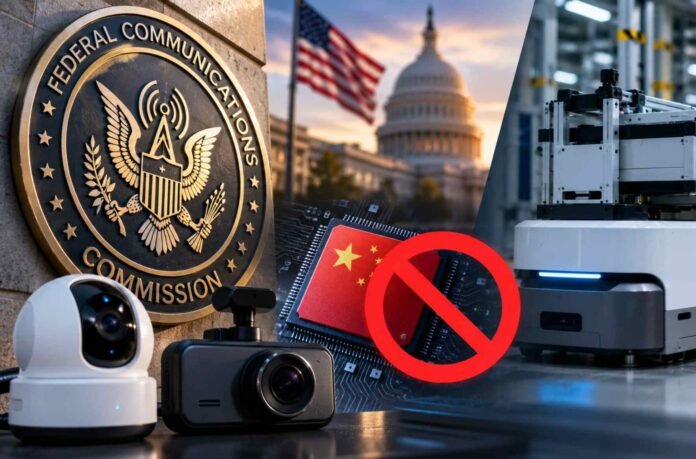
The US Federal Communications Commission (FCC) is expanding its restrictions on technology considered a national security risk, with new rules allowing the agency to target devices containing components from certain companies. However, the latest developments also highlight how difficult it can be to enforce those restrictions when American manufacturers depend on foreign made equipment.
The FCC has reportedly added two unnamed devices containing chips from HiVision, a subsidiary of Chinese technology company Huawei, to its official Covered List. These components are commonly used in products such as home security cameras and dashcams, where image processing and facial detection capabilities can be important features.
At the same time, Intel has secured a temporary exemption covering certain foreign made robots used in its semiconductor manufacturing facilities. The company argued that suitable domestic alternatives were not available, and that restricting the equipment could disrupt semiconductor production in the US.
The two developments show how the FCC is approaching technology restrictions at the component level while making exceptions where an immediate ban could affect important domestic manufacturing operations.
FCC expands its restrictions to foreign made components
The FCC’s Covered List identifies communications equipment and services that the agency considers to pose unacceptable risks to US national security. The list has already included products from several Chinese technology companies, including Huawei and drone manufacturer DJI.
Under rules that took effect this month, the FCC can extend restrictions beyond products sold under a particular company’s name to devices containing components supplied by companies covered by the restrictions.
According to reporting by The Verge, the agency has now begun applying that approach to two unnamed devices containing HiVision chips.
HiVision, a Huawei subsidiary, produces technology used in imaging and surveillance applications. Its chips can support features such as facial detection, which may be used in security cameras and vehicle dashcams.
The FCC describes the affected components as foreign surveillance chips and has raised concerns about their built in capabilities.
The distinction is important because a product does not necessarily need to carry Huawei branding to fall within the scope of a component based restriction. If a device contains a component covered by the relevant rules, it could potentially face restrictions even when another company manufactures or sells the finished product.
This approach could have broader implications for hardware manufacturers, particularly those that rely on components sourced from multiple suppliers around the world.
However, the reported addition of two unnamed devices does not mean that every camera, dashcam or consumer gadget containing a foreign made chip has automatically been banned. The precise scope depends on the FCC’s rules and the products identified under its Covered List.
Intel wins a temporary exemption for factory robots
While the FCC is expanding its restrictions on certain components, Intel has received an exception for foreign made robotics equipment used in its semiconductor factories.
According to Reuters, the waiver covers Automated Guided Vehicles, or AGVs, that Intel uses to move materials and equipment around its manufacturing facilities.
These robots are designed to transport items through factory environments with limited manual intervention. In semiconductor manufacturing, where production processes require carefully controlled conditions and precise material handling, automated transport systems can play an important operational role.
Intel reportedly argued that it could not source suitable replacements domestically. Applying the restrictions to the equipment could therefore disrupt the availability of semiconductor manufacturing services in the US.
The FCC granted the company a waiver to avoid those potential disruptions.
The exemption is limited, however. It lasts for one year, meaning Intel will need to find suitable alternatives, seek another waiver or otherwise comply with the applicable rules when that period ends.
The exception also does not provide a blanket approval for all future foreign made robots. It covers existing AGVs already operating in Intel’s facilities and certain modifications to those machines, including software, firmware and hardware changes.
That distinction allows Intel to maintain equipment it already depends on without automatically opening the door to new models containing restricted components.
Why the rules could affect technology manufacturers
The FCC’s move reflects a wider challenge facing technology companies: modern devices are rarely built entirely from components supplied by a single manufacturer or country.
A security camera, connected device or industrial robot may contain processors, imaging chips, networking components and software from several different suppliers. Restrictions aimed at one supplier can therefore affect products made and sold by other businesses.
Component level rules could make it more difficult for manufacturers to avoid restrictions simply by purchasing a finished product from a different supplier. They may also encourage businesses to review their supply chains and identify where restricted components are being used.
For consumer electronics manufacturers, that could mean additional compliance checks, alternative sourcing arrangements or redesigns of existing products.
Industrial companies face a different problem. Factory equipment is often expensive, highly specialized and integrated into established production systems. Replacing a machine can require more than purchasing a new model. Companies may also need to test new equipment, update software, retrain staff and ensure that production processes continue to operate reliably.
Intel’s waiver illustrates why regulators sometimes need to account for those practical considerations when applying national security restrictions.
The decision does not mean that the FCC has abandoned its security concerns. Instead, it demonstrates how the agency may weigh those concerns against the potential consequences of restricting equipment that manufacturers cannot readily replace.
Intel’s waiver highlights the challenge of balancing security and manufacturing
The semiconductor industry has become a major focus of US efforts to strengthen domestic technology production. Manufacturing chips requires sophisticated equipment, carefully managed processes and a complex network of suppliers.
Although the US is investing in domestic semiconductor manufacturing, companies may still rely on foreign made machinery and components for specific tasks.
Intel’s existing factory robots are a case in point. According to the report, the company has used the Automated Guided Vehicles for around two decades.
That long service history helps explain why an immediate restriction could create operational difficulties. Equipment that has been integrated into a factory over many years may be difficult to replace quickly, especially if equivalent domestic alternatives are unavailable.
The one year waiver provides temporary flexibility, but it does not remove the longer term challenge. Intel will eventually need to address the restrictions through alternative equipment, a further exemption or another compliant arrangement.
For other manufacturers, the case is a reminder that supply chain reviews need to consider the components inside existing equipment, not just the names on product labels.
It also remains important to distinguish between the specific devices placed on the Covered List and the broader universe of products that use foreign made technology. The FCC’s action does not establish that every foreign component represents a security threat, nor does the Intel waiver suggest that all industrial equipment is exempt.
The impact will depend on which components and products fall within the rules and how the agency applies them.
What happens next?
The latest developments suggest that component based restrictions will require manufacturers to pay closer attention to the origins of the technology inside their products.
For businesses selling cameras and connected devices, the immediate concern is whether their products contain components covered by the FCC’s restrictions. For semiconductor manufacturers such as Intel, the challenge is ensuring that essential factory equipment can continue operating while complying with changing requirements.
Intel’s exemption provides a limited period to address its existing equipment, while the addition of HiVision powered devices shows that the FCC is beginning to apply its expanded rules in practice.
The broader question is how regulators can reduce potential national security risks without causing unnecessary disruption to manufacturing and technology supply chains.
For now, the FCC appears to be pursuing both approaches: extending restrictions to additional components while allowing narrowly defined exceptions where an immediate ban could interfere with domestic semiconductor production.
Follow TechBSB For More Updates