
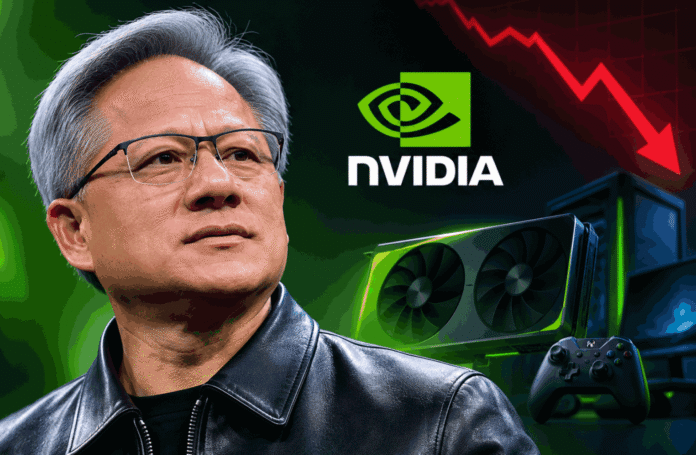
Nvidia is entering a new chapter, and the departure of its longtime leader Jensen Huang could have consequences that extend well beyond the company’s boardroom. While the chipmaker remains one of the biggest players in the technology industry, losing the person who helped build its success could change its priorities, particularly when it comes to gaming graphics cards.
Huang’s resignation comes amid a controversy involving allegations of personal relationships with two women, including a business executive reportedly linked to Chinese intelligence. Nvidia’s board had launched an investigation into whether Huang had been targeted by a foreign intelligence operation. Huang also acknowledged being unfaithful to his wife. Following the developments, Nvidia announced his immediate departure and appointed CFO Colette Kress as interim CEO.
The company is now preparing to find a permanent replacement, but the transition raises an important question: what happens to Nvidia’s gaming business when the person who helped shape its GeForce legacy is no longer in charge?
For PC gamers, the timing could hardly be more uncomfortable. Graphics card prices are already under pressure, AI infrastructure is consuming enormous amounts of industry investment, and both Nvidia and AMD have increasingly focused on data centre opportunities.
Huang’s departure could make that imbalance even more noticeable.
Why Jensen Huang’s departure matters so much to Nvidia
Jensen Huang was more than the public face of Nvidia. He played a central role in shaping the company’s technology roadmap, business strategy and relationships with major hardware suppliers.
His leadership style was also unusual. Rather than building a traditional corporate hierarchy with several layers of management, Huang reportedly maintained around 50 direct reports. The approach allowed him to stay closely involved in different parts of the business and make important decisions without relying on an extensive management structure.
His influence extended to Nvidia’s product development and supply chain strategy. Industry analyst Ming-Chi Kuo previously highlighted Huang’s ability to bring together technology, organisational planning, business strategy and supplier relationships when making major decisions.
That combination helped Nvidia establish itself as a dominant force in artificial intelligence and graphics processing.
His departure therefore creates more than a leadership vacancy. It leaves the company without the executive who has been closely associated with many of its biggest strategic decisions.
Nvidia has appointed Colette Kress, its longtime chief financial officer, as interim CEO while the board searches for a permanent replacement. Her immediate responsibility will be maintaining stability across the business during an unusually difficult transition.
However, managing Nvidia’s finances and setting its long term technology direction are two different challenges. Whoever eventually takes over will have to balance the company’s enormous AI ambitions with its established businesses, including GeForce graphics cards.
Why PC gamers could be pushed further down Nvidia’s priority list
The biggest concern for gamers is that Nvidia’s next CEO may have different priorities from Huang.
Artificial intelligence has become the company’s biggest growth opportunity, with data centre processors generating enormous demand. Major technology companies are investing heavily in AI infrastructure, creating a lucrative market for Nvidia’s advanced chips.
From a business perspective, it makes sense for Nvidia to concentrate on this opportunity. Data centre customers are willing to spend substantial amounts on high performance computing hardware, while the gaming GPU market operates under very different commercial conditions.
A new CEO will also face pressure from shareholders to maintain revenue growth and protect the company’s market position.
That could encourage Nvidia to devote even more resources to AI products rather than consumer graphics cards.
Huang had a personal connection to Nvidia’s gaming heritage. The company’s GeForce business played a major role in establishing its reputation long before the current AI boom. His successor may not have the same attachment to that history.
This does not mean Nvidia will abandon gaming GPUs. GeForce remains an important brand and a significant part of the company’s business. However, its position within Nvidia’s wider strategy could change as the AI market continues to expand.
The concern is that future product development, manufacturing capacity and investment decisions could increasingly favour data centre customers.
For PC gamers, that could mean fewer affordable graphics cards, less attractive product launches and greater difficulty finding high end GPUs at reasonable prices.
Rising GPU prices could make an already difficult situation worse
The timing of Huang’s departure is particularly concerning because the consumer graphics card market is already facing several challenges.
High end Nvidia GPUs have become increasingly expensive, making it harder for ordinary PC builders and gamers to upgrade their systems. Supply constraints, rising component costs and growing demand for AI hardware have all contributed to uncertainty across the graphics card market.
The situation is not limited to Nvidia. AMD has also made its data centre ambitions a major priority, leaving gamers concerned about how much attention traditional desktop graphics cards will receive in the coming years.
The RTX 5090 has already become a difficult product for many consumers to justify financially. If Nvidia shifts even more of its resources towards AI accelerators, the availability and pricing of future GeForce products could become another concern.
There is also the question of manufacturing capacity. Advanced semiconductor production is expensive, and companies must decide how to allocate available resources between different products.
AI processors are currently attracting enormous commercial interest. If Nvidia’s management believes that data centre products offer better financial returns, consumer GPUs could receive less attention when production and investment decisions are made.
Some industry observers have already expressed concerns about the long term consequences of Huang’s departure. Revenue may remain strong in the immediate future, but replacing his strategic vision could prove more difficult over the next decade.
That does not guarantee a shortage of GeForce cards or another round of price increases. However, it does introduce another source of uncertainty into an already complicated market.
What Nvidia’s future could mean for the next generation of GeForce GPUs
The biggest question now is how Nvidia’s next permanent CEO will approach the company’s gaming business.
Colette Kress is currently serving as interim CEO, but the board has confirmed that it will consider both internal and external candidates for the permanent position.
Whoever takes over will inherit a company with enormous financial resources, a dominant position in AI computing and a well established gaming brand.
There are several possible directions Nvidia could take.
One possibility is that the company continues treating GeForce as an important part of its business while investing heavily in AI infrastructure. This would allow Nvidia to maintain its relationship with gamers without sacrificing its most profitable growth opportunities.
Another possibility is that consumer graphics cards become a smaller part of the company’s overall strategy. Nvidia could concentrate more heavily on enterprise customers, AI accelerators and data centre hardware.
For gamers, the second scenario would be particularly concerning. A weaker focus on consumer GPUs could affect everything from product availability to development priorities and pricing.
AMD could potentially benefit if Nvidia becomes less aggressive in the gaming market. However, AMD is also prioritising data centre technology, so there is no guarantee that it will fill any gaps left by its competitor.
Ultimately, Nvidia’s next CEO will have to decide how much attention the GeForce brand deserves in a market increasingly dominated by artificial intelligence.
Huang’s departure does not automatically mean the end of Nvidia’s gaming business. The company still has considerable reasons to maintain its presence in the consumer graphics market.
But the leadership change arrives at a time when PC gamers are already struggling with expensive hardware and uncertain upgrade plans.
For now, Nvidia’s future direction remains unclear. What happens over the next few years could determine whether GeForce remains a central part of the company’s identity or gradually becomes a smaller piece of a much larger AI focused business.
Follow TechBSB For More Updates