
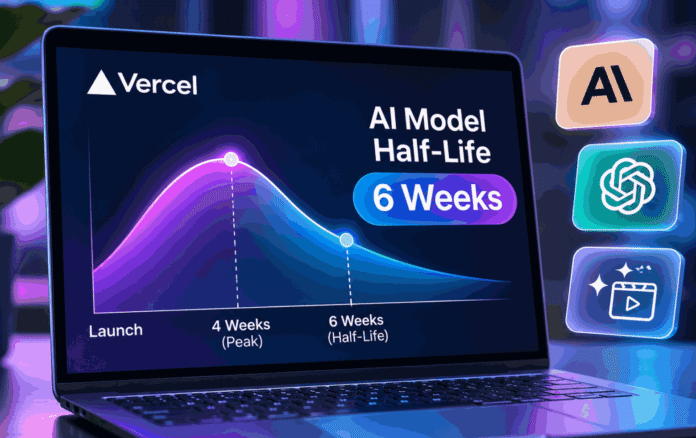
AI Model Half Life is becoming an important measure of how quickly the artificial intelligence industry is changing. New research from Vercel suggests that developers and businesses are moving between AI models at an astonishing pace, with a typical model enjoying just a few weeks of peak popularity before users start switching to newer alternatives.
According to Vercel’s November 2026 AI Gateway Production Index report, the average paid AI model stays at peak usage for around four weeks. After that, interest and spending begin to decline as developers explore recently released models offering improved performance, capabilities or efficiency.
Vercel describes this trend as an AI model half life of approximately six weeks. In other words, a model that attracts significant attention shortly after launch can lose much of its momentum within a relatively short period.
The findings highlight an interesting change in how companies approach AI adoption. Rather than committing to one provider or model for years, development teams increasingly treat AI tools as interchangeable resources, choosing whichever option currently delivers the best results.
For companies building AI powered applications, coding assistants and autonomous agents, staying current is becoming almost as important as choosing the right technology in the first place.
AI models are losing their popularity faster than ever
Vercel’s findings are based on token transactions processed through its AI Gateway, which provides insight into how developers and businesses use different AI models in production environments.
The data suggests that adopting a new model is no longer a particularly complicated process. Many development teams use coding environments, APIs and third party tools that allow them to switch between different models without rebuilding their entire workflow.
As a result, developers can begin experimenting with a newly released AI model almost immediately.
This flexibility is helping accelerate adoption, but it also means that established models have less time to maintain their positions.
Vercel divided model adoption into three age groups: models available for 0 to 14 days, those available for 15 to 30 days, and those that have been available for 31 to 60 days.
The figures reveal a growing preference for recently released models. By September 2026, nearly 17% of AI model usage came from models that had been available for less than two weeks.
That is a notable indication of how quickly developers are responding to new releases.
Older models are not necessarily disappearing altogether. Businesses may continue using them for established applications, familiar workflows or tasks where changing models offers little practical benefit. However, their overall usage and associated spending tend to decline as newer alternatives gain attention.
This creates a competitive environment in which AI companies must continually improve their products rather than relying on the popularity of an earlier release.
Anthropic is attracting developers as AI competition intensifies
One of the more interesting findings in Vercel’s report concerns the growing presence of Anthropic in paid AI usage.
Anthropic’s Claude models accounted for several of the most widely used paid options during the reporting period.
Claude Sonnet 5.5 reportedly accounted for 26% of usage, followed by Claude Haiku 5.5 at 22%, Claude Haiku 4.5 at 20% and Claude Opus 5.5 at 18%.
These figures suggest that developers are not necessarily relying on a single model for every task. Instead, many teams appear to be using multiple Claude models depending on their requirements.
For example, a development team might choose a more capable model for complicated reasoning and coding tasks while using a lighter alternative for simpler requests.
Anthropic’s position is also reflected in spending figures. Claude Opus 5.5 became the leading model by spending during its first full month following its September 22, 2026 launch.
It reportedly attracted more than 14% of total model spending in October.
This is particularly significant because paid AI adoption is increasingly influenced by practical performance rather than brand recognition alone.
OpenAI continues to compete in the same market, but Vercel’s figures indicate that Anthropic has been particularly successful in attracting teams looking for newer AI development tools.
The findings also highlight why model providers cannot afford to become complacent. Even established services can lose developer attention when competitors introduce something more attractive.
Image and video generation are becoming bigger parts of AI development
While text based AI models continue to account for a significant share of developer activity, Vercel’s report also identifies growing interest in image and video generation.
One particularly notable finding is that approximately one in six AI development teams now uses a video generation model.
That represents an increase from around 10% in previous months, suggesting that video generation is becoming a more common part of AI powered development workflows.
Businesses are increasingly exploring ways to incorporate generated visuals into applications, marketing platforms, creative tools and other digital services.
Image generation is also attracting considerable spending.
Interestingly, OpenAI performed strongly in this category, with GPT Image 2.5 Sunburst reportedly leading image generation model spending during October.
This demonstrates that competition in the AI industry is not limited to conversational assistants or coding tools. Different providers are finding opportunities in specialised areas, where the most suitable model depends heavily on the task.
The growing use of image and video generation also suggests that businesses are becoming more comfortable integrating generative AI into products used by customers.
For developers, the challenge is no longer simply finding a model that can generate an answer. They must identify which model can produce the best results for a particular application while keeping processing costs under control.
Vercel’s findings ultimately point towards an AI industry where loyalty to individual models is becoming less important than flexibility and performance.
A model that leads the market today could find itself competing for attention against several newer releases just weeks later.
For AI companies, that means continuous development and innovation are essential. For businesses, it creates more opportunities to experiment, compare services and choose the technology that best suits their needs.
The six week figure may not apply equally to every AI model or use case, but it offers a useful indication of just how quickly the market is evolving.
Follow TechBSB For More Updates