
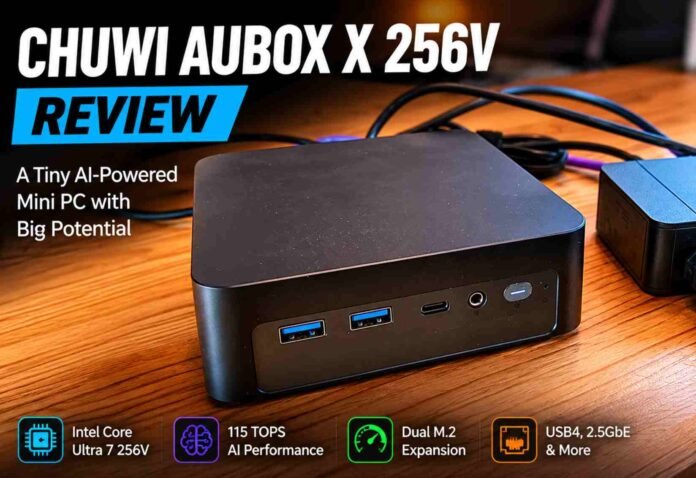
- Compact metal mini PC with premium design and strong connectivity.
- Intel Core Ultra 7 256V delivers excellent AI and productivity performance.
- Fixed 16GB LPDDR5X memory severely limits long term flexibility.
- Strong overall performance, but pricing weakens the value proposition.
Mini PCs have quietly evolved from niche desktop replacements into serious productivity and AI machines. The latest example is the Chuwi AuBox X 256V, a tiny desktop powered by Intel’s Lunar Lake architecture that aims to balance performance, efficiency and affordability in a surprisingly small footprint.
At first glance, the AuBox X 256V feels like a throwback to the original Intel NUC era. It is compact enough to disappear behind a monitor, yet powerful enough to handle demanding workloads, light gaming and even local AI tasks.
But while Chuwi gets many things right here, one questionable hardware decision keeps this system from becoming an easy recommendation.
Compact design with premium touches
The first thing that stands out about the AuBox X 256V is its build quality. Chuwi has moved well beyond the cheap plastic reputation often associated with budget PC brands. The metal chassis feels sturdy, clean and minimal without trying too hard to look futuristic.
At just 128.4mm wide and weighing 580g, the machine is genuinely tiny. It can easily fit into cramped workspaces or mount behind a monitor using the included VESA bracket. Despite the compact dimensions, connectivity is impressive.
The front panel includes USB ports, audio connectivity and a USB4 interface, while the rear houses dual HDMI outputs, additional USB ports and fast networking support. Chuwi also includes dual M.2 storage slots, which is a welcome surprise in a machine this small.
Thermals, however, remain the unavoidable compromise. Under light workloads the system stays quiet, but sustained processing pushes the cooling fan into noticeable territory. It never becomes unbearable, but users expecting silent operation may walk away disappointed.
Lunar Lake delivers serious AI potential
The real highlight is Intel’s Core Ultra 7 256V processor. Built on the Lunar Lake platform, this chip combines CPU, GPU, NPU and memory into a single package designed for efficiency focused AI computing.
For everyday productivity, the experience is excellent. Office workloads, multitasking, video streaming and browser heavy sessions all feel smooth and responsive. The integrated Intel Arc 140V graphics also perform surprisingly well for an iGPU, making casual 1080p gaming entirely realistic.
Where the AuBox X becomes more interesting is AI performance. Intel’s dedicated NPU delivers 47 TOPS on its own, while the combined platform reaches a claimed 115 TOPS. In practical use, that means the machine comfortably supports Microsoft Copilot+ features like Live Captions, Recall and local AI assisted workflows without relying heavily on cloud processing.
It also handles lightweight local language models reasonably well. Smaller AI models run smoothly, especially for experimentation or personal productivity tasks. Developers interested in local assistants, document indexing or lightweight inference workloads will find plenty to like here.
The memory limitation changes everything
Unfortunately, Chuwi makes one decision that significantly affects the system’s long term appeal.
The AuBox X 256V ships with 16GB of LPDDR5X memory soldered directly onto the package. There is no upgrade path and no higher capacity configuration available.
For general users, 16GB still works well enough today. But this machine clearly markets itself toward AI enthusiasts and advanced workloads, where memory matters more than ever. Running larger local AI models quickly exposes the limitations of the fixed RAM ceiling.
This is especially frustrating because the rest of the hardware feels forward thinking. USB4 support allows for external GPUs, the processor is highly capable and storage expansion is generous. Yet the memory bottleneck prevents the system from fully realizing its potential.
Competitors are beginning to offer compact systems with 32GB or even 64GB configurations, making Chuwi’s choice feel restrictive rather than practical.
Strong performance, but value feels uncertain
Performance numbers are undeniably impressive for a system this size. Benchmarks place the AuBox X ahead of some competing mini PCs using the same processor, suggesting Chuwi has tuned the hardware aggressively.
The machine feels fast in real world use and easily replaces a traditional desktop for most users. Power efficiency is another major advantage, especially compared to larger gaming focused systems.
Still, pricing complicates the story. At around $829, the AuBox X enters territory where buyers expect fewer compromises. Some competing mini PCs offer similar hardware with larger storage options or more memory at lower prices.
That makes the Chuwi system difficult to position. It is clearly well engineered and surprisingly capable, but it also feels like a product shaped by rising component costs rather than user priorities.
In many ways, the AuBox X 256V represents the direction the mini PC market is heading. Compact AI capable desktops are becoming more common, but buyers are increasingly paying more while receiving fewer upgrade options in return.
The Chuwi AuBox X 256V remains a highly capable compact desktop with excellent processing power, strong AI support and thoughtful design. But with fixed 16GB memory, it stops just short of becoming one of the best mini PCs in its category.
Follow TechBSB For More Updates

