
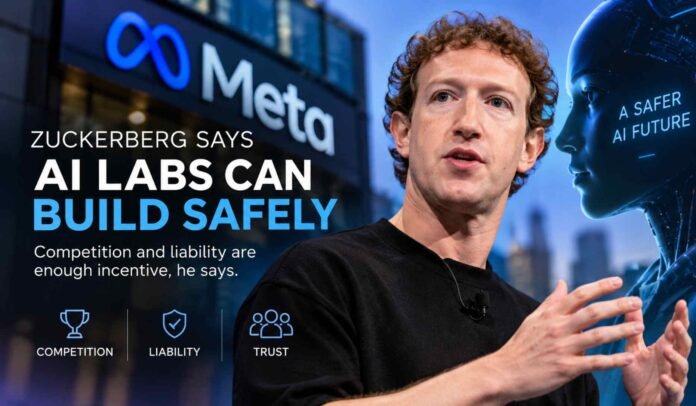
- Mark Zuckerberg says AI companies already have enough financial, competitive and legal reasons to build safer systems.
- Meta delayed its Muse AI agent release to improve security, according to Zuckerberg.
- Zuckerberg says most of Meta’s AI computing power is focused on products for users rather than AI systems that improve themselves.
- Anthropic is calling for a coordinated slowdown, while Meta favors individual safety measures and independent evaluation.
Meta CEO Mark Zuckerberg has pushed back against growing calls for artificial intelligence companies to slow down the development of increasingly capable AI systems.
In comments posted on X, Zuckerberg argued that AI companies already have strong reasons to take safety seriously. Competition between labs, the risk of legal liability and the commercial importance of building trustworthy systems can all encourage companies to put safety measures in place without requiring an industry wide agreement to slow development.
His comments come at a time when the debate over AI safety is becoming increasingly divided. Some technology leaders and researchers are warning that AI capabilities are advancing at a pace that could create serious risks. Others argue that slowing development could leave companies in the United States at a disadvantage, particularly as competition with China intensifies.
The disagreement became more visible after Anthropic CEO Dario Amodei called for AI companies to slow the pace at which they improve their models. OpenAI CEO Sam Altman and xAI CEO Elon Musk subsequently supported the idea.
Zuckerberg is taking a different position. Rather than calling for companies to collectively reduce the speed of AI development, he says individual labs can make their own decisions about safety and act when additional safeguards are needed.
Meta points to its own AI safety decisions
Zuckerberg used Meta’s handling of its Muse AI agent as an example of how companies can respond to safety concerns independently.
According to Zuckerberg, Meta delayed the release of Muse earlier this year while it worked to improve security. He argued that Meta did not need an industry wide agreement before taking that step.
The point is central to his broader argument. Zuckerberg believes AI companies have both the responsibility and the incentive to manage safety risks themselves.
He also argued that trust and alignment are becoming increasingly important as AI agents and models become more capable. In his view, companies that fail to focus on alignment could eventually fall behind competitors because users will place greater value on systems they can trust.
This approach differs from the proposal put forward by Amodei, who has called specifically for an industry wide slowdown in recursive self improvement. The concern is that systems capable of helping improve future AI systems could accelerate development in ways that become increasingly difficult to control.
Zuckerberg says Meta is already directing most of its computing resources toward AI products designed to address users’ immediate needs rather than concentrating those resources on self improving AI systems.
Independent testing becomes part of Meta’s argument
Another part of Zuckerberg’s position is Meta’s use of independent evaluators.
He said Meta Superintelligence Labs already works with external evaluators in several areas and described independent evaluation as an industry best practice. His argument is that other AI companies can adopt similar measures without waiting for a collective agreement or regulatory requirement.
The debate therefore involves more than simply whether AI development should continue or stop. It also concerns how companies should demonstrate that increasingly powerful models are being developed responsibly.
Supporters of stronger coordination argue that individual companies may not always have sufficient incentives to slow down when competitors continue moving ahead. A company that voluntarily reduces development could potentially give rivals an advantage.
Zuckerberg’s position is that the incentives already exist. Companies face reputational damage, legal exposure and commercial consequences if their AI systems cause serious harm or fail to earn users’ trust.
That disagreement is likely to remain important as AI agents become more autonomous and companies compete to build increasingly capable systems.
Washington remains divided over AI regulation
The debate is also playing out in Washington.
President Donald Trump recently downplayed concerns about potential AI harms and argued that the United States already has guardrails in place. He also warned that excessive restrictions could weaken America’s position against China.
That concern is shared by some technology executives. Nvidia CEO Jensen Huang has also argued that regulation should not undermine the ability of US companies to compete internationally.
At the same time, FTC Chairman Andrew Ferguson has expressed skepticism about AI companies seeking special antitrust treatment. Ferguson said people should be deeply suspicious of AI companies asking for antitrust exemptions while simultaneously seeking new regulations.
His comments are particularly relevant because Amodei has sought antitrust permission that could allow competing AI companies to coordinate around slowing AI development for safety reasons.
That creates an unusual regulatory question. Companies normally compete aggressively, but AI safety concerns could require cooperation in areas where competition law traditionally discourages coordination.
The outcome of that debate could influence how AI companies approach safety testing, model development and the deployment of autonomous systems.
For now, Zuckerberg’s message is clear: Meta does not believe an industry wide slowdown is necessary. He argues that individual companies already have sufficient reasons to build safer AI and that independent evaluation, security work and alignment efforts can provide practical safeguards while development continues.
Follow TechBSB For More Updates