
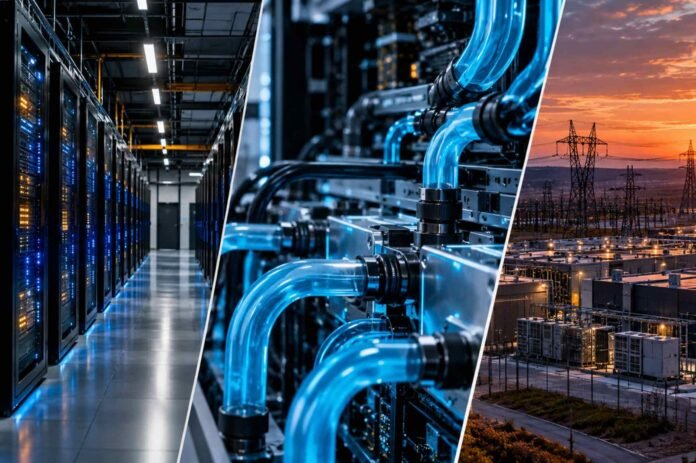
The rapid expansion of artificial intelligence is putting unprecedented pressure on the physical infrastructure that keeps modern computing running. While powerful GPUs and advanced AI models continue to push performance forward, the systems supplying electricity, removing heat and transferring data are struggling to keep pace.
AI data centers are becoming larger and more energy intensive, creating new challenges for operators and electricity providers. High density GPU racks generate enormous amounts of heat, traditional cooling systems are approaching their practical limits, and electrical grids are finding it increasingly difficult to accommodate new facilities. At the same time, conventional copper connections are struggling to deliver the bandwidth required by increasingly complex AI workloads.
These challenges are changing how data centers are designed, built and powered. From advanced liquid cooling and optical interconnects to solid state transformers and on site power generation, companies are exploring new approaches to keep the AI industry moving forward.
AI data centers are hitting the thermal wall
Heat management has become one of the biggest engineering challenges facing modern AI infrastructure. Conventional server racks were designed for much lower power consumption than today’s high performance GPU systems, which can demand more than 50 to 100 kW per rack.
As power consumption rises, so does the amount of heat that must be removed. Traditional air cooling systems often struggle once rack densities move beyond approximately 30 to 40 kW. Keeping temperatures under control at higher densities requires stronger airflow, more powerful fans and additional electricity, increasing the energy required to operate the facility.
The problem becomes more complicated when hundreds or thousands of GPUs work together. Even a cooling system that performs well under normal conditions can struggle when workloads increase sharply. If chip temperatures approach their thermal limits, processors may reduce their operating speeds to protect themselves from damage, affecting overall performance.
Liquid cooling offers a more practical route for high density systems. Direct to chip cooling uses cold plates attached to processors to transfer heat into a circulating liquid. Because liquids can carry away heat more effectively than air in these applications, operators can manage increasingly powerful hardware without relying entirely on energy hungry fans.
Two phase cooling is another emerging approach. It uses the heat absorbed during a liquid’s transition into vapour to remove energy from hot components. The vapour is subsequently condensed and returned to the cooling system, allowing the process to continue. Certain implementations can significantly reduce cooling energy requirements, although actual savings depend on system design and operating conditions.
Closed loop liquid cooling is also attracting attention. Microsoft, for example, has introduced systems that circulate coolant through servers and cooling equipment, reducing the need for continuous fresh water consumption. However, these systems require substantial upfront investment and careful engineering to support expansion.
The direction is clear. As GPU power densities rise, cooling is becoming a central part of data center design rather than a secondary facility requirement.
Optical connections are becoming essential for AI computing
Processing power alone cannot deliver the full benefits of increasingly sophisticated AI hardware. GPUs must constantly exchange data with other processors, memory systems and networking equipment. When those connections cannot keep up, expensive computing resources can spend more time waiting for data instead of completing useful work.
Copper interconnects have traditionally handled many of these connections because they are well established and relatively affordable. However, their limitations become more significant as bandwidth requirements increase and signals travel over longer distances.
Electrical signals weaken as they move through copper, while interference between closely packed connections can complicate signal transmission. Maintaining signal quality requires additional electronic components and processing, which consume power and generate more heat.
Copper traces on circuit boards also introduce resistive losses. At the high currents associated with advanced AI hardware, these losses contribute to the overall thermal burden inside already crowded server racks.
Optical interconnects offer an alternative by transmitting information as pulses of light through fibre optic cables. They can support high bandwidth over longer distances with lower signal loss, while their physical characteristics can help simplify cable management in dense computing environments.
The next step is silicon photonics and co packaged optics. These technologies bring optical communication components closer to the processors and switching hardware they serve, potentially reducing the energy and space required to move large amounts of data.
Cost remains a significant obstacle. Optical solutions can be substantially more expensive than conventional copper connections in some configurations, and integrating optical components into advanced computing systems introduces additional manufacturing challenges.
Nevertheless, as AI clusters grow, the ability to move data efficiently is becoming just as important as the ability to process it. Optical technology is likely to play an increasingly important role in next generation data center architecture.
Grid constraints are delaying new data center capacity
The electricity supply has emerged as one of the most serious barriers to AI infrastructure expansion. Building a data center is no longer simply a matter of securing land, constructing a facility and installing servers. Operators must also obtain sufficient grid capacity, transformers, substations and other electrical equipment.
Many existing power networks were not designed to accommodate the concentrated electricity demand of today’s largest AI facilities. As more projects compete for connections, utilities face growing pressure to expand generation, transmission and distribution infrastructure.
The equipment supply chain is another concern. Large power transformers are essential for delivering electricity at the appropriate voltage, but manufacturing capacity and lengthy procurement processes have pushed delivery times well beyond those seen several years ago. Delays can leave completed or partially built facilities waiting for the equipment needed to begin operations.
AI workloads can also change electricity demand rapidly. Large GPU clusters may experience sharp variations in power consumption as computing activity changes. These fluctuations can complicate voltage regulation and power quality management, requiring additional investment in control systems and grid infrastructure.
Solid state transformers are among the technologies being explored to address these challenges. Unlike conventional transformers, which rely on magnetic components, they use power electronics to convert and regulate electricity. This can enable more active voltage management and improved control over certain power quality issues.
However, solid state transformers are not a universal replacement for conventional equipment. They can be expensive, require sophisticated electronics and introduce their own thermal management and maintenance requirements. Their long term advantages will depend on efficiency, reliability, manufacturing costs and the demands of each installation.
Some operators are taking a more immediate approach by generating electricity on site. At its Colossus facility in Memphis, xAI has deployed natural gas turbines to supply substantial power while navigating grid connection constraints.
Small modular nuclear reactors are another potential source of dedicated power, although cost, regulation, construction timelines and deployment readiness remain significant hurdles.
These developments highlight a broader shift in the industry. Access to reliable electricity is becoming a critical factor in determining where AI infrastructure can be built and how quickly it can become operational.
The next phase of AI growth depends on infrastructure innovation
The challenges facing AI data centers are closely connected. Higher GPU performance increases electricity demand, which produces more heat and places greater pressure on cooling systems. Larger clusters also require faster connections, while the resulting power requirements demand more capable electrical infrastructure.
Addressing just one bottleneck will not necessarily solve the wider problem. More powerful cooling systems cannot compensate for an unavailable grid connection, and faster optical links cannot deliver their full value if processors are constrained by inadequate power or thermal management.
The industry therefore needs a coordinated approach. Data center designers must consider electricity availability, cooling capacity, networking architecture and long term expansion plans from the earliest stages of a project.
Energy efficiency will be equally important. Better power management, more efficient computing hardware and improved cooling designs could reduce the electricity required for a given amount of AI processing. That would help operators expand capacity without placing unnecessary pressure on local power networks.
The environmental and community impact of new facilities also deserves attention. Water consumption, backup generation, noise and the demand placed on local electricity infrastructure can influence whether projects receive approval and public support.
Despite these obstacles, investment in AI infrastructure continues to accelerate. New cooling methods, optical networking technologies, advanced power electronics and dedicated electricity generation are creating additional options for operators.
The next stage of the AI boom will depend on how effectively these innovations move from individual projects into widespread commercial deployment. Computing performance remains important, but the availability of electricity, the ability to remove heat and the speed of data transmission will increasingly determine how quickly the industry can grow.
Follow TechBSB For More Updates