
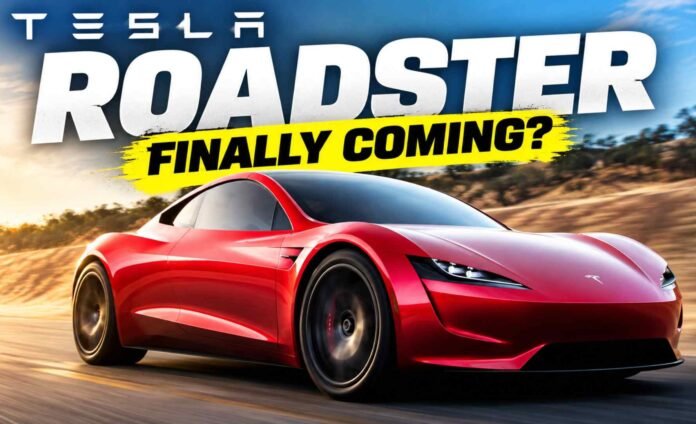
Tesla is once again teasing the next generation Roadster, and after nearly a decade of promises, it is becoming increasingly difficult to get excited without a healthy dose of skepticism.
The company has confirmed that the long delayed electric sports car will finally get a major public reveal on October 1 in Waco, Texas. Tesla has released a deliberately mysterious teaser showing what appears to be part of the car’s rear end, along with what looks like a system capable of firing gas into the air.
That last detail is particularly interesting because Elon Musk has spent years talking about using SpaceX technology to give the Roadster extraordinary performance.
On paper, the idea sounds spectacular. In reality, it raises a rather obvious question. How much of this technology will ever make it into a road legal production car?
The second generation Roadster was first announced in 2017. At the time, Tesla promised performance figures that sounded almost absurd for a production electric car. The company claimed a 0 to 60 mph time of less than two seconds, a top speed of 250 mph and a range of around 620 miles.
Those numbers are still listed by Tesla, despite the fact that the car has spent years stuck in development limbo.
A nine year wait for a sports car
The Roadster is not just another Tesla model. The original car played a crucial role in establishing Tesla as a serious automotive company.
Based heavily on the Lotus Elise, the first Roadster demonstrated that an electric car could be fast, desirable and genuinely exciting. It helped change perceptions of electric vehicles at a time when most people still associated them with limited range and sensible city driving.
That makes the current Roadster situation particularly frustrating.
Tesla opened reservations for the new car almost nine years ago. Customers put down deposits expecting to eventually receive one of the most technologically ambitious sports cars ever announced. Since then, the launch has been repeatedly delayed.
The goalposts have moved so often that the Roadster has become something of a running joke among Tesla watchers.
Musk has also added increasingly ambitious claims over the years. The car has been linked to cold gas thrusters, which could theoretically provide additional acceleration. There have even been suggestions that the Roadster could hover or fly.
That is where the excitement starts to collide with reality.
A car fitted with propulsion equipment designed to produce thrust is unlikely to fit comfortably within normal road vehicle regulations. Even if Tesla manages to demonstrate such technology at the October event, that does not necessarily mean ordinary buyers will ever be able to use it on public roads.
Another Tesla spectacle?
Tesla has become extremely good at turning product announcements into events. The problem is that spectacular demonstrations do not always translate into products that customers can actually buy in meaningful numbers.
The company’s 2024 Robotaxi event is a useful example. Tesla presented an ambitious vision involving autonomous vehicles and Optimus robots, creating the kind of futuristic spectacle that generates headlines around the world.
But the technology shown at a carefully controlled demonstration is not the same thing as a mature product operating independently in everyday conditions.
The same concern applies to the Roadster.
If Tesla arrives in October and demonstrates a ridiculously quick car using experimental propulsion technology, it will certainly grab attention. Videos will spread across social media and performance figures will dominate the conversation.
But what happens afterwards?
Will customers be able to buy the car? When will production begin? What will it cost? Can the claimed range and acceleration figures be achieved outside a demonstration environment? Most importantly, will the car meet the regulations required for normal road use?
Those are the questions that matter far more than another dramatic reveal.
Tesla needs a new car people can actually buy
There is a bigger issue hiding underneath all the Roadster excitement.
Tesla’s passenger vehicle range has become increasingly narrow. The Model 3 and Model Y remain important products, but they are facing a much more competitive electric vehicle market than the one Tesla dominated several years ago.
There are now electric cars from established manufacturers and newer Chinese companies offering impressive range, sophisticated interiors, advanced driver assistance and increasingly competitive pricing.
That makes the lack of genuinely new mainstream Tesla models more noticeable.
The Cybertruck was supposed to bring something completely different to the market, but its sales performance has not matched the enormous expectations surrounding it. Meanwhile, long discussed replacements for the Model S and Model X have yet to become the kind of major launches Tesla urgently needs.
There has also been persistent speculation about a cheaper Tesla aimed at a much broader market.
That, arguably, would create far more excitement than another futuristic sports car.
A genuinely affordable Tesla could expand the company’s customer base, increase sales and put pressure on competitors. A new Model S or Model X could demonstrate that Tesla still intends to compete seriously in the premium electric vehicle market.
The Roadster, by comparison, is a halo product.
That does not make it unimportant. In fact, a spectacular sports car could remind people why Tesla became famous in the first place. But after nine years of waiting, the company needs to prove that the Roadster is more than another impressive concept wrapped in a dramatic presentation.
Tesla has already shown that it can make people dream about the future.
Now it needs to show that it can actually build that future.
Follow TechBSB For More Updates