
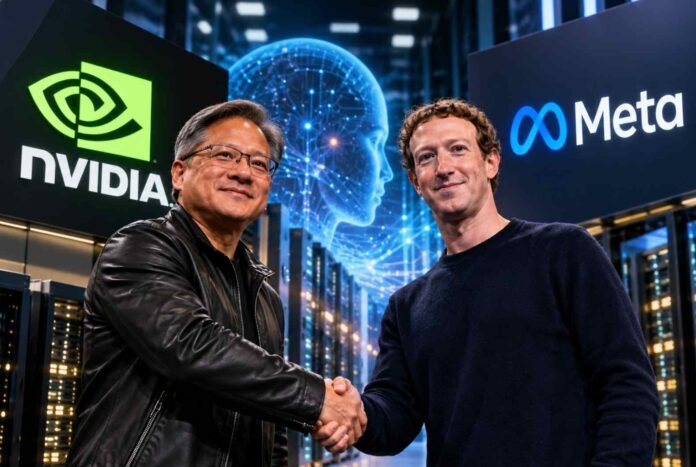
Nvidia Meta AI partnership is set to enter a new phase as the chipmaker plans to invest $3 billion in Meta’s share offering while expanding its collaboration with the social media giant. The move comes as Meta steps up its investment in artificial intelligence infrastructure and prepares to develop a new generation of AI agents powered by its Muse models.
The proposed investment gives Nvidia a financial stake in one of its biggest customers while strengthening a business relationship that already plays an important role in the AI industry. For Meta, the partnership could provide access to more advanced computing hardware and networking technology as it works towards building AI systems capable of handling increasingly complex tasks.
The two companies are also exploring ways to improve how AI agents operate, including technologies designed to monitor their activity and make their deployment safer. However, neither company has provided a firm timeline for every part of the expanded agreement.
Nvidia and Meta are preparing for a new generation of AI agents
Meta plans to expand its use of Nvidia hardware as it develops its next generation of artificial intelligence models and services. The deployment is expected to include Nvidia’s upcoming Vera Rubin platform and Vera central processing units, which will support both AI training and the execution of agent-based applications.
The partnership is not limited to supplying graphics processing units. Both companies are looking at improvements across the wider computing infrastructure, including processing efficiency, data movement, system performance and operating costs.
Networking technology will also play an important role. Meta is expected to use Nvidia Spectrum-X networking equipment and BlueField-4 components to improve communication between different parts of its expanding AI infrastructure.
These technologies matter because running advanced AI agents requires more than simply having powerful processors. Systems must also move large amounts of data efficiently, coordinate workloads and respond to user requests without introducing unnecessary delays.
Meta’s Muse models are central to this strategy. The company wants to develop AI assistants that can understand instructions, make decisions and complete tasks with less direct human involvement.
The companies are also discussing Nvidia’s OpenShell architecture, which is intended to support safer AI agent deployment. Its Sentry technology is another part of the proposed collaboration, with a focus on monitoring agent activity and supporting data processing.
Nvidia CEO Jensen Huang described AI agents as a major change in how people interact with computers. Rather than opening applications and completing every step manually, users could increasingly rely on software that understands their goals, uses available tools and carries out tasks on their behalf.
Meta CEO Mark Zuckerberg also expressed confidence in the collaboration, saying the company wants to make personal AI agents and advanced models available to billions of people.
Despite the ambitious claims, there is still limited independent evidence showing how Meta’s Muse models compare with competing AI systems. Meta has pointed to encouraging benchmark results and growing consumer interest, but it has not published detailed download figures or comprehensive comparisons that establish their wider performance.
Meta’s AI expansion comes with a huge funding requirement
Nvidia’s planned $3 billion investment arrives at a time when Meta is preparing to raise substantial amounts of money to support its artificial intelligence ambitions.
Building and operating large AI data centres requires enormous capital. The costs extend beyond processors to include networking equipment, power infrastructure, cooling systems, buildings and the ongoing expense of running computing workloads.
Meta has already outlined a significant fundraising programme to help finance this expansion. Its initial proposal included approximately $35 billion in funding, split between $22.5 billion in ordinary Class A shares and $12.5 billion in convertible depositary securities.
The company subsequently increased the size of its ordinary share offering to $25 billion. The Class A shares were priced at $625 each, while the depositary securities were offered at $50 per share.
Meta’s wider fundraising ambitions could eventually bring in as much as $95 billion through successive offerings. However, that figure represents a potential fundraising target rather than a guaranteed amount.
Nvidia’s proposed contribution of $3 billion would make it a notable participant in the financing exercise. It also creates an interesting relationship between the two companies, with Nvidia investing in a major customer that is expected to spend heavily on its technology.
For Nvidia, the arrangement could strengthen its position in the AI infrastructure market. Meta’s continued expansion would create additional demand for processors, networking equipment and other components supplied by the chipmaker.
For Meta, closer cooperation could help secure access to the hardware and technical expertise needed to compete with other major AI developers.
The partnership highlights Nvidia’s growing influence over AI infrastructure
The agreement reflects how closely connected the largest technology companies have become in the race to build advanced AI systems.
Meta is investing heavily in infrastructure to support its AI ambitions, while Nvidia continues to supply much of the computing technology required to train and operate sophisticated models.
The relationship also highlights a broader shift in the AI industry. Companies are no longer competing solely on the quality of their models. Access to computing resources, networking performance, energy efficiency and the ability to deploy AI services at scale are becoming equally important.
AI agents could be another major driver of infrastructure demand. Unlike conventional chatbots that primarily respond to individual prompts, agents are designed to carry out multiple steps, interact with tools and complete more complicated tasks.
That could mean longer workloads and greater demand for computing resources, particularly when millions of users rely on these services simultaneously.
However, there are still unanswered questions surrounding the Nvidia and Meta agreement. Neither company has disclosed the exact amount of additional Nvidia equipment Meta intends to purchase, nor has it confirmed when all the proposed infrastructure deployments will be completed.
The companies have also yet to provide detailed implementation plans for their agent supervision technologies.
For now, the $3 billion investment and expanded hardware partnership signal a deeper commitment between two of the biggest players in the AI market. Whether the collaboration delivers a meaningful improvement in personal AI agents will depend on how effectively Meta turns its infrastructure spending into useful products.
Follow TechBSB For More Updates