
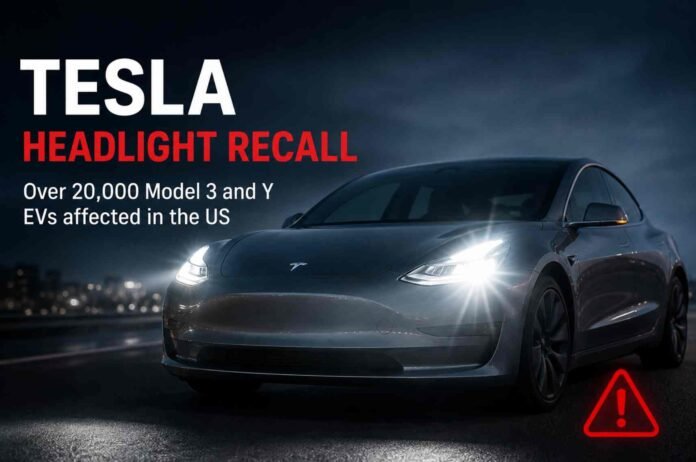
Tesla is facing a physical recall involving more than 20,000 Model 3 and Model Y electric vehicles in the US after regulators found that certain headlights can produce too much light in specific testing areas. Unlike many recent Tesla recalls that have been resolved with software updates, this issue is expected to require replacement parts.
The recall covers 20,349 vehicles, according to the US National Highway Traffic Safety Administration. It applies to selected Tesla Model 3 cars from 2017 through 2023 and Model Y vehicles from 2020 through 2023. The affected cars are equipped with specific headlamp assemblies supplied by Marelli Automotive Lighting.
Why Tesla is recalling these cars
The problem is not simply that the headlights are too bright in everyday driving. The issue relates to how much light they produce at specific points used during federal testing.
Headlights are designed to provide strong illumination while keeping glare under control. Excessive light in the wrong area can make it harder for other drivers to see clearly, particularly when they are approaching a vehicle at night. The same problem can also affect the driver of the car if the lighting pattern does not meet the required standards.
According to the NHTSA, the low beams on the affected Tesla vehicles exceed the permitted light intensity in the outer upper left and outer upper right portions of the defined testing area.
That means this is a compliance issue rather than a complaint about Tesla headlights being generally brighter than those found on other cars.
The regulator has classified the action as recall 26V507. Tesla is expected to contact owners of affected vehicles with information about the remedy. Notifications are due to be sent by September 15.
This one cannot be fixed with an update
The most notable part of the recall is that Tesla cannot simply push a software update to affected vehicles and call the problem solved.
Tesla has become particularly well known for using over the air updates to address vehicle problems without requiring owners to visit a service centre. That approach has helped the company resolve a range of issues remotely, often making recalls less disruptive for customers.
This headlight problem is different.
Tesla has said that the repair solution is still being developed. If the final remedy requires the affected headlamp assemblies to be replaced, owners will need to have their vehicles physically serviced.
Tesla was reportedly aware of the issue as far back as 2023. The company proposed recalling a smaller group of vehicles and also asked the NHTSA not to require a broader recall. That request was rejected, leading to the current action covering more than 20,000 vehicles.
For affected owners, the immediate takeaway is that there is no confirmed repair procedure yet. They should wait for Tesla to provide instructions rather than arranging any replacement work themselves.
Owners could get a useful upgrade
There could be a positive side to the situation for some owners, particularly those with older Model 3 and Model Y vehicles.
If Tesla ultimately decides that complete headlamp assemblies need to be replaced, some affected cars could potentially receive newer lighting hardware. There has been speculation that certain owners might receive Tesla’s matrix headlights as part of the repair.
Matrix lighting can provide more sophisticated illumination by controlling different sections of the light output. In theory, that can improve visibility while helping reduce glare for other road users.
However, this should not be treated as a confirmed upgrade yet. Tesla has not established the final remedy, so owners will need to wait for official instructions before knowing exactly which parts will be fitted to their vehicles.
It is also worth remembering that recalls are a normal part of the automotive industry. Finding a problem and fixing it through a formal recall is part of the safety process, even when the number of affected vehicles is relatively small.
Tesla has dealt with several recalls in recent years, including issues involving cameras and other vehicle components. The company has been able to resolve many of those problems through software, but physical repairs remain necessary when the underlying issue involves hardware.
In this case, the headlights themselves are at the centre of the problem, which explains why an over the air update is not expected to be enough.
What Tesla owners should know
For now, affected owners do not need to take immediate action beyond keeping an eye out for Tesla’s recall notification. The company is expected to provide more information once the repair has been finalised.
The recall is unlikely to affect every Model 3 or Model Y from the listed production years. The important factor is whether the vehicle is equipped with the specific headlamp assembly covered by the recall.
That distinction matters because the headline figure can make the issue sound broader than it actually is. Thousands of Tesla vehicles are included, but the recall is limited to vehicles meeting the relevant equipment and production criteria.
For Tesla, the bigger story is perhaps the reminder that software cannot solve every automotive problem. Over the air updates are useful when the underlying fault can be corrected electronically, but hardware that fails to meet a physical lighting standard still needs a physical solution.
The company now has to finalise the remedy and communicate it clearly to owners. Until that happens, the possibility of a new headlamp assembly, including a potential matrix lighting upgrade, remains just that: a possibility.
Follow TechBSB For More Updates