
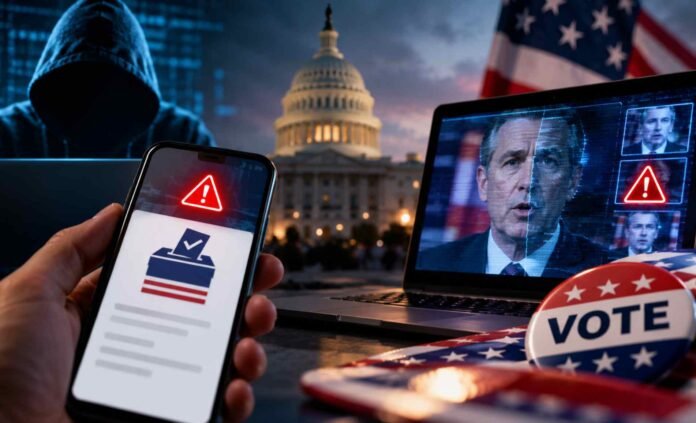
The FBI has warned Americans to remain alert to a growing wave of election related scams ahead of the 2026 US midterm elections. Cybercriminals are preparing increasingly convincing fraud campaigns designed to steal money, personal information and financial credentials, with artificial intelligence making it easier to deceive unsuspecting victims.
As election season approaches, scammers are exploiting public interest in political campaigns, voter registration and candidates. Their tactics range from fake donation websites and fraudulent political merchandise stores to investment schemes that promise financial returns based on election results.
The growing threat extends beyond financial fraud. Phishing campaigns targeting voters could expose sensitive personal information, potentially leading to identity theft and further online attacks. AI generated images, manipulated videos and deepfake content may also make fraudulent messages appear more credible than traditional scams.
AI deepfakes are making political scams harder to spot
Artificial intelligence is giving scammers new ways to make their campaigns look legitimate. Fake campaign announcements, manipulated media and impersonations of political figures can be used to persuade people to hand over money or disclose confidential information.
One emerging tactic involves election related investment pools. Victims are encouraged to contribute money to a scheme that promises to pay them a larger amount if their preferred candidate wins. The offer may sound attractive to politically engaged supporters, particularly when it is presented as an exclusive opportunity linked to a campaign.
However, these promises are designed to exploit political enthusiasm rather than provide a legitimate investment. Once victims transfer their money, scammers may disappear without delivering the promised returns.
Fraudsters are also impersonating political action committees, commonly known as PACs. These organisations can raise money to support political causes and candidates, making them a convenient target for criminals seeking to exploit public trust.
Fake fundraising websites may use candidate photographs, campaign slogans and convincing descriptions to create the impression that donations are going towards a legitimate political effort. In reality, the money may be collected by scammers for their own benefit.
Political merchandise is another target. Fraudulent online shops advertise clothing, accessories and other products featuring candidates’ names or political branding. Buyers may pay for these items only to discover that their orders never arrive.
The use of AI generated content can make these operations more persuasive, but the underlying objective remains the same: to convince people to part with their money or personal information.
Fake voter registration messages could expose personal data
Election related phishing is another major concern as Americans prepare to vote.
Scammers may send large numbers of text messages claiming that recipients have not completed their voter registration or that an approaching deadline could prevent them from voting. These messages often create a sense of urgency, encouraging people to act before checking whether the information is genuine.
A message may direct recipients to a fraudulent registration website that resembles an official government service. People who enter their personal details could unknowingly hand over information that criminals can use for identity theft, account fraud or other malicious activities.
The danger lies in how ordinary these messages can appear. Many people expect to receive election reminders during campaign season, making it easier for fraudulent notifications to blend in with legitimate communications.
The safest approach is to avoid clicking on unexpected voter registration links received through text messages or email. Anyone who needs to check their registration status or confirm a deadline should independently locate the relevant official election authority rather than relying on a link supplied by an unknown sender.
The same caution applies to requests for donations. Supporters should verify the organisation receiving their money and examine payment requests carefully before sharing financial details.
Suspicious messages that use threatening language, demand immediate action or promise unusual rewards deserve particular scrutiny.
Thousands of suspicious domains raise concerns
The FBI’s warning comes as reports point to thousands of potentially malicious websites being prepared for the 2026 election period. These domains could be used for phishing, fraudulent fundraising, impersonation and other forms of cybercrime.
Some websites may imitate legitimate campaign pages or established political organisations. Others could appear briefly to collect donations or personal information before disappearing.
The broader threat also includes coordinated disinformation campaigns intended to influence public opinion and deepen political divisions. Foreign actors, including groups linked to Iran, Russia and China, have been associated with efforts to spread misleading narratives around US politics and elections.
Such campaigns can target people across the political spectrum, using emotionally charged content to encourage distrust, amplify controversial claims or make fabricated stories appear authentic.
AI tools add another layer of complexity by allowing deceptive material to be produced and distributed more quickly. Realistic images, synthetic voices and manipulated video clips can make it harder for audiences to distinguish genuine political communications from fabricated content.
However, not every misleading post or suspicious website is necessarily connected to a foreign government. Criminal scammers, independent groups and coordinated influence operations may have different motives, even when their tactics overlap.
For voters, the practical response is to verify information before sharing it, check important claims against reliable sources and avoid making financial decisions based on sensational political content.
As election day approaches, the combination of online fraud, AI generated deception and voter focused phishing creates a serious challenge for people trying to navigate an increasingly crowded information environment.
The FBI’s warning highlights the importance of treating unexpected political messages with caution. A familiar candidate’s photograph, a convincing video or an urgent registration reminder is not proof that a communication is genuine.
Staying alert, independently checking official information and refusing to rush into payments or requests for personal details can help voters protect themselves as the election season intensifies.
Follow TechBSB For More Updates