
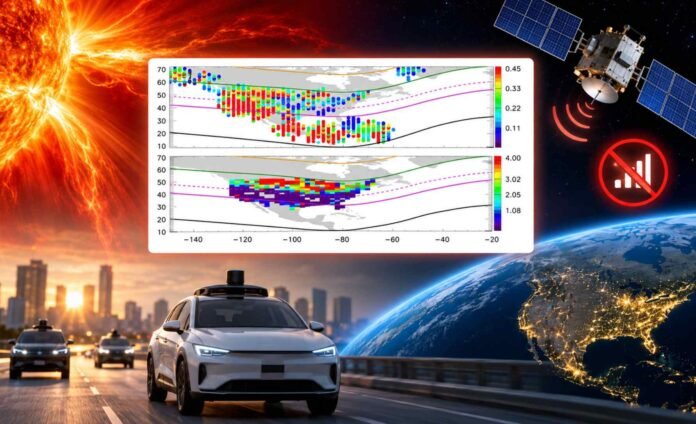
A powerful solar storm that struck Earth in November 2025 caused GPS positioning errors of up to 10 metres across parts of the United States, raising fresh concerns about the reliability of satellite based navigation for autonomous vehicles, farming equipment and other precision technologies.
Researchers studying the event say the storm produced unusually severe disturbances in the ionosphere, the electrically charged region of Earth’s upper atmosphere. The disruption lasted for hours and affected a large area of the country, making the event particularly significant for technologies that depend on highly accurate positioning data.
The findings were published in Geophysical Research Letters, where scientists examined the effects of the November 11, 2025 solar event. The storm reached the highest category on the scale used to describe geomagnetic storms and produced conditions that researchers say were rarely observed at this level.
GPS accuracy took a serious hit
GPS is often treated as a dependable background technology, but its signals can be affected by changes in the atmosphere. Satellite navigation signals travel through the ionosphere before reaching receivers on the ground. When solar activity dramatically changes conditions in this region, the signals can be delayed, distorted or otherwise affected.
During the November storm, researchers recorded positioning errors of as much as 10 metres in some locations. That may not sound like much when using a navigation app in a car, where an error of several metres might simply place your position on the wrong side of a road.
For systems that need much greater precision, however, the consequences can be far more serious.
The researchers point out that errors of only one or two metres can create major problems for autonomous vehicles and precision agriculture. A self driving vehicle relies on a combination of sensors and positioning systems to understand where it is and how it should move. A sudden loss of accuracy from GPS could therefore make an already complex driving environment more difficult to interpret.
Importantly, the study does not report that autonomous cars actually crashed because of this particular solar storm. The reference to potentially catastrophic problems describes the risks associated with GPS errors of this scale rather than documenting specific crashes involving self driving vehicles.
The disruption spread across the US
One of the more unusual features of the November event was its geographic reach.
The researchers found evidence of significant ionospheric disruption extending across the United States from coast to coast. The effects continued for several hours, showing how a major space weather event can affect systems over a very large area rather than producing a problem limited to a particular region.
Satellite communications were also affected during the storm.
Modern infrastructure depends heavily on satellites. Navigation, communications, aviation, agriculture, logistics and numerous other industries use satellite signals in one form or another. As these systems become increasingly interconnected, disruptions in space can have consequences much closer to the ground.
That makes solar weather more than an astronomy problem. A sufficiently powerful event can become a technology and infrastructure problem too.
Agriculture could face major losses
Precision agriculture is another area that could be particularly vulnerable to severe GPS disruption.
Modern farming equipment can use highly accurate satellite positioning to guide tractors, manage planting patterns, apply fertiliser and control machinery. These systems are designed to work with very small margins of error because precision can save both time and resources.
Researchers warn that the timing of the November storm limited some of the potential economic consequences. The event occurred outside the main farming season in the United States. Had a storm of similar strength occurred during a critical period for agricultural operations, the financial impact could have been much greater.
A separate solar storm in May 2024 was estimated to have caused roughly $500 million in losses for the US agriculture sector. That figure illustrates why space weather is increasingly being considered an economic risk for industries that rely on satellite positioning.
Preparing for the next major solar storm
There is no way to prevent the Sun from producing powerful solar eruptions. The practical response is therefore to improve the ability to predict these events and make vulnerable systems more resilient.
Better space weather forecasting could give operators additional time to prepare for major disturbances. Hardware and software designed to cope with degraded satellite signals could also help reduce the effects when an event occurs.
For autonomous vehicles, that could mean relying more heavily on systems such as cameras, radar, lidar and onboard positioning technologies rather than treating GPS as an unquestionable source of location data.
The same principle applies to agriculture, aviation and communications. Critical systems should be capable of continuing to operate safely when one source of information becomes unreliable.
The November 2025 storm is a useful reminder that space weather can affect everyday technology in ways that are easy to overlook. GPS may appear to work silently and reliably most of the time, but it depends on signals travelling through an atmosphere that can be dramatically altered by activity on the Sun.
The researchers argue that better observations, improved physical models and stronger forecasting capabilities will be essential for reducing future disruption.
For drivers and consumers, there is no immediate reason to panic about solar storms bringing autonomous vehicles to a halt. The bigger lesson is that as more industries depend on precise satellite positioning, even relatively small changes in GPS accuracy can become important.
A major solar storm does not need to physically damage a car, tractor or satellite to cause problems. In some cases, simply making the information those machines rely on less accurate could be enough to create a serious challenge.
Follow TechBSB For More Updates