
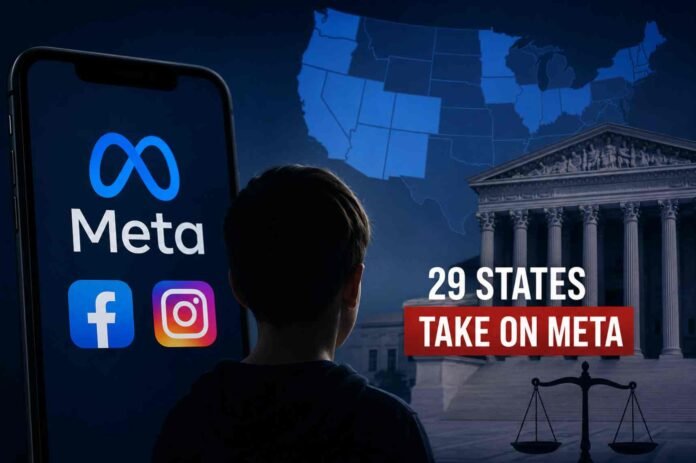
- Meta is being challenged by 29 US states over allegations involving child safety on Facebook and Instagram.
- The states claim Meta prioritised engagement and designed its platforms in ways that could encourage excessive use among young people.
- Meta denies the allegations, setting the stage for a major legal fight that could involve significant financial penalties.
- The case could affect the wider tech industry by encouraging stronger rules around children, data protection and social media design.
Meta is heading into one of its most serious legal battles in the United States after 29 states accused the company of putting user engagement ahead of the safety of children and teenagers on its platforms.
The case centres on allegations that Meta designed Facebook and Instagram in ways that encouraged young users to spend more time on its services, while allegedly failing to properly address the risks associated with those products. The states also claim that Meta mishandled information relating to children and did not fully acknowledge the potential harm its platforms could cause to younger users.
Meta has rejected the allegations and continues to dispute the claims made against it. However, the scale of the lawsuit makes it an important test for how large social media companies could be held responsible for the design choices behind their platforms.
The legal action could also have consequences beyond Meta. If the states succeed, other technology companies may face greater pressure to demonstrate that their products are designed with stronger protections for younger users from the beginning.
Why the case matters for Facebook and Instagram
The central issue is not simply whether children can access Facebook and Instagram. Regulators and state officials are increasingly examining how social platforms are designed and whether certain features encourage excessive use among younger audiences.
For years, engagement has been a key part of the social media business model. Platforms measure how long people stay, how often they return and how frequently they interact with content. That information can help companies improve their services and generate advertising revenue.
The states involved in the case argue that Meta went too far when dealing with younger users. Their allegations suggest that the company understood the potential risks associated with highly engaging social products but did not do enough to prevent those risks from affecting children.
That distinction could become particularly important during the trial. The case may examine internal company decisions, product development practices and the way Meta assessed possible effects on younger users.
Potential financial and regulatory consequences
The financial consequences could be significant if Meta is found liable. The states are seeking accountability for what they describe as serious failures in protecting children, and a successful case could result in substantial penalties.
However, money may not be the only concern for Meta.
A major ruling against the company could lead to increased regulatory scrutiny across the technology industry. Governments could demand stronger safeguards around children’s accounts, data collection and recommendation systems. Companies could also face greater pressure to explain how their products affect younger audiences.
The case arrives at a time when child safety has become a growing issue for technology companies. Lawmakers and regulators in the US have increasingly questioned whether existing rules are strong enough to protect children in an online environment that has changed dramatically over the past decade.
For Meta, that means the outcome could influence how it develops and markets its platforms in the future.
What happens next
Meta denies the allegations, meaning the case will now move through a legal process in which both sides will have the opportunity to present evidence and arguments.
One of the most closely watched aspects will be the evidence surrounding Meta’s knowledge of potential risks and the decisions it made after those risks were identified. The states will need to establish their allegations, while Meta will have the opportunity to challenge the claims and defend its product decisions.
The outcome could take time, but the wider implications are already clear. Social media companies are facing growing expectations to take greater responsibility for the experiences of children and teenagers on their platforms.
For Meta, the dispute is about more than a potential financial penalty. It could become a significant test of how much responsibility technology companies carry for the way their products are designed, how they keep younger users engaged and how they respond when those products create potential risks.
If regulators succeed, the case could encourage governments to take a tougher approach to the design of social platforms. It could also force technology companies to rethink how they balance engagement, advertising and growth with the safety of younger users.
Follow TechBSB For More Updates