
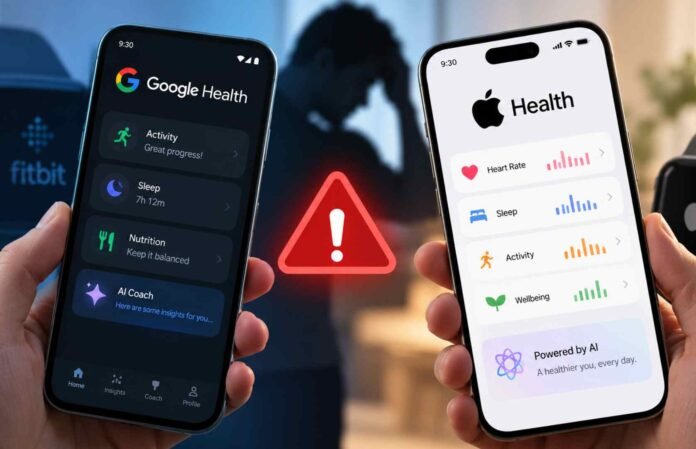
- Apple is bringing AI features to its Health app, but Google’s recent health AI problems show how risky inaccurate advice can be.
- Health AI needs to be much more reliable than ordinary chatbots because its recommendations can influence real wellbeing decisions.
- Apple has strong experience with health data, privacy and clinical validation, but using outside AI technology still raises questions about accuracy.
- Apple’s success will depend on making its Health AI cautious, transparent and dependable instead of simply making it more conversational.
Apple is preparing to give its Health app a major artificial intelligence upgrade, but Google’s recent experience with AI powered health features offers an uncomfortable warning.
For Apple users, the promise is exciting. Having an assistant that can understand health data, spot patterns and offer useful suggestions could make the Health app far more valuable. But when artificial intelligence starts interpreting information that can influence decisions about exercise, diet or wellbeing, accuracy becomes far more important than clever presentation.
That is where Google’s recent problems matter.
The redesigned Google Health experience, which replaced the familiar Fitbit app for many users, has faced criticism over its interface, missing features and, more seriously, the behaviour of its AI assistant. Users have reported recommendations and interpretations that do not match their actual activity or health data. Some complaints have gone beyond simple annoyances, with people describing fictional workout information, questionable fitness guidance and inaccurate food tracking.
For an ordinary productivity app, an AI mistake can be frustrating. In a health app, the consequences can be much more serious.
AI has a higher standard in health
The biggest lesson for Apple is that health AI cannot be treated like a general purpose chatbot.
People already understand that chatbots can make mistakes. They can invent information, misunderstand a question or confidently provide an incorrect answer. That behaviour is often described as an AI hallucination. It is irritating when it happens while asking for a restaurant recommendation. It is a completely different problem when an assistant is analysing sleep, heart rate, exercise, nutrition or other personal health information.
An AI health assistant needs to know when it does not have enough information.
That may sound obvious, but it is one of the hardest problems to solve. Health data is complicated, incomplete and highly personal. A change in someone’s sleep does not necessarily mean the same thing for everyone. A lower activity level could be the result of illness, travel, recovery or simply a change in routine. Nutrition data can also be messy because estimates are often based on incomplete information.
This is why Apple’s approach will need to be considerably more cautious than simply placing a conversational AI over a database of health records.
Apple has an advantage, but it is not a guarantee
Apple does have some reasons for optimism.
The company has spent years building its health ecosystem around the Apple Watch and iPhone. Features such as heart monitoring, activity tracking and other health measurements have generally been introduced with considerable emphasis on validation and privacy.
Apple also has a strong incentive to keep health information tightly protected. Health data is among the most sensitive information stored on a smartphone, and users are unlikely to accept an assistant that appears careless with it.
But privacy and accuracy are two separate challenges.
A system can protect someone’s data extremely well and still give bad advice. Apple therefore needs to prove that its AI can interpret information reliably before users start depending on it.
There is another complication. Apple’s broader artificial intelligence strategy has increasingly involved technology from outside the company. Google has become an important partner in Apple’s AI ambitions, particularly as Apple works to bring more capable intelligence to Siri and its wider software ecosystem.
That naturally raises questions about how much of Google’s underlying technology could influence Apple’s health features.
Using Google’s technology does not automatically mean Apple Health will repeat Google’s mistakes. Apple can build additional safeguards around a model, restrict what it is allowed to answer and combine AI with its own health data infrastructure. The important question is how much control Apple has over the final experience.
The real test will be restraint
Apple’s biggest opportunity may actually be knowing when its AI should stay quiet.
A good health assistant does not need to have an answer to everything. It should be able to distinguish between straightforward observations and situations where interpretation requires a medical professional.
For example, summarising a user’s activity over several weeks could be genuinely useful. Pointing out that sleep has changed compared with a normal pattern could also help users notice something they might otherwise overlook.
The danger begins when the software turns those observations into confident conclusions without enough evidence.
Apple therefore needs to make its Health AI feel less like a chatbot and more like a carefully controlled analytical tool. Its responses should be grounded in verified information, clearly identify uncertainty and avoid presenting speculation as fact.
That approach could also help Apple avoid another problem seen with AI products. People quickly lose confidence when an assistant repeatedly gets small details wrong. Once users discover that the system has invented a workout, misunderstood their meals or made an obviously incorrect claim about their data, they have little reason to trust it with more important questions.
Apple Health has something to prove
The arrival of AI in Apple Health is potentially one of the company’s most interesting software moves. Bringing together information from the Apple Watch, iPhone and compatible health services could give users a much clearer picture of their habits and wellbeing.
But the technology needs to earn that trust.
Google’s experience shows that users are not automatically impressed simply because an AI assistant has been added to a health app. In fact, the opposite can happen. If AI makes the experience less accurate or less predictable, users may prefer the simpler product they had before.
Apple has the opportunity to learn from that mistake before its own redesigned Health experience reaches everyone.
The company does not need to make its AI more talkative than Google’s. It needs to make it more dependable.
That distinction could determine whether Apple’s health ambitions become a genuinely useful part of the iPhone experience or another example of artificial intelligence being added simply because the technology is available.
For now, the biggest question is not whether Apple can put AI into Health. It clearly can.
The question is whether Apple can make users trust what the AI tells them.
Follow TechBSB For More Updates