
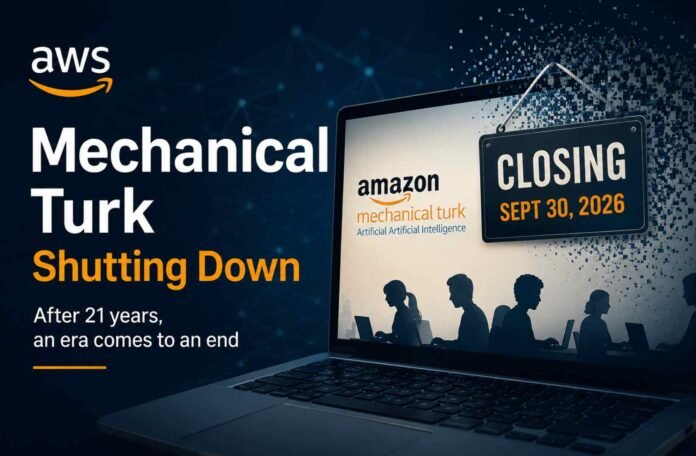
- AWS Mechanical Turk will permanently close on September 30, 2026, ending a 21-year run.
- The platform connected human workers with paid tasks such as image labeling, transcription, and surveys.
- AI can now perform many routine tasks that once required Mechanical Turk’s workforce.
- Newer companies are taking over with specialized human work focused on training and evaluating modern AI.
Amazon is preparing to close one of the internet’s longest-running marketplaces for online human work.
AWS Mechanical Turk, the platform that connected businesses with people willing to complete small digital tasks for payment, will permanently shut down on September 30, 2026. The decision marks the end of a service that spent more than two decades demonstrating something that early computers often struggled to do: finding a human when automation was not good enough.
At its height, Mechanical Turk connected hundreds of thousands of workers with companies and researchers looking for help with tasks ranging from image labeling and transcription to surveys and data categorization.
But the technology industry that created the need for Mechanical Turk has changed dramatically. AI is now capable of handling many of the routine assignments that once required a human workforce, while newer companies have built more specialized platforms for the kinds of human input that modern AI systems still need.
A platform built for the jobs computers could not handle
Mechanical Turk launched in 2005 with a relatively simple idea.
Computers could process enormous amounts of information quickly, but they often failed when asked to perform tasks that came naturally to people. Recognizing objects in images, understanding messy language, checking information, and making subjective judgments were all difficult problems for software at the time.
Mechanical Turk created a marketplace where those problems could be broken into small assignments and distributed to people online.
The platform’s name came from the famous historical chess-playing machine that appeared to operate automatically but was secretly controlled by a person. It was an appropriate comparison for a service built around the idea that what looked like automation could sometimes be powered more effectively by humans.
Amazon initially used the concept to help manage and organize large volumes of product information. Over time, the service became much broader, attracting researchers, businesses and developers who needed access to a flexible online workforce.
Workers, often known as turkers, could pick up individual tasks and complete them for small payments. For some, it was occasional extra income. For others, the platform became a much more significant source of work.
The rise of AI changed the economics
Mechanical Turk’s closure is difficult to separate from the extraordinary progress made in artificial intelligence.
Many tasks that once had to be outsourced to people can now be completed, at least partially, by AI systems. Image recognition, speech transcription, text classification and basic content analysis have all improved dramatically.
That does not mean humans are no longer needed.
In fact, the rapid expansion of AI has created enormous demand for human workers who can train, evaluate and improve models. The difference is that the market has become more specialized.
Companies now need people to assess complicated AI responses, provide expert feedback, test reasoning capabilities and create high-quality training data. Those requirements are very different from the small, repetitive assignments that defined Mechanical Turk’s early success.
Newer platforms have stepped into that space with business models designed specifically around the AI industry.
Companies such as Scale AI, Mercor and Prolific have built systems aimed at connecting organizations with workers who can provide increasingly sophisticated forms of data and evaluation.
That shift may explain why Mechanical Turk, despite helping establish the online human task marketplace, struggled to maintain the same relevance.
Workers face an uncertain transition
For the people who still relied on Mechanical Turk, the shutdown is more than a technology story.
Some workers continued using the platform regularly, even as activity appeared to decline. The closure now leaves them looking for alternatives at a time when competition in the online work economy is becoming more intense.
The platform was never without criticism. Payments for individual tasks could be extremely low, and workers often had limited protections. Even so, it provided access to work that could be completed remotely and with relatively few barriers to entry.
Its disappearance highlights an uncomfortable reality about the AI economy.
Artificial intelligence is creating new categories of work while also removing older ones. The workers who once helped computers understand the world are increasingly competing with the systems they helped train.
There is also an irony at the heart of Mechanical Turk’s story.
The service was built because computers could not reliably perform certain tasks without human assistance. Twenty-one years later, many of those tasks are being handled by machines.
Yet modern AI still depends heavily on people behind the scenes. Humans continue to label data, evaluate outputs, correct mistakes and teach models what good answers look like.
The human workforce has not disappeared. It has simply become less visible and, in many cases, more specialized.
The end of an important chapter for online work
Amazon’s decision to close Mechanical Turk brings an important era of internet labor to a close.
The platform helped popularize the idea that large groups of people could be coordinated online to solve problems at scale. That model influenced research, machine learning and the broader gig economy.
Its legacy is particularly important in AI.
Before today’s race to build increasingly powerful models, Mechanical Turk provided a practical way to collect the human input that machines needed to improve. It helped establish workflows that later became essential to data annotation and machine learning development.
Now the industry has moved on.
AI systems are replacing some of the work Mechanical Turk was created to distribute, while the remaining human tasks are increasingly being handled through newer and more specialized services.
For Amazon, the closure may simply be a business decision following an assessment of a declining service.
For workers and researchers, however, it marks the disappearance of a platform that played a surprisingly important role in the development of modern AI.
Mechanical Turk began as a solution to the limitations of computers. Its closure is a reminder of how quickly those limitations can change.
Follow TechBSB For More Updates