
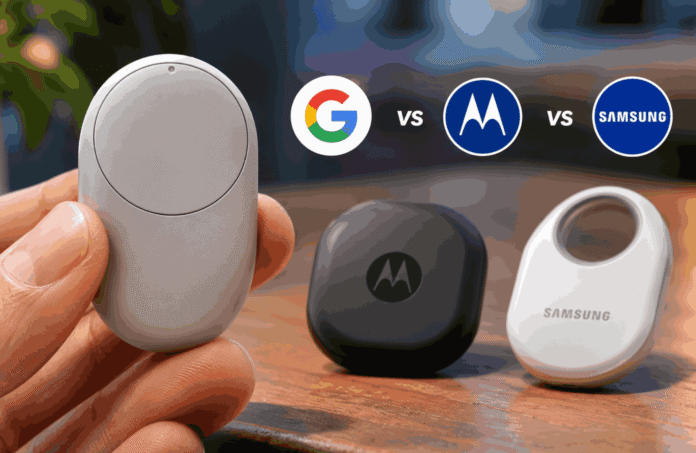
Google Pixel Tag has finally arrived, giving Android users another option for keeping track of their belongings. Announced alongside the Pixel 11 series in August, Google’s new Bluetooth tracker is now available to purchase, bringing Ultra Wideband connectivity, a replaceable battery and support for Google’s Find Hub network.
The launch is particularly interesting because Google is entering a market that already has established competitors. Motorola’s Moto Tag 2 and Samsung’s Galaxy SmartTag 2 offer similar tracking capabilities, making the choice between these devices less straightforward than it might initially appear.
Google’s tracker costs $29 in the US, £29.99 in the UK and AU$49 in Australia. Buyers can also purchase a four pack for $99, £99 or AU$169.
On paper, the Pixel Tag looks competitive. It is lightweight, offers IP67 water resistance and promises more than a year of battery life. However, Motorola and Samsung have some advantages of their own, particularly when it comes to battery endurance and durability.
Until independent testing is complete, it is difficult to declare an outright winner. Nevertheless, the specifications reveal some important differences worth considering before buying an Android item tracker.
Google Pixel Tag brings precise tracking to Android users
The biggest selling point of the Google Pixel Tag is its integration with Find Hub, Google’s crowdsourced network for locating lost devices and accessories.
The system uses a network of more than one billion Android devices to help locate tagged belongings when they are outside Bluetooth range.
For example, if you leave your Pixel Tag attached to a bag at a restaurant, another compatible Android device passing nearby could help update its location through the Find Hub network.
Once the tracker is nearby, users can activate its built in speaker to make it produce a sound. This should make it easier to locate misplaced keys, wallets or other belongings around the house.
The Pixel Tag also supports Ultra Wideband technology, allowing compatible phones to locate it more precisely. Instead of relying entirely on a map or an audible alert, users can receive directional guidance on their smartphone screen.
Google has included a useful reverse tracking feature as well. Double pressing the button on the Pixel Tag can make a connected phone ring, which is handy when the handset has disappeared somewhere nearby.
Other features include separation alerts, lost item notifications and the ability to share a tracker’s location with other people.
Google also supports shared tracking, allowing multiple people to monitor the same tagged item. Users can even share location information with airlines or other people who have a Google account.
The tracker weighs just 11.8g and measures 28 x 46.1 x 5.4mm. It carries an IP67 rating and uses a replaceable CR2032 coin cell battery that should last more than a year.
Google Pixel Tag vs Moto Tag 2 vs Galaxy SmartTag 2
Google is not introducing a completely new category of hardware. Its tracker shares several features with Motorola and Samsung alternatives, although there are some meaningful differences.
Here is how the three devices compare.
| Specification | Google Pixel Tag | Moto Tag 2 | Galaxy SmartTag 2 |
| Dimensions | 28 x 46.1 x 5.4mm | 31.9 x 31.9 x 8mm | 28.8 x 52.44 x 8mm |
| Weight | 11.8g | 8.5g | 13.75g |
| Water resistance | IP67 | IP68 | IP67 |
| Connectivity | Bluetooth 6.0, UWB | Bluetooth 6, UWB | Bluetooth LE 5.3, UWB |
| Battery | CR2032 | CR2032 | CR2032 |
| Battery life | Over one year | Over 600 days | Up to 500 days |
| Compatibility | Android phones | Android phones | Samsung phones |
| US price | $29 | $29.99 | $29.99 |
Motorola’s tracker has a slight advantage in durability, thanks to its IP68 rating. It is also the lightest of the three, weighing just 8.5g.
Battery life is another area where Motorola appears to have an edge. The Moto Tag 2 is rated for more than 600 days, while Samsung’s Galaxy SmartTag 2 promises up to 500 days.
Google’s claim of more than one year is respectable, but it falls short of Motorola’s advertised endurance.
The Pixel Tag also supports Bluetooth 6.0 with Channel Sounding and Ultra Wideband. These technologies are designed to improve proximity detection and make locating nearby objects more convenient.
However, hardware specifications are only part of the experience. The tracking network and smartphone compatibility can be just as important when choosing an item tracker.
Compatibility and pricing could decide the winner
One of Google’s biggest advantages is its broad Android compatibility.
The Pixel Tag works with Android phones running Android 9 or later, giving it access to a much wider range of devices than Samsung’s Galaxy SmartTag 2.
Samsung’s tracker is primarily designed for Galaxy smartphones, meaning users with other Android devices will need to consider alternatives.
Motorola’s Moto Tag 2 also supports Android phones, making it a direct competitor to Google’s offering.
Availability is another consideration. The Pixel Tag is now available in multiple markets, while the Moto Tag 2 is not currently available in Australia according to the reported launch information.
Pricing is relatively close across all three devices.
Google charges $29 for one Pixel Tag, with a four pack costing $99. Motorola’s Moto Tag 2 starts at $29.99, while Samsung’s Galaxy SmartTag 2 is priced at $29.99 in the US.
This puts all three products in a similar price category.
Interestingly, Apple’s latest AirTag also starts at $29 in the US, showing that Bluetooth tracking accessories have become relatively affordable.
For people already using Google Pixel or other Android smartphones, the Pixel Tag could be the more convenient choice because of its integration with Find Hub.
Samsung users, meanwhile, may prefer the Galaxy SmartTag 2 because of its integration with Samsung’s ecosystem.
Motorola’s tracker could appeal to buyers who prioritise longer battery life and better water resistance.
There is also another development worth watching. Samsung has announced the Galaxy SmartTag 3, which adds iOS compatibility. However, widespread availability is not expected until sometime in 2027.
Is the Google Pixel Tag worth buying?
The Google Pixel Tag looks like a promising addition to the Android accessory market, particularly for people who regularly misplace their keys, bags or other everyday belongings.
Its lightweight design, Ultra Wideband support and integration with Find Hub make it an interesting alternative to existing trackers.
The biggest advantage is its compatibility with Android phones running Android 9 or later. This makes it more accessible than Samsung’s Galaxy SmartTag 2, which is restricted to Samsung devices.
However, Motorola’s Moto Tag 2 remains a strong competitor. Its IP68 protection and advertised battery life of more than 600 days give it advantages that Google has not matched.
The Pixel Tag’s real value will ultimately depend on how accurately it tracks belongings, how reliable its crowdsourced network proves to be and how well its battery performs during everyday use.
Google’s new tracker is available now, but independent testing will be needed before recommending it over Motorola or Samsung’s alternatives.
For the moment, Android users have another compelling option, and that is good news for anyone looking for a reasonably priced way to keep track of their belongings.
Follow TechBSB For More Updates