
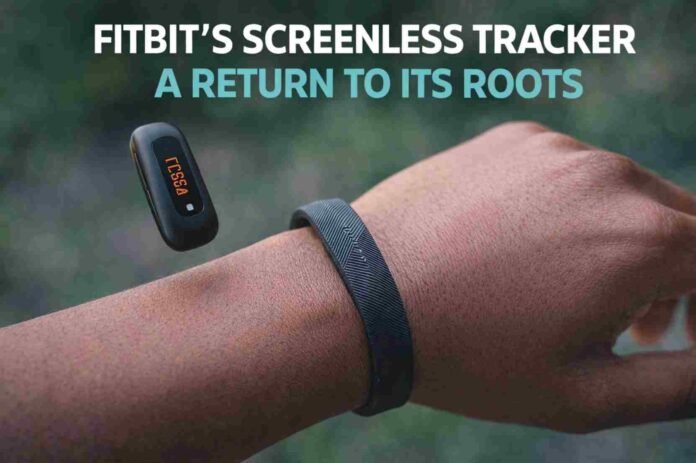
- Fitbit may return to its roots with a screenless fitness tracker focused on passive data tracking
- The move aligns with growing demand for distraction free wearables like Whoop
- Google can clearly separate Fitbit from Pixel Watch within its ecosystem
- Simplicity and invisibility could help Fitbit regain relevance
There is something quietly fitting about Fitbit circling back to where it began. Long before smartwatches crowded wrists with notifications, apps, and glowing displays, Fitbit built its name on simplicity. Its earliest devices were discreet, almost forgettable in daily use, yet deeply effective in tracking movement and sleep.
Now, with Google reportedly preparing a screenless Fitbit tracker, the brand seems ready to revisit that original philosophy. This is not just another product launch. It feels like a recalibration of what a fitness wearable should be.
Back in 2008, Fitbit’s first device was little more than a clipped pedometer with a tiny display. It did not demand attention. It quietly collected data and left interpretation to the user later. That “set it and forget it” approach resonated because it stayed out of the way.
The new screenless tracker appears to follow that same path. Instead of competing with smartwatches, it avoids the battle entirely.
Why less might actually be more
The wearable market has spent years chasing more features. Bigger screens, brighter interfaces, deeper app ecosystems. But in doing so, many devices lost their core purpose. Fitness tracking became secondary to notifications, calls, and distractions.
A screenless Fitbit changes that dynamic. Without a display, the device cannot interrupt you. It cannot pull your attention away mid workout or flood you with alerts during rest. It simply tracks.
That shift is significant. Devices like Whoop and similar bands have already shown that there is strong demand for minimal, data driven wearables. Users are increasingly interested in recovery, strain, and sleep insights rather than step counts alone.
Fitbit entering this space is not just trend chasing. It is a strategic move that aligns with what the brand once did best. Instead of trying to outdo smartwatches, it focuses on doing one thing exceptionally well.
Google’s quiet course correction
Since Google acquired Fitbit, the direction of the brand has been uncertain. Smartwatches like the Versa series struggled to stand out, especially when compared to more advanced alternatives. Meanwhile, Google’s own Pixel Watch absorbed many of Fitbit’s strengths.
Over time, Fitbit’s smartwatch lineup began to feel redundant. It was neither as powerful as a full smartwatch nor as simple as a dedicated fitness tracker. That middle ground proved difficult to sustain.
A screenless tracker resolves that identity crisis. It gives Fitbit a clear role within Google’s ecosystem. Pixel Watch handles the smartwatch experience, while Fitbit returns to being the specialist in health tracking.
This separation makes sense. It reduces overlap and allows each product line to excel in its own category. More importantly, it restores Fitbit’s distinct identity, something it has gradually lost over the years.
The appeal of invisible technology
There is a growing appreciation for technology that does not constantly demand attention. In a world saturated with screens, subtlety has become a feature in itself.
A screenless fitness band fits perfectly into this shift. It blends into daily life rather than dominating it. You wear it, it works, and you check your data when you choose.
This approach also encourages a healthier relationship with technology. Instead of reacting to constant prompts, users engage with their data more intentionally. Workouts feel more focused. Sleep tracking feels less intrusive.
If executed well, this could make Fitbit relevant again in a crowded market. Not by competing on features, but by offering something refreshingly different.
A full circle moment
What makes this move particularly compelling is how it mirrors Fitbit’s origins. The company once thrived by offering simplicity in a complex tech landscape. Over time, it drifted toward feature heavy devices and lost some of that clarity.
Now, it has the opportunity to reclaim it.
The upcoming tracker is not just another wearable. It represents a return to a philosophy that prioritizes usefulness over noise. If Google gets the balance right between hardware simplicity and powerful app insights, Fitbit could once again lead rather than follow.
In many ways, the future of Fitbit might look a lot like its past.
Follow TechBSB For More Updates