
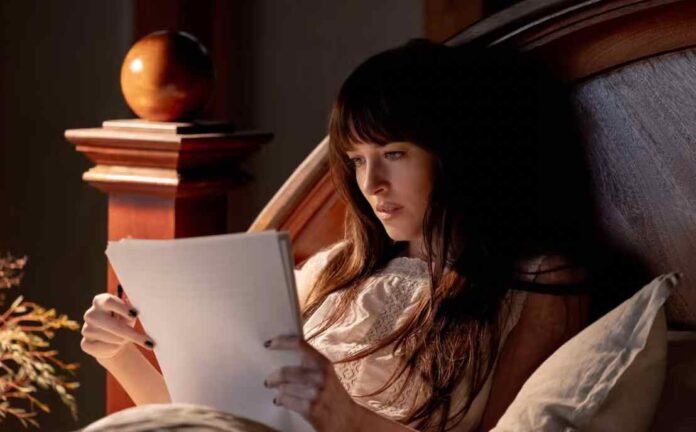
Colleen Hoover’s Verity has always been built around one uncomfortable question: who is telling the truth?
The movie adaptation takes that uncertainty and pushes it even further. Starring Anne Hathaway as Verity Crawford, Dakota Johnson as Lowen Ashleigh and Josh Hartnett as Jeremy Crawford, the psychological thriller follows a writer who enters a wealthy family’s troubled world and discovers a secret that could completely change her understanding of the people around her.
The ending deliberately refuses to provide an easy answer. Instead, it leaves viewers with two competing versions of the truth: Verity’s disturbing manuscript and the letter she secretly leaves behind.
That final twist is what makes the story so unsettling. One account suggests Verity is a murderer who deliberately caused her daughter Harper’s death. The other suggests the manuscript was nothing more than fictional writing created to process unbearable grief, while Jeremy was the person hiding a deadly secret.
Here is what happens and why the ending remains deliberately open to interpretation.
What happens at the end of Verity?
Lowen initially travels to the Crawford family home after being hired to continue Verity’s bestselling book series. Verity has suffered a serious accident and appears unable to communicate, leaving Lowen to work through her unfinished material.
While searching through Verity’s belongings, Lowen discovers a hidden manuscript. What she reads is horrifying. The pages appear to describe Verity’s darkest thoughts, including an alleged admission that she caused the death of her young daughter Harper.
The discovery changes the way Lowen sees Verity. She begins to suspect that Verity is not actually incapacitated and may have been pretending to be unresponsive.
Lowen eventually tells Jeremy about the manuscript. Jeremy is devastated and furious when he learns what it appears to contain. He confronts Verity and discovers that she is capable of moving and communicating.
In a moment of rage, Jeremy strangles Verity while Lowen watches. Rather than reporting what happened, Lowen becomes involved in covering up the death. The two make the incident appear to be an accident and leave the house behind.
Lowen is also pregnant with Jeremy’s child, making the decision even more complicated.
However, the story has one final revelation waiting for her.
The letter changes everything
After the family has moved away, Lowen returns to the old house. While exploring the property, she discovers a letter hidden beneath a loose floorboard.
The letter is supposedly written by Verity.
Its contents completely challenge the story Lowen has believed.
According to Verity, the manuscript was never a confession. She claims she created it as part of an exercise called antagonistic journaling after Harper’s accidental death. The disturbing scenes were fictional and represented an attempt to explore the darkest possible version of her grief.
Verity also claims Jeremy discovered the manuscript and interpreted it as proof that she had murdered their daughter.
According to her account, Jeremy then tried to kill her by deliberately causing the car crash. When that attempt failed, Verity realised that Jeremy might come after her and Crew again. She therefore pretended to be unresponsive so that he would believe she was incapable of exposing him.
If Verity’s letter is genuine, Lowen has made a catastrophic mistake.
She has helped Jeremy kill a woman who may have been innocent.
The revelation also means that many of Jeremy’s earlier explanations can no longer be taken at face value.
So, is the manuscript or the letter true?
That is the central mystery of Verity, and the movie intentionally avoids confirming one definitive answer.
There are convincing arguments on both sides.
The manuscript appears credible because it contains details that seem connected to real events in the Crawford household. Its descriptions of Harper’s death and other disturbing incidents make it difficult for Lowen, and the audience, to dismiss it as simple fiction.
But Verity is also a professional novelist who regularly writes about disturbing characters and situations. The manuscript could therefore be exactly what she says it is: an exercise in writing from the perspective of a fictional antagonist.
The letter creates another problem. If Verity really was guilty, she would have an obvious reason to write something designed to make herself look innocent. She knew that anyone discovering the letter might question the evidence against her.
At the same time, Jeremy’s behaviour gives the letter additional weight. The movie establishes that he has not been completely honest with Lowen from the beginning. He even knows more about Lowen than he initially admits.
That means Lowen has very little reliable information with which to reconstruct what actually happened.
The ending therefore works less like a traditional mystery with a final solution and more like a psychological puzzle. Viewers are given evidence for two conflicting stories and left to decide which version makes more sense.
What does Colleen Hoover think?
Colleen Hoover has also discussed how she views the mystery.
In a 2026 conversation with Jenna Bush Hager, Hoover explained that she was primarily writing from Lowen’s perspective while working on the original novel. Because she was inside Lowen’s head, she did not fully construct the story from Jeremy’s or Verity’s point of view.
Hoover said that she finished the book with the same uncertainty Lowen experiences. However, she has since developed her own interpretation of the story.
Her position is that the manuscript is the more truthful account.
That does not necessarily settle the question for the audience. Hoover’s interpretation is useful because she created the original characters and story, but the movie deliberately preserves the ambiguity.
The most interesting part of the ending is therefore not simply asking whether Verity or Jeremy is lying. It is recognising how easily Lowen can be manipulated because she wants to believe the version of events that supports the future she has started imagining with Jeremy.
By the final scene, Lowen knows enough to question everything, but she chooses not to confront Jeremy.
That decision may be the most revealing part of the entire ending.
Whether Verity was guilty or innocent, Lowen now has a reason to stay silent. She has a child on the way, a relationship to protect and a horrifying secret that could destroy her new life.
The movie leaves viewers with that uncomfortable uncertainty rather than a clean resolution.
Follow TechBSB For More Updates