
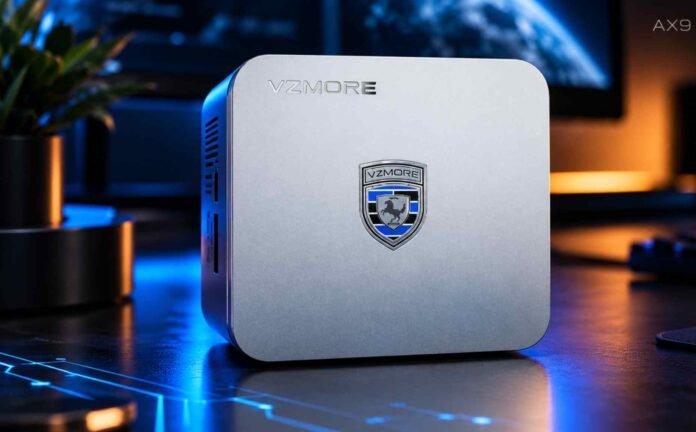
The VZMORE AX9 Max AI is a compact desktop computer that aims to deliver powerful processing, modern AI capabilities and extensive connectivity without taking up much space on a desk. With its AMD Ryzen AI 9 HX 470 processor, Radeon 890M integrated graphics and dedicated neural processing unit, it promises to handle everything from demanding office workloads to creative applications and locally running AI models.
At first glance, it looks like an appealing option for professionals who want workstation style performance in a small package. Its metal chassis, generous selection of ports and upgradeable memory and storage give it plenty of flexibility.
However, there is a catch. The reviewed configuration comes with 32GB of RAM and a 1TB SSD, which can limit its performance when running demanding creative applications or larger AI models locally. Upgrading the hardware could unlock more of its potential, but doing so can significantly increase the overall cost.
The AX9 Max AI is available with a starting price of around £1,349 in the UK, while the US listing mentioned in the review puts it at approximately $1,399. That puts it firmly in premium mini PC territory, where buyers should expect strong performance across a broad range of workloads.
Premium construction, compact design and plenty of ports
The VZMORE AX9 Max AI makes a strong first impression with its full metal casing and compact dimensions. Measuring approximately 134.9 x 131.8 x 57.7mm and weighing 777.5g, it is small enough to fit comfortably on a crowded desk or in a compact workspace.
Its styling is more divisive. The large logo and decorative detailing give the machine a distinctive appearance, although the design may feel a little excessive for a professional desktop computer. The overall construction, however, is solid, and the casing feels well finished.
Connectivity is one of the system’s strongest features.
The front provides USB Type A ports for everyday peripherals, along with a 3.5mm audio jack. Around the back, the system offers two USB4 ports, HDMI 2.1 outputs, additional USB connections and two 2.5Gb Ethernet ports. There is also an SD 4.0 card reader for transferring files from compatible memory cards.
Wireless connectivity includes Wi Fi 7 and Bluetooth 5.4.
This combination makes the mini PC suitable for users who regularly connect external storage, multiple displays, cameras and other accessories. The USB4 ports are particularly useful for expanding storage or connecting compatible high speed devices.
Accessing the internal components requires removing the base, and the initial process involves taking out small rubber plugs that cover the screws. Once those are removed, the base comes away without too much difficulty.
The overall design is practical, although the emphasis on premium styling does not necessarily translate into a more professional appearance.
AMD Ryzen AI hardware delivers strong processing performance
At the heart of the AX9 Max AI is AMD’s Ryzen AI 9 HX 470 processor, featuring 12 cores and 24 threads. It is paired with Radeon 890M integrated graphics and an NPU rated at up to 55 TOPS.
This combination gives the machine the processing power needed for demanding everyday computing, multitasking and a range of AI accelerated workloads.
The system also includes VZMORE’s V Cooling arrangement, which combines a vapour chamber with airflow drawn through the base and vents at the rear. The manufacturer claims the design can sustain a 65W thermal design power output while keeping noise under control.
During testing, the cooling system generally performed well. The fans remained reasonably quiet during routine work, becoming more noticeable under heavier loads.
Users can also choose between three power modes: Silent at 45W, Balanced at 54W and Performance at 65W. The review used Performance mode for testing.
The machine ships with Windows 11 Pro, and everyday productivity applications run smoothly. Word, Excel and PowerPoint are comfortably within its capabilities, while the strong processor also helps with multitasking and demanding workloads.
The benchmark results reinforce its CPU performance.
| Benchmark | Result |
| Geekbench 6 single core | 2,997 |
| Geekbench 6 multi core | 15,845 |
| Cinebench R23 single core | 2,076 |
| Cinebench R23 multi core | 21,568 |
| PCMark overall | 8,910 |
| CrystalDiskMark read speed | 6,047.65 MB/s |
| CrystalDiskMark write speed | 5,058.87 MB/s |
These figures suggest a capable machine for professionals who need strong CPU performance in a compact form factor. The included PCIe 4.0 SSD also delivers fast storage performance, although the reviewer would have preferred a larger drive at this price.
Upgradeable memory and storage are useful, but costly
The AX9 Max AI comes with 32GB of DDR5 memory and a 1TB PCIe 4.0 SSD. That is enough for many office tasks, but it feels restrictive for a machine marketed towards creative professionals and local AI users.
The system supports memory upgrades up to a claimed 256GB, although finding suitable modules at a reasonable price is another matter. During testing, the reviewer found a 128GB memory configuration priced at approximately £1,999 for the two 64GB modules.
That is a substantial additional expense on top of the mini PC itself.
Storage expansion is more straightforward. The machine includes two M.2 slots, one accommodating an M.2 2280 SSD and the other an M.2 2230 drive with support for up to 1TB. This provides room to expand the available storage, although the primary drive is limited to PCIe 4.0 rather than the newer PCIe 5.0 standard.
The supplied 1TB drive can fill up quickly when working with large video projects, high resolution images or locally stored AI models. The reviewer had to connect an external SSD through USB4 during parts of the testing.
For buyers working primarily with office applications, 32GB of RAM and 1TB of storage may be perfectly adequate. Those planning to edit complex 4K footage or run larger language models locally should consider the upgrade costs before making a purchase.
The AX9 Max AI’s flexibility is a genuine advantage, but its headline price does not tell the whole story.
Creative workloads and local AI expose the limits
The AX9 Max AI performs well in many creative applications, including Photoshop, Lightroom and Premiere Pro. Images load quickly, common adjustments are handled smoothly, and both HD and 4K video editing are manageable.
However, the 32GB memory configuration becomes a bottleneck as workloads grow more demanding.
Batch processing in Lightroom and managing large collections of files in Adobe Bridge caused memory usage to climb. More complex 4K video projects also introduced occasional pauses while the system caught up with rendering tasks.
The reviewer found that increasing the memory to 64GB would be a sensible upgrade for more demanding video editing work.
Local AI testing revealed a similar limitation.
Using LM Studio, the reviewer ran Qwen3.6 35B A3B and Gemma 4 26B A4B models through tasks involving technical writing, programming, reasoning, image understanding and review analysis.
The machine was capable of running these models locally, with responses often beginning within a few seconds. However, memory usage regularly reached between 95% and 99%, leaving very little room for other applications.
In one technical writing test, the Qwen model took 4.38 seconds to produce its first response and generated output at 19.1 tokens per second. The complete run took 316.7 seconds.
A Python programming task involving the organization of 2,764 images took 407.36 seconds to complete, with the model generating output at 18.84 tokens per second after a little over one second to the first token.
More demanding image analysis tasks took more than ten minutes in some cases.
These results show that the AX9 Max AI can run local language models, but the experience depends heavily on model size, task complexity and available memory. It is not a direct replacement for more powerful AI workstations or cloud based models.
For users who value offline processing and control over their data, local AI support remains an attractive feature. However, the cost of upgrading the RAM could make this a much more expensive proposition than the base configuration suggests.
Gaming performance is respectable, with integrated graphics limitations
Gaming is another area where the AX9 Max AI delivers mixed results.
The integrated Radeon 890M graphics are capable enough for casual gaming and some demanding titles at moderate settings. During testing, Indiana Jones and the Great Circle ran well enough to provide an enjoyable experience.
Cyberpunk 2077 was more challenging. The reviewer had to lower graphics quality settings considerably to achieve the preferred level of smoothness.
This is not particularly surprising for a compact system relying on integrated graphics rather than a dedicated desktop GPU.
The processor provides substantial computing power, but CPU performance alone does not guarantee strong results in graphics intensive games. Buyers interested in demanding gaming workloads should therefore consider whether a mini PC with a dedicated GPU would be a better fit.
The AX9 Max AI makes more sense as a professional desktop that can also handle some gaming than as a dedicated gaming machine.
Final verdict: A capable mini PC that needs the right configuration
The VZMORE AX9 Max AI offers a compelling combination of CPU performance, connectivity, compact construction and upgrade flexibility. Its Ryzen AI processor handles demanding productivity tasks comfortably, while the fast SSD and extensive port selection make it practical for professional work.
Its weaknesses become clearer when the system is pushed beyond everyday computing. The integrated graphics limit demanding gaming, and the supplied 32GB of RAM can restrict creative applications and local AI workloads.
Upgrading the memory and storage could make the machine more capable, but those changes can add significantly to the overall cost.
For office users and professionals who need a compact, powerful desktop, the AX9 Max AI has plenty to offer. For people buying it specifically to run large AI models locally, the total cost of the required upgrades deserves careful consideration.
The key is to look beyond the impressive processor specifications and assess the complete configuration needed for your workload. The AX9 Max AI has the hardware foundations for a capable compact workstation, but reaching its full potential may be considerably more expensive than its starting price suggests.
Follow TechBSB For More Updates