
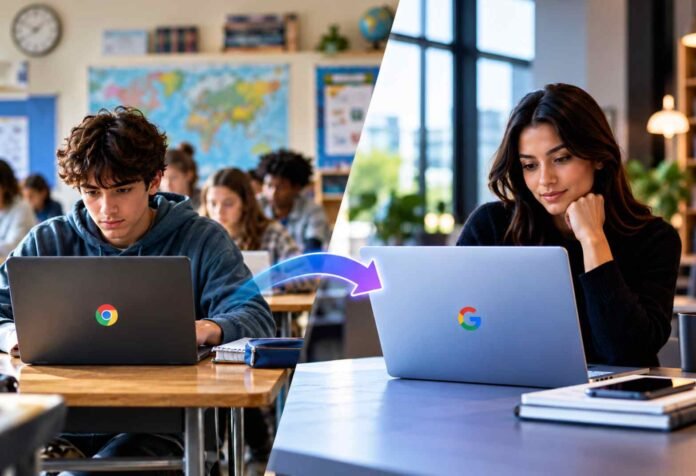
Google has spent more than a decade building a strong presence in schools with its affordable Chromebooks. Now, as students move on to university and enter the workforce, the company wants to turn that familiarity into a new opportunity with its premium Googlebooks.
The challenge is that using Google’s software at school does not necessarily mean students will want to buy a Google laptop when they have to pay for one themselves.
Googlebooks represent a significant change in strategy. Unlike the inexpensive, education focused Chromebooks that helped establish Google’s position in classrooms, the new devices are designed to offer a more premium computing experience, combining an Android based operating system, deeper smartphone integration and Google’s Gemini AI features.
The Acer Googlebook 14 is one example of this new direction. Google is hoping that students who have spent years using ChromeOS, Google Docs and Google Drive will see its latest laptops as a natural upgrade.
However, Apple is making its own play for younger buyers with the MacBook Neo, while Windows laptops continue to offer options across a wide range of budgets. For Google, the real test is whether it can turn a familiar software ecosystem into a laptop brand that students actively want to choose.
Chromebooks gave Google a powerful foothold in education
Google introduced Chromebooks in 2011, but the devices found their strongest market in education, where affordability, simple administration and access to classroom software made them attractive to schools.
Windows had traditionally been a major presence in educational computing, but Chromebooks offered schools a relatively straightforward alternative. Their integration with Google’s online services also made it easier for students and teachers to collaborate on assignments, share documents and manage classroom activities.
According to figures cited by Futuresource principal analyst Michael Boreham, Chromebooks accounted for around 16% of mobile PC sales to US K12 schools in 2013. By the end of 2015, that figure had risen to 50%.
Since 2020, Chromebooks have reportedly accounted for between 61% and 67% of annual US K12 mobile PC shipments.
That is a substantial achievement, giving Google access to millions of students during their formative years of using computers.
Many of those students have become comfortable with Google Docs, Drive, Gmail and Classroom. They know how Google’s software works and may already use it for personal projects as well as school assignments.
But there is an important distinction between familiarity with a service and loyalty to the hardware that provides access to it.
Students can continue using Google Docs and Drive on a MacBook or Windows laptop. Their existing files and workflows do not necessarily tie them to Google’s operating system.
As Carolina Milanesi, president and principal analyst at The Heart of Tech, explains, school issued Chromebooks are often devices students are assigned rather than products they choose for themselves.
That distinction could become particularly important when those students graduate and start making their own purchasing decisions.
Googlebooks face a difficult price comparison
Price could be one of the biggest obstacles to Google’s ambitions.
The Googlebooks discussed in the report start at £999 in the UK, while Apple’s MacBook Neo starts at £599, falling to £499 with Apple’s education discount.
That leaves a substantial gap between the entry prices of the two product ranges.
The devices are not necessarily direct equivalents, and specifications, performance and features need to be considered before comparing them. Nevertheless, the difference matters to students who may be paying for their own laptops using savings, part time earnings, university loans or grants.
Futuresource’s research into student purchasing habits identified durability, value for money, storage and battery life among the key factors influencing laptop choices.
Brand reputation and compatibility with existing devices also play a role.
Apple benefits from its position as a lifestyle brand and from the connections between Macs, iPhones and iPads. Students who already own an iPhone may see a MacBook as an attractive addition to a familiar ecosystem.
Windows has a different advantage. Its broad range of manufacturers and price points gives students plenty of options, from inexpensive everyday laptops to more powerful machines designed for specialist workloads.
Googlebooks therefore face competition from both ends of the market. They need to justify their premium positioning while convincing buyers that the experience is worth paying more for.
As Milanesi notes, asking customers to pay a premium for a relatively new platform can be difficult when established alternatives are already available at lower prices.
Including a year’s subscription to Google AI Pro with each Googlebook adds value, but the bundle may not be enough to persuade budget conscious students.
More affordable models and competitive student offers could help Google broaden its appeal over time.
Software compatibility could determine whether students make the switch
A laptop that handles everyday browsing, documents and video calls may be perfectly adequate for school. University and professional work can be a different matter.
Depending on their course or career, students may need specialist applications for photo editing, video production, engineering, programming or other demanding tasks.
This creates a challenge for Google’s new platform. Familiarity with Chrome and access to online services will only go so far if a student’s required software is unavailable or does not work as expected.
Boreham argues that Googlebooks could attract more students if they can match or exceed the performance of MacBook and Windows alternatives while providing access to important applications, including Adobe’s photo editing tools.
That is a reasonable benchmark. Students need to know that their laptop can handle the work they intend to do, not simply that it offers an attractive interface or useful AI features.
Compatibility will also matter to graduates entering workplaces where particular applications and established IT systems are required.
Google will need to demonstrate that its new devices can support a broad range of workloads reliably. The more students have to work around software limitations, the less attractive the platform becomes.
This is where the transition from a school focused Chromebook to a premium Googlebook becomes particularly significant. The new machines need to appeal to people whose computing requirements are expanding, rather than simply offering a more expensive version of what they already used in class.
Android integration could be Google’s biggest advantage
Google’s strongest opportunity may lie in a device students already carry every day: their smartphones.
For people who use Android phones, a laptop that works closely with their existing device could provide a compelling reason to consider Googlebooks.
Features such as Cast My Apps are designed to let users access phone applications on a Googlebook, while the Files app can help bring photos and documents from an Android phone onto the laptop.
The broader goal is to create a connected experience in which moving between a phone and a computer feels straightforward.
Apple has spent years developing this kind of integration between its devices. Features that allow users to share files, continue tasks and move between devices help make the Mac more appealing to people who already own an iPhone.
Google is attempting to offer a comparable experience across Android and its new laptop platform.
However, early impressions suggest that there is still work to do. The Acer Googlebook 14 reportedly impressed during testing with its hardware and AI integration, but connecting an Android phone proved more complicated than expected.
There is also a compatibility issue. According to Milanesi, full phone integration requires Android 17, which could limit the number of users able to access the complete experience at launch.
Android updates do not reach every device at the same time, so some potential customers may not immediately benefit from all the features Google is promoting.
That could weaken one of the platform’s most important selling points.
Gemini AI offers another possible advantage, particularly if Google can integrate it into everyday tasks in ways that feel genuinely useful. However, Milanesi argues that Gemini’s role in the overall Googlebook experience has not been made sufficiently clear.
Google needs to show buyers not just that its laptops contain AI, but how those capabilities improve their daily work.
Can Google turn Chromebook familiarity into long term loyalty?
Google has a valuable starting point. Millions of students already understand its software, use its online services and are familiar with the company’s approach to computing.
But that does not guarantee that they will choose a Googlebook when they buy their first laptop independently.
Apple has an established ecosystem, Windows offers extensive software compatibility and devices at numerous price points, and students are often highly sensitive to the cost of technology.
For Googlebooks to succeed, Google will need to make a convincing case on several fronts. The laptops must offer dependable performance, support the applications students need, provide seamless Android integration and justify their prices.
More affordable models could also help the company reach buyers who are interested in the ecosystem but cannot justify spending £999 or more on a laptop.
Ultimately, Google’s education success has created an opportunity rather than a guaranteed customer base.
The company has already shown that it can persuade schools to adopt its hardware. Now it must persuade students and graduates to choose that hardware for themselves, even when they are free to buy from Apple, Windows manufacturers or any other competitor.
That is a much harder challenge, and the outcome will depend on whether Googlebooks offer something people genuinely want rather than simply something they already know.
Follow TechBSB For More Updates