
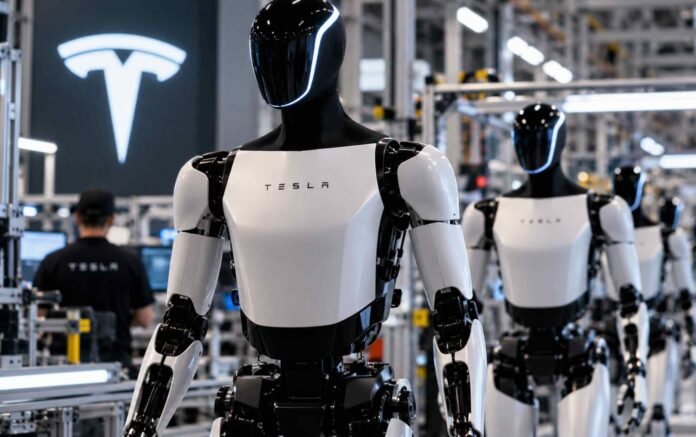
Tesla has started production of its Optimus humanoid robot at its Fremont factory in California, marking a significant step in the company’s ambition to expand beyond electric vehicles. However, the milestone comes as the automaker faces mounting costs from its investments in artificial intelligence, robotics and autonomous driving technology.
In its third quarter 2026 shareholder letter, Tesla said the first production quality Optimus robots had rolled off the manufacturing line. The company believes its current manufacturing process is suitable for a commercial product, although it expects further changes to the robot’s design and production methods.
CEO Elon Musk described the current phase as early production, warning that increasing output would be a gradual process. He also acknowledged that Tesla still needs to improve the robot’s reliability, durability and AI capabilities before it can perform a wide range of tasks independently.
The company has an ambitious target for the future. Musk said Tesla could eventually manufacture 20,000 Optimus robots per week by the end of 2027.
Yet the announcement arrives alongside disappointing financial results. Tesla reported third quarter revenue of $28.04 billion, slightly below the $28.09 billion recorded during the same period last year. Net income fell 43% year over year to $787 million, compared with $1.37 billion a year earlier.
The results highlight the challenge facing Tesla as it attempts to turn its robotics and AI ambitions into commercially successful businesses while maintaining its position in the electric vehicle market.
Tesla begins manufacturing Optimus robots in Fremont
Tesla’s Fremont facility, which has historically been associated with electric vehicle manufacturing, is now being used to produce its Optimus humanoid robots.
The company described the machines coming off the production line as its first production quality units. While Tesla expects to continue refining both the hardware and manufacturing process, it believes the current approach provides a foundation for commercial production.
Musk has cautioned that the production ramp will not be straightforward. Optimus represents a new category of product for Tesla, requiring improvements to mechanical design, software, manufacturing processes and safety systems.
A humanoid robot intended for practical use must do more than demonstrate impressive movements. It needs to perform tasks consistently, operate safely around people and remain reliable over extended periods.
Musk acknowledged that Tesla still has work to do to ensure the robots do not wear out prematurely. He also noted that the AI systems controlling them need further development before Optimus can reliably handle open ended tasks.
These challenges are important because Tesla’s longer term plans depend on the robots being useful outside carefully controlled demonstrations.
The company’s proposed production target of 20,000 units per week by the end of 2027 would represent a substantial manufacturing operation. Reaching that level will require Tesla to improve production efficiency while ensuring that the robots meet appropriate standards for reliability and safety.
For now, Tesla’s announcement marks the beginning of early production rather than proof that large scale commercial deployment is already within reach.
Tesla profits fall as AI and robotics spending increases
Tesla’s latest financial results reveal the pressure created by its investment strategy.
The company generated $28.04 billion in revenue during the third quarter, broadly in line with the $28.09 billion recorded a year earlier. Revenue was also slightly below the $28.23 billion reported in the previous quarter.
Net income, however, declined considerably. Tesla earned $787 million, representing a 43% year over year drop from $1.37 billion.
The company has been spending heavily on artificial intelligence, autonomous driving and Optimus development. These investments could create new sources of revenue in the future, but they also increase costs before their commercial benefits are fully established.
Electric vehicles remain central to Tesla’s business. Automotive revenue was approximately $20 billion, broadly flat compared with the previous year.
Tesla delivered 486,532 vehicles during the quarter. That was around 6,000 more than in the previous quarter, but fewer than the company delivered during the same period last year.
The company’s energy business also faced challenges. Revenue from solar and energy storage declined 16% year over year to $2.8 billion, which Tesla attributed to tariff related customer refunds.
There was more encouraging news from its services business, which includes subscriptions to its Full Self Driving driver assistance software. Revenue in this category increased 33% year over year to $4.6 billion, generating a record $734 million in gross profit.
However, those gains were not enough to offset the wider pressures on profitability. Lower regulatory credit sales also affected Tesla’s results.
The figures illustrate the balancing act facing the company. Tesla needs to maintain its established automotive business while funding projects that could eventually change how it generates revenue.
Optimus and autonomous driving remain long term bets
Tesla is positioning Optimus as part of a broader strategy centred on artificial intelligence and automation.
Humanoid robots could eventually be used for repetitive industrial tasks, material handling and other activities that require physical interaction with the surrounding environment. However, making them commercially useful requires significant progress in AI, movement control, safety and long term reliability.
Musk’s production ambitions suggest Tesla expects the manufacturing process to improve considerably over the next year. Nevertheless, production volume alone will not determine whether Optimus becomes a successful product. The company will also need to demonstrate that customers can use the robots reliably and that the economics make sense.
Autonomous driving is another major part of Tesla’s plans, but its consumer rollout continues to face delays.
Tesla currently offers a supervised version of Full Self Driving that requires drivers to remain attentive and ready to take control. The more advanced unsupervised system discussed by Musk would represent a significant step beyond that arrangement.
During the earnings call, Tesla’s AI software leadership discussed the possibility of privately owned vehicles joining the company’s robotaxi fleet after receiving a software update. Ashok Elluswamy, Tesla’s vice president of AI software, suggested that some customer vehicles could potentially participate around the second quarter of 2027.
That timeline remains a forward looking expectation rather than a confirmed launch date.
Musk had previously suggested in April that an unsupervised version could arrive during the fourth quarter of 2026. The latest discussion indicates that the rollout could take longer than he initially anticipated.
The distinction between supervised driver assistance and fully autonomous driving is important. Until the necessary capabilities and regulatory requirements are met, drivers must continue to follow the instructions and limitations associated with the system they are using.
Both Optimus and autonomous driving offer potentially significant opportunities for Tesla, but each requires further technical development before the company can fully realise its ambitions.
Tesla faces the challenge of turning ambition into profit
Tesla’s latest results present a company investing heavily in its future while facing pressure on its established business.
The start of Optimus production is an important manufacturing milestone, but it does not yet demonstrate that the robots can be produced at the scale Musk envisions or generate substantial revenue.
The same uncertainty surrounds Tesla’s autonomous driving ambitions. Improved software and AI capabilities could create new business opportunities, but delays show how difficult it can be to move from ambitious targets to dependable products.
The company also needs to manage its existing electric vehicle business, which remains a major source of revenue. Flat automotive revenue and lower vehicle deliveries compared with the previous year make the performance of its newer initiatives particularly important to investors.
Tesla’s services business provides one encouraging sign, with growth in subscriptions and other services helping diversify its revenue. Whether robotics and autonomous driving can eventually provide similarly meaningful contributions remains an open question.
The immediate challenge is to ensure that spending on new technology leads to products that customers can use and are willing to pay for. For Optimus, that means improving reliability, expanding production and proving that humanoid robots can perform useful tasks outside demonstrations.
For autonomous driving, it means delivering the promised capabilities while maintaining safety and meeting regulatory requirements.
Tesla has taken its first reported step towards manufacturing Optimus at production quality, but the financial results show that its wider transformation is still underway. The next phase will be judged not only by how many robots it can build, but also by whether its investments can translate into sustainable growth and stronger profitability.
Follow TechBSB For More Updates