
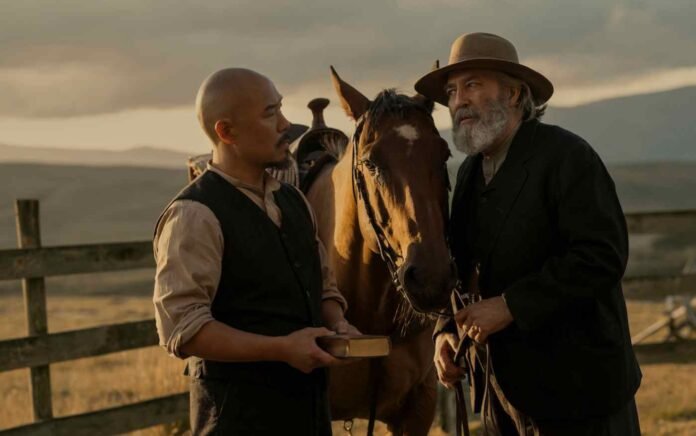
Zoe Kazan’s East of Eden brings John Steinbeck’s sprawling family drama to a painful but hopeful conclusion. The Netflix limited series follows the Trask family across generations, exploring jealousy, guilt, violence, love and the question of whether people are destined to repeat the sins of those who came before them.
At the heart of the story is one word: timshel.
The term becomes the key to understanding what happens to Cal Trask and why the ending matters. Rather than accepting that his family history has already decided his future, Cal is given another possibility. He can choose what happens next.
That idea becomes especially important after Cathy Ames, Adam Trask’s wife and the mother of Cal and Aron, spends years causing destruction around her. Her actions leave scars across the family, but the series also spends considerable time examining the experiences that shaped Cathy herself.
By the final episodes, almost every major character is forced to confront the consequences of their choices.
What happens to Cathy?
Cathy begins the story as one of its most mysterious and unsettling figures. After escaping a violent relationship, she arrives at the Trask family home badly injured. Adam immediately wants to protect her, while Charles remains suspicious of her motives.
Adam eventually marries Cathy, believing that he can build a happy life with her. Cathy sees things very differently. She wants independence and has little interest in becoming a wife or mother.
After giving birth to twin boys, Aron and Cal, Cathy decides to leave. Adam refuses to accept that she wants to walk away from their marriage, so Cathy shoots him and leaves him behind.
She then creates a new identity as Kate and eventually takes control of a brothel. The position gives her money and authority, but it also brings out the most destructive parts of her personality.
Cathy takes over the business after Faye, the woman who originally gives her protection, becomes the victim of Cathy’s manipulation. From that point, Cathy increasingly isolates herself behind fear, blackmail and suspicion.
Her final moments are deeply personal. Cathy becomes trapped in memories of her childhood and encounters a vision of her younger self. The series suggests that something traumatic happened to Cathy when she was very young, while deliberately leaving the precise details unresolved.
This does not erase responsibility for the terrible things Cathy does. Instead, the ending asks viewers to consider how trauma can influence a person without turning that history into an excuse.
Cathy eventually dies after taking a potion in a final act of escape from the world she has built around herself.
What happens to Cal and Aron?
The twin brothers grow up with completely different personalities.
Aron is seen as the ideal son. He is kind, admired and closely connected to his father. Cal, meanwhile, struggles with jealousy and insecurity. He feels that he is constantly living in his brother’s shadow.
The situation becomes even more painful when Cal discovers that their mother is still alive.
Cal visits Cathy’s brothel and comes face to face with the woman he believed was dead. The encounter leaves him horrified and forces him to question whether he has inherited her darkness.
Lee becomes crucial at this point. Instead of allowing Cal to believe that his bloodline has already determined his future, Lee reminds him of the meaning behind timshel.
Cal can choose.
That message does not immediately solve his problems, but it gives him a way to understand himself without believing that he is condemned to become Cathy.
The brothers’ relationship eventually collapses after Cal reveals the truth about their mother to Aron. Aron is devastated by the discovery and leaves college to join the army.
His decision has devastating consequences. Aron is killed, leaving Adam emotionally shattered.
How does East of Eden end?
Aron’s death pushes Adam into another health crisis, leaving him severely incapacitated. Cal is overwhelmed by guilt because he knows that his actions helped trigger the chain of events that led to his brother leaving home.
At first, Cal believes there is no way to repair what he has done.
Lee refuses to let him disappear into that guilt.
He brings Cal to Adam’s bedside and pushes father and son toward a final reconciliation. Adam struggles to speak, but manages to say the word that has been at the centre of the story from the beginning: timshel.
The meaning is crucial. Cal is not being told that everything he has done is acceptable. He is being told that his mistakes do not have to become the final definition of his life.
Cal has the ability to make another choice.
That is why the ending is ultimately more hopeful than tragic. The Trask family has spent generations repeating patterns of jealousy, resentment and violence. Adam repeated some of the failures of his own father. Cal fears that he has inherited Cathy’s darkness. But the final scene argues that inheritance does not have to become destiny.
The past matters, but it does not have complete control over the future.
What does timshel mean in East of Eden?
Timshel is the central idea behind Steinbeck’s story and the emotional foundation of the Netflix adaptation.
The word is connected to the biblical story of Cain and the question of whether human beings have the power to overcome sin. In the interpretation used by the story, timshel means thou mayest.
The phrase suggests possibility rather than certainty.
You may choose differently.
You may change.
You may reject the pattern that came before you.
That idea also explains why the series spends so much time exploring the relationship between parents and children. Adam, Charles, Cathy, Cal and Aron are all shaped by what they inherit from previous generations. Yet the story repeatedly returns to the possibility that people can make different choices.
Cathy’s story remains deliberately complicated. Her childhood experiences help explain aspects of her behaviour, but they do not remove the consequences of her actions. Cal faces a similar question from the opposite direction. He carries the fear that he is like Cathy, but the ending tells him that resemblance does not mean inevitability.
Adam’s final word therefore becomes more than a farewell. It is a message to his son.
Cal does not have to spend the rest of his life paying for the mistakes of his family.
He can choose what comes next.
That is the final message of East of Eden. Eden is not a place where nothing goes wrong. The story suggests that leaving Eden, experiencing failure and confronting painful truths may be necessary parts of becoming free.
The Trasks cannot change everything that has already happened. They can, however, decide what they do with what comes after it.
Follow TechBSB For More Updates