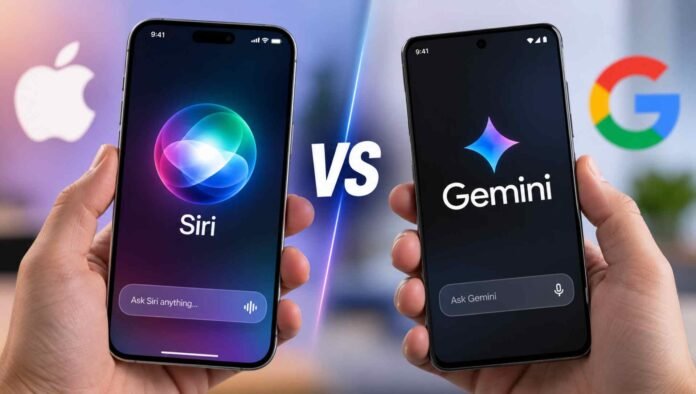
For years, Siri has been one of those Apple features that was easy to overlook. It was useful for simple requests, but rarely felt essential. Ask for the weather, set an alarm, send a message or settle a quick question, and Siri could usually handle it. Anything more complicated often meant reaching for a search engine or another app.
That experience appears to be changing with Apple’s new approach to Siri AI.
After spending time comparing Siri AI with Gemini on Android, one thing stands out. Apple is not necessarily trying to give users more choices. Instead, it is trying to remove choices from the experience altogether.
That may sound limiting, especially to people who use AI every day. But for ordinary users, it could be exactly what makes Apple’s approach more appealing.
Apple understands that most people do not care which AI model answers
One of the first things that can feel strange about the new Siri is how little it tells you about what is happening underneath.
There is no obvious model selector. You are not asked whether you want a faster model or a more powerful one. There is no menu filled with different versions and performance options.
You simply open Siri, type or speak your request and wait for the response.
For people who spend a lot of time experimenting with AI, that can initially feel frustrating. Different models can have very different strengths, particularly when you are writing code, analysing documents or working on complicated projects.
But most people are not comparing models before asking a question.
They want an answer.
That distinction is important. The average smartphone owner is unlikely to know the difference between an AI model designed for speed and one designed for deeper reasoning. They probably do not want to learn those differences either.
Apple appears to understand that.
The company can make those decisions in the background, selecting the appropriate technology without forcing users to understand the machinery powering the response.
That is a very Apple like idea. The complicated part exists, but the user does not have to deal with it.
Siri becomes more useful when you stop thinking about Siri
The bigger change is not necessarily the intelligence of Siri itself. It is how naturally the assistant fits into the iPhone.
On an iPhone, many people already have habits that require almost no thought. Swipe down, type something and continue. It might be an app, a contact, a setting or a question.
With the new Siri experience, that familiar behaviour becomes an entry point for AI.
This matters because good technology often disappears into a person’s routine.
When a feature requires users to remember where it is, which mode to select or which application to open, it becomes another task. When it appears exactly where users already expect it, adoption becomes much easier.
That is where Apple’s approach could have an advantage.
Siri is not presented as something completely separate from the operating system. It is becoming part of the way people interact with the device.
The same assistant can be reached through different parts of the Apple ecosystem, while conversations can remain connected through the Siri interface.
That consistency makes the technology easier to understand, even if users never think about the AI architecture behind it.
Gemini is powerful, but Android can make the experience feel fragmented
Google has arguably built a more ambitious AI platform with Gemini. There are more tools, more settings and more ways to interact with the technology.
For experienced AI users, that flexibility is valuable.
The problem is that flexibility can also introduce friction.
On Android, Gemini can exist as a dedicated application, while Google Search provides its own AI powered experiences. Voice access and device integration can involve different entry points and settings.
None of these individual choices are necessarily bad. In fact, they can be useful for people who want control.
The problem appears when a user simply wants to ask an AI assistant something without thinking about which Google product they are currently using.
The experience can feel less unified.
Apple’s approach is almost the opposite. Rather than presenting AI as a collection of separate capabilities, Siri is being positioned as a single doorway into the experience.
That does not automatically make Siri smarter than Gemini. It does, however, make the technology easier to approach.
For someone who is already comfortable with AI, that difference may seem insignificant. For someone who is uncertain about AI, it could be decisive.
Advanced users still need control
There is an important caveat to Apple’s strategy.
Hiding complexity works extremely well for mainstream users, but it should not come at the expense of people who need more control.
Developers, researchers, writers and other professionals sometimes need to choose a particular model for a particular job. They may care about speed, reasoning ability, context limits or output quality.
For those users, a completely automated system can feel restrictive.
There is also a larger lesson here. AI companies have spent a great deal of time competing on model names and benchmark scores. That competition matters, but consumers rarely want to spend their day thinking about it.
People generally want technology that solves the problem in front of them.
Apple seems to be betting that AI will become more successful when it becomes less visible.
That may ultimately be more important than having the longest list of models or the most impressive collection of settings.
The real test will be whether Siri consistently delivers useful results while staying out of the user’s way. If Apple can achieve that, the company may have understood something important about the next phase of AI.
The future of AI assistants may not belong entirely to the assistant with the most features.
It could belong to the one people barely notice they are using.
Follow TechBSB For More Updates