
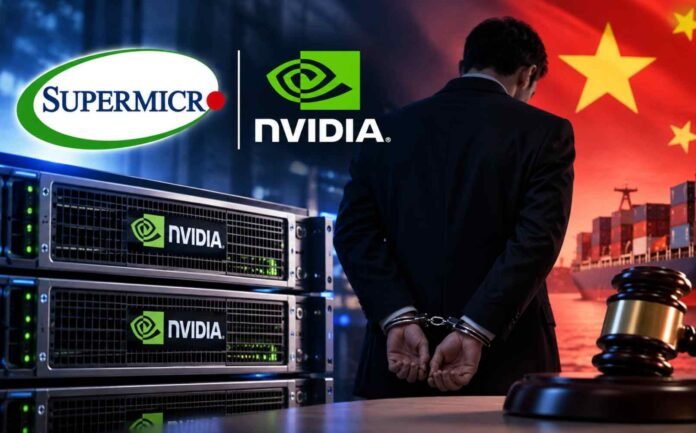
- Willy Sun pleaded guilty to four counts connected to an alleged scheme to export restricted AI servers to China.
- US prosecutors alleged that the scheme involved around $2.5 billion worth of American AI technology.
- The indictment also named Super Micro co founder Wally Liaw and sales manager Steven Chang.
- The case highlights US efforts to enforce export restrictions on advanced Nvidia chips amid growing competition with China over AI.
A contractor associated with Super Micro Computer has pleaded guilty to participating in a scheme to send advanced AI servers containing Nvidia chips to China without the required US export licences. The case highlights the growing scrutiny of technology exports as Washington seeks to limit China’s access to high performance computing hardware.
Ting Wei “Willy” Sun entered his guilty plea on Thursday in the US District Court for the Southern District of New York. According to a court filing reported by Reuters on October 9, Sun pleaded guilty to four counts involving conspiracies to violate export controls, smuggle goods out of the United States, defraud the country and obstruct justice.
The case centres on the alleged diversion of advanced computing equipment that US authorities have restricted from being exported to China. Such hardware is used to train and operate artificial intelligence models, making it strategically important to technology companies, researchers and governments.
Prosecutors charged Sun and two other individuals associated with Super Micro in March 2026. The indictment alleged that the group conspired to divert approximately $2.5 billion worth of US AI technology to China in violation of export laws.
The alleged operation began around October 2023. According to prosecutors, Sun and his associates arranged for servers manufactured in the United States to be shipped to China without obtaining the necessary licences.
The guilty plea marks a significant development in a case involving the international AI supply chain and the enforcement of US technology export restrictions.
Allegations Include Concealed Servers and False Statements
Prosecutors described Sun as a broker and fixer who helped coordinate orders and conceal the alleged export scheme. The indictment also outlined steps that were allegedly taken to mislead authorities during an inspection of servers that were supposed to be in storage.
According to the indictment, Sun helped stage dummy servers in December 2025. These machines were allegedly used to create the appearance that the equipment remained in the expected location, even though the actual servers had already been diverted to China.
The filing further alleged that Sun made false statements to an officer from the US Department of Commerce during the inspection.
These allegations illustrate the enforcement challenges authorities face when investigating international technology shipments. Advanced servers can move through complex commercial supply chains involving manufacturers, contractors, distributors and customers. Establishing where equipment ultimately ends up, and whether the appropriate export permissions were obtained, can require extensive investigation.
The case also underlines the importance of export compliance for companies operating in the AI hardware sector. Businesses involved in manufacturing, selling, transporting or reselling restricted equipment can face serious legal consequences when transactions breach applicable controls.
Sun’s guilty plea relates to his own role in the case. The allegations against other individuals must be considered separately, and the indictment’s broader claims should not be treated as proven against every person named in it.
Super Micro and Nvidia Face Continued Scrutiny
The case has drawn attention to Super Micro Computer, a US based manufacturer known for its high performance servers and systems used in data centres and AI computing.
Super Micro was not named as a defendant in the indictment, according to the company’s previous statements cited by Reuters. The company also said the case had not affected its business operations.
Following the emergence of the criminal case earlier in 2026, Super Micro terminated Sun and ended its relationships with the other defendants, according to the report.
The indictment also named Yih Shyan “Wally” Liaw, a Super Micro co founder, and Ruei Tsang “Steven” Chang, a sales manager at the company’s Taiwan office. Liaw co founded the company in 1993 and joined its board in 2023. Sun was working as a contractor.
Lawyers for Liaw and Chang were not immediately available for comment when Reuters sought responses. Sun’s lawyer declined to comment on the guilty plea.
Nvidia is also central to the case because the servers allegedly involved contained its advanced graphics processing units. The indictment identified the company’s B200, H100 and H200 chips, along with servers containing them, as products covered by the relevant restrictions.
There is no indication in the report that Nvidia itself was charged with wrongdoing in this case. The focus of the criminal allegations is the alleged conspiracy to divert restricted technology to China.
For companies across the AI hardware industry, the proceedings reinforce the distinction between manufacturing advanced chips and servers, and ensuring that those products are sold and delivered only through legally authorised channels.
US Export Controls Remain Central to the AI Race
The case comes amid intensifying competition between the United States and China over artificial intelligence. Both countries are investing heavily in AI research, computing infrastructure and technologies considered important to economic development and national security.
Advanced AI chips are a critical part of that competition. They provide the computing power needed to train large AI models and support demanding workloads across research, industry and other applications.
The US government has imposed restrictions on exports of certain advanced AI chips and related systems to China, citing national security concerns. These rules are intended to limit access to computing capabilities that Washington considers strategically sensitive.
The alleged diversion of servers containing Nvidia chips therefore raises questions that extend beyond a single criminal case. It highlights the difficulty of enforcing export restrictions when sophisticated hardware passes through international networks and multiple commercial intermediaries.
For hardware manufacturers, distributors and contractors, compliance involves more than processing an order or shipping a product. Companies must also account for applicable licensing requirements, end users and the intended destination of controlled technology.
The guilty plea could become an important part of the legal proceedings as authorities pursue the wider case. However, the outcome for the other defendants and any further corporate consequences will depend on subsequent legal developments.
For the AI industry, the broader message is clear: as advanced computing hardware becomes increasingly important to global competition, governments are likely to continue scrutinising how restricted chips and servers are sold, shipped and ultimately used.
The case also serves as a reminder that export compliance is a significant operational and legal issue for companies involved in the global AI supply chain. As demand for advanced computing systems grows, businesses will need to maintain effective oversight of transactions involving sensitive technology.
Follow TechBSB For More Updates