
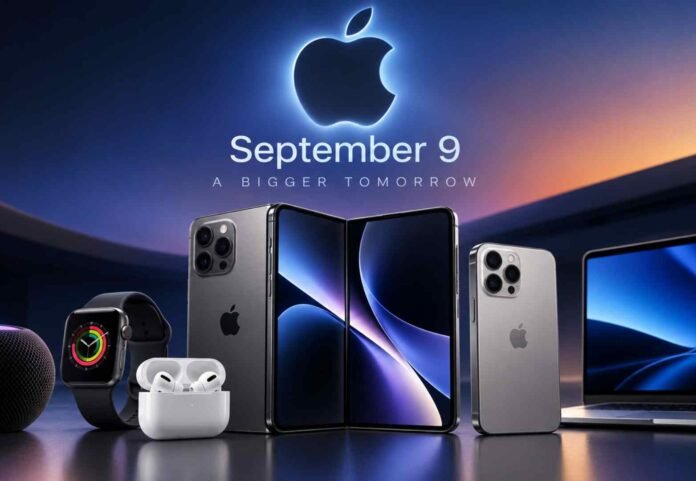
Apple’s September 9 event could mark the beginning of one of the company’s biggest product cycles in years. While the spotlight will naturally fall on the new iPhone lineup and Apple Watch models, the real story may be Apple’s long awaited move into new device categories.
The biggest reveal is expected to be Apple’s first foldable iPhone, reportedly known internally as the iPhone Ultra. Alongside it, Apple is expected to introduce the iPhone 18 Pro and iPhone 18 Pro Max, updated Apple Watch models, new AirPods and refreshed versions of the Apple TV and HomePod mini.
The event also matters because it comes just days after John Ternus takes over as Apple’s chief executive. Many of the products expected over the next few years have been developed under his leadership of Apple’s hardware teams, making this an important moment for the company’s next chapter.
The foldable iPhone could steal the show
The foldable iPhone is expected to be the headline product. Apple has reportedly been working on foldable devices for years, and the first model could finally bring the company into a market already established by rivals.
The design is expected to resemble a book style foldable, with a smaller external display and a larger screen on the inside. When folded, it is said to be roughly the size of a passport.
Apple is reportedly aiming for a more refined foldable experience rather than simply copying existing designs. A new hinge could make the display crease much less noticeable, while split view multitasking would take advantage of the larger internal screen.
The phone is expected to use an A20 Pro chip and Apple’s C2 modem. It could also feature Touch ID, along with standard and ultrawide cameras. A telephoto camera is reportedly not planned for the first generation.
The biggest obstacle could be the price. Reports suggest the foldable iPhone may cost more than $2,000, putting it firmly in Apple’s premium range.
iPhone 18 Pro focuses on performance and cameras
The iPhone 18 Pro and iPhone 18 Pro Max are not expected to receive a dramatic redesign. Instead, Apple appears ready to concentrate on improvements beneath the surface.
Both Pro models are expected to use the A20 Pro processor and Apple’s C2 modem. Better battery efficiency and improved thermal management could also be part of the upgrade, potentially allowing the phones to maintain high performance for longer periods.
Camera improvements could be another major selling point. Apple is reportedly exploring a mechanical aperture that would give users greater control over how much light reaches the sensor. The feature could also improve depth control and give photographers more flexibility.
New colour choices are expected too, including light blue and dark red options.
For buyers who prefer a familiar iPhone design but want the latest performance, the Pro models may be the safer upgrade. The foldable iPhone, however, is clearly positioned as the more experimental device.
Apple is preparing a much bigger product push
The September event may only be the first step in a much broader hardware expansion.
Apple Watch Series 12 and Apple Watch Ultra 4 are expected to receive new colours, ceramic case options and additional health and fitness capabilities. Apple is also working on improvements to Siri that could make the assistant more useful through AI powered features.
AirPods 5 are expected to refresh the more affordable end of Apple’s wireless earbud lineup. The camera equipped AirPods that have reportedly been in development are expected later rather than at this event.
The Apple TV and HomePod mini are also expected to receive relatively modest hardware updates. Faster processors could be more important than their unchanged designs, particularly because Apple is reportedly preparing to bring more AI powered Siri features to both products.
Beyond the September launches, Apple is working on an OLED iPad mini, new M6 Macs and its first MacBook Pro models with touch displays and OLED panels. A new smart home hub with a roughly 7 inch screen is also expected to become one of Apple’s most important new product categories.
The company is reportedly considering a range of form factors for the hub, including versions designed for a bedside table or wall mounting. Siri, widgets, FaceTime and smart home controls would form the core of the experience.
Apple’s roadmap extends well beyond 2026
The larger story is Apple’s increasingly ambitious hardware roadmap.
In 2027, the company is expected to change the way it launches its iPhone lineup by separating Pro models from the standard iPhone range. The regular iPhone 18 and iPhone 18e could arrive in spring, alongside a second generation iPhone Air.
Apple is also working on camera equipped AirPods, smart home security products and its first smart glasses. Unlike true augmented reality glasses, the initial glasses are expected to work without built in displays. Cameras and AI features could allow them to understand surroundings while handling calls, music and visual tasks.
The iPhone is also expected to receive a major redesign for its 20th anniversary. Apple could move toward curved glass around the edges and corners while reducing bezels, creating the most significant Pro design change since the iPhone X.
Foldable technology is expected to evolve as well. Apple is reportedly testing a second generation foldable iPhone and exploring a larger third generation model.
Further into the future, Apple is considering products including a robotic smart home hub, more powerful Mac Studio models and a lighter Vision Pro. A camera equipped AI pendant has also reportedly been explored.
A foldable iPad with a display approaching 20 inches has been discussed for years, although pricing, manufacturing complexity and practicality have reportedly created problems. It could still return to Apple’s roadmap if those challenges are solved.
Taken together, these plans suggest that Apple is moving beyond its traditional cycle of making familiar devices faster and thinner. The September 9 event could therefore be less about a single iPhone launch and more about the opening chapter of a much broader hardware strategy.
Follow TechBSB For More Updates