
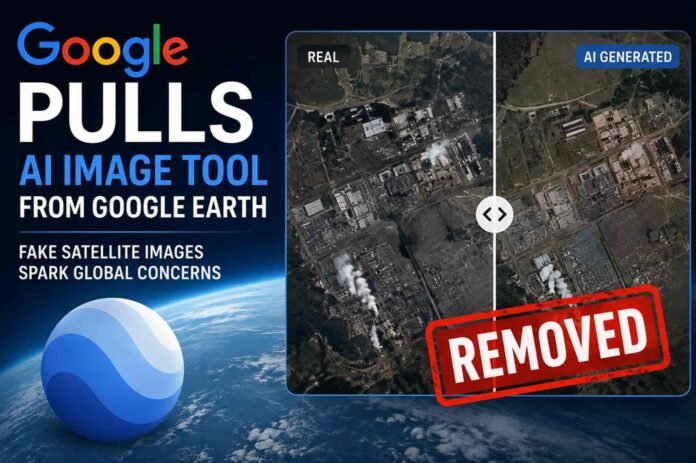
- Google removed its AI image generation feature for Google Earth within a day of launch.
- Realistic fake satellite images quickly raised concerns about misinformation and misuse.
- Experts warned the technology could undermine trust in satellite imagery used for verification.
- The incident highlights the growing need for stronger AI safety measures and content authentication.
Google has removed its newly introduced AI image generation feature for Google Earth less than 24 hours after its public debut. The decision came after the tool sparked widespread criticism over its ability to create highly realistic satellite images that could easily be mistaken for genuine aerial photography.
The feature was designed to let users generate custom satellite style visuals using artificial intelligence. While the technology showcased Google’s latest advances in generative AI, it also highlighted a growing challenge facing the industry. The line between authentic imagery and AI generated content is becoming increasingly difficult to recognize.
Almost immediately after the rollout, technology experts, researchers, and online users began sharing examples of convincing AI generated satellite images across social media platforms. Many warned that such images could spread misinformation, confuse the public, or even be misused in sensitive situations involving news reporting, emergency response, or geopolitical events.
The rapid backlash appears to have prompted Google to withdraw the feature while it evaluates its next steps.
Realistic AI Images Trigger Misinformation Fears
Satellite imagery has long been viewed as one of the most trusted forms of visual evidence. It is frequently used by journalists, governments, humanitarian organizations, and researchers to verify natural disasters, military activity, environmental changes, and infrastructure development.
Introducing an AI tool capable of producing convincing satellite style images raises serious questions about authenticity. Even if the feature was intended for creative purposes, realistic generated visuals could be taken out of context or deliberately presented as genuine evidence.
Experts have pointed out that fake satellite images could complicate fact checking efforts and make it harder to distinguish verified information from fabricated content. In situations where accurate imagery plays a critical role, the spread of convincing AI generated visuals could create unnecessary confusion before experts have the opportunity to verify the facts.
The incident also reflects a broader challenge facing AI developers as image generation models continue to improve at an extraordinary pace.
Google Faces Growing Pressure Over Responsible AI Development
The removal of the feature demonstrates how quickly technology companies may need to respond when new AI products produce unintended consequences. Although Google has invested heavily in responsible AI practices, the reaction suggests that safeguards surrounding advanced image generation remain under close scrutiny.
Technology companies are increasingly expected to anticipate potential misuse before releasing powerful AI tools to the public. Features that can generate realistic visual content often require clear labeling, usage restrictions, and technical protections that reduce the risk of deception.
The discussion extends beyond Google. Nearly every major AI developer is facing similar questions about balancing innovation with public trust. As generative AI becomes more capable, companies are under pressure to ensure their tools cannot easily contribute to misinformation campaigns or manipulated evidence.
Removing the feature shortly after launch may indicate that Google intends to revisit its safety measures before considering another release.
The Incident Highlights a Bigger Industry Challenge
The brief launch and equally rapid withdrawal of the AI image feature illustrates how sensitive generative AI has become when applied to trusted forms of information. Unlike artistic image generators, satellite imagery carries an expectation of accuracy because it is often used in decision making and public reporting.
As AI generated visuals become increasingly realistic, the demand for reliable verification methods is expected to grow. Digital watermarking, metadata standards, and stronger detection technologies are likely to play a more important role in helping users identify whether an image is authentic or AI generated.
For Google and the wider technology industry, the episode serves as a reminder that innovation alone is no longer enough. Public confidence depends not only on what AI can create but also on how responsibly those capabilities are introduced and managed.
The incident is likely to influence future discussions around AI governance, transparency, and content authenticity as companies continue expanding the capabilities of generative technology.
Follow TechBSB For More Updates