
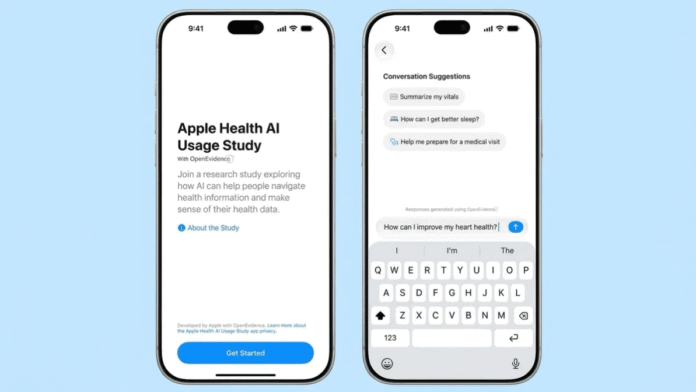
Apple Health AI Study App marks a new step in the company’s efforts to bring artificial intelligence into healthcare. Apple has introduced a dedicated research app that allows iPhone users to ask health related questions, understand symptoms and receive personalised suggestions through an AI powered chatbot.
The new app has been developed in collaboration with OpenEvidence, a clinical AI platform. While Apple has not officially introduced its long rumoured Health+ service, this research initiative could offer an early look at how the company plans to combine artificial intelligence with its existing health ecosystem.
Unlike a conventional AI chatbot, the Apple Health AI Study App is designed around medical research and clinical guidelines. Users can ask questions about health conditions, symptoms and general wellbeing, with responses presented in straightforward language and supported by references to peer reviewed medical research.
Privacy is another major part of the initiative. Apple says information shared through the research programme will remain confidential and will not be used to train AI models. The company is also allowing participants to decide which health information they want to share.
However, access is currently restricted. The research programme is open to eligible US residents aged 21 or older, and Apple is accepting a maximum of 200,000 participants. Users will also need a compatible iPhone to take part.
Apple Health AI Study App brings medical research to an AI chatbot
Apple’s latest health initiative could make it easier for people to understand medical information without having to navigate complicated research papers or technical terminology.
The Apple Health AI Study App allows participants to ask questions about their symptoms, existing health conditions and other medical concerns. The chatbot then generates responses using information drawn from peer reviewed clinical research and established medical guidelines.
One particularly useful aspect is the way the app presents its answers. Instead of providing complicated medical explanations, it aims to communicate information in approachable language that ordinary users can understand.
Importantly, the responses also include references to clinical research. This gives users an opportunity to examine the supporting evidence rather than relying entirely on an AI generated answer.
That could make the experience more useful than asking general health questions through a standard chatbot. Medical information needs to be accurate, understandable and supported by reliable evidence, particularly when people are using it to make decisions about their wellbeing.
The app could also help users prepare for appointments with healthcare professionals. Rather than arriving at a consultation without knowing what to ask, participants may be able to use the chatbot to organise their concerns and better understand their health information.
However, Apple makes an important distinction about the app’s purpose. It is a research tool, not a replacement for professional medical care. Its responses should not be treated as medical advice, a diagnosis or a treatment recommendation.
HealthKit integration could make Apple’s AI more personal
One of the most interesting features of the new app is its optional integration with Apple’s HealthKit platform.
Users can choose to share health information collected through their iPhone and Apple Watch, giving the AI additional context when answering questions.
This information can include resting heart rate, physical activity and sleep data. By considering these measurements alongside a user’s questions, the chatbot could offer more relevant insights into general health and lifestyle habits.
For example, someone trying to improve their daily routine could use the available information to explore personalised exercise and meal plans. Similarly, users preparing for a medical appointment could use their recorded health metrics to organise relevant information before speaking with a doctor.
The ability to connect different types of health information is potentially one of the biggest advantages of Apple’s approach.
Traditional chatbots generally depend on the information users provide during a conversation. HealthKit integration gives Apple’s research app the option to consider additional information from the user’s existing health records.
However, sharing this information is optional. Participants can choose what they want to provide, rather than automatically giving the chatbot access to every available health measurement.
This is particularly important because health information is among the most personal data people store on their devices.
Privacy is central to Apple’s new health research programme
Apple is placing considerable emphasis on privacy with its new AI health initiative.
The company says information shared through the study will remain confidential and that participant responses will not be used to train AI models.
This is an important distinction at a time when AI services increasingly rely on large amounts of user information to improve their systems.
Health related conversations can contain sensitive details about medical conditions, symptoms, medication and personal circumstances. Users may understandably hesitate before sharing such information with an AI service.
Apple’s decision to emphasise confidentiality and optional data sharing could help address some of those concerns.
The collaboration with OpenEvidence is also significant. The platform focuses on clinical AI, giving the research initiative access to a foundation built around medical literature and evidence based information.
Still, users should understand the limitations of the technology. Even when an AI system relies on peer reviewed research and clinical guidelines, its answers are not guaranteed to be correct in every situation.
Apple explicitly states that neither the application nor the research study provides medical advice, diagnosis or treatment. Anyone experiencing concerning symptoms or requiring medical attention should consult a qualified healthcare professional.
For now, the app should be viewed as a health information and research tool rather than a digital doctor.
Who can download the Apple Health AI Study App?
Although Apple has made the research app available for sign ups, participation is currently limited to a specific group of users.
The programme is open to US residents aged 21 or older, and Apple is initially accepting up to 200,000 participants.
There are also hardware and software requirements. Users need an iPhone 15 Pro or a newer compatible model running iOS 26 or later.
This means owners of older iPhone models will not be able to participate in the initial study, even if their devices support Apple’s other health features.
The participant limit is another important consideration. With only 200,000 places available, interested users may want to register sooner rather than later.
The timing of this launch is particularly interesting because Apple has faced growing expectations surrounding its AI ambitions. The company has been rumoured to be developing a more comprehensive AI powered Health+ service for some time, although that product has yet to appear.
The new study app does not necessarily confirm that Health+ is coming, but it does provide an indication of how Apple is exploring AI driven healthcare experiences.
If the research proves successful, Apple could eventually use what it learns to develop more advanced health features across its ecosystem.
For iPhone and Apple Watch users, the prospect of having an AI assistant that understands personal health measurements and explains medical research in simpler language is certainly appealing.
However, the bigger challenge will be maintaining accuracy, protecting sensitive information and making sure users understand the limitations of AI generated health guidance.
For now, Apple’s Health AI Study App offers an interesting preview of what the future of digital healthcare could look like. Whether it eventually becomes part of a wider Health+ experience remains to be seen.
Follow TechBSB For More Updates