
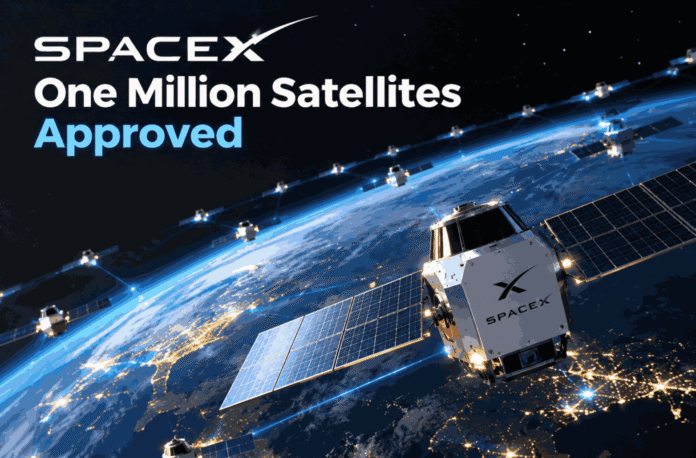
SpaceX has secured a major regulatory victory after the US Federal Communications Commission (FCC) authorised the company to deploy up to one million satellites in low Earth orbit. The ambitious project, known as Starmind, aims to establish a network of data centres in space, potentially changing how computing infrastructure is built and powered as demand for artificial intelligence continues to grow.
The FCC announced its decision on 25 November 2026, approving SpaceX’s proposal to develop an enormous satellite constellation designed to process data beyond Earth’s atmosphere. The decision marks a significant step towards Elon Musk’s vision of moving some of the world’s computing infrastructure into orbit.
Unlike the company’s existing Starlink satellites, which primarily provide internet connectivity, the proposed Starmind network is designed to perform computing tasks. Its satellites will carry orbital computing modules capable of processing large amounts of information before transmitting the results back to Earth.
The scale of the proposal is particularly striking. SpaceX is seeking to establish a constellation of up to one million satellites, making it one of the most ambitious commercial space infrastructure projects ever proposed.
SpaceX plans to take AI computing beyond Earth
The idea behind Starmind is relatively straightforward. Instead of relying entirely on enormous data centres built on the ground, SpaceX wants to place computing infrastructure in orbit. These satellites would use solar energy to power their operations and communicate with one another through high-speed optical links.
The company believes this approach could help address the growing energy demands of artificial intelligence. As AI models become more sophisticated, the infrastructure required to train and operate them is becoming increasingly demanding. Data centres need substantial electricity, cooling systems and physical space, creating challenges for technology companies looking to expand their computing capacity.
SpaceX sees orbit as a possible alternative. Satellites positioned in suitable orbits could receive sunlight for extended periods, potentially reducing their dependence on conventional electricity infrastructure. The company also argues that space-based computing could offer better energy efficiency and lower operating costs over time.
The proposed Starmind constellation is expected to rely primarily on optical inter-satellite links. These connections would allow satellites to communicate directly with other spacecraft, including members of SpaceX’s existing Starlink networks.
The FCC’s authorisation covers a constellation operating across several orbital shells, at altitudes ranging from approximately 500km to 1,002km above Earth. This would create a substantial network of interconnected computing satellites rather than a collection of isolated spacecraft.
However, the technology remains at an early stage. Building a functioning orbital data centre network will require more than simply launching satellites. SpaceX must demonstrate that the hardware can handle demanding computing workloads, maintain reliable connections and operate safely over extended periods.
FCC approval comes with strict deployment deadlines
Although the FCC has approved SpaceX’s ambitious proposal, the authorisation is not an unrestricted licence to launch one million satellites immediately.
The regulator has established a series of deployment milestones that the company must meet to retain its approval. SpaceX must place and operate its first authorised Starmind satellite by 25 November 2033.
The requirements become considerably more demanding after that initial deployment.
By November 2035, SpaceX must have 10% of its authorised constellation operational, equivalent to 100,000 satellites. The company must reach 50% deployment by November 2038 before completing the full constellation by 25 November 2040.
These deadlines give SpaceX approximately 14 years to build the network to its approved maximum size.
The FCC has also imposed conditions relating to communications and interference. Starmind will primarily use optical connections, while authorised Ka-band frequencies will provide backup and emergency telemetry, tracking and command capabilities. SpaceX must coordinate with relevant federal operators and avoid causing harmful interference to other systems.
Another important part of the decision concerns satellite disposal. SpaceX requested permission to use alternative disposal methods for satellites operating above 600km, including moving retired spacecraft into different Earth or solar orbits.
The FCC deferred that particular request because it did not consider the information supplied by SpaceX sufficient to establish whether the proposed alternatives would satisfy its requirements. The company will need further approval before operating satellites that will not be disposed of through atmospheric re-entry.
These conditions highlight that regulatory approval is only one part of the challenge. SpaceX must still prove that its plans can work at an unprecedented scale.
Environmental and technical concerns remain unresolved
The project has attracted criticism from several organisations and industry competitors. Amazon Leo, Viasat and the American Astronomical Society were among those that raised objections during the FCC’s review.
One of the biggest concerns is the potential impact of such a large satellite constellation on Earth’s orbital environment. Deploying one million satellites would introduce an enormous number of additional objects into low Earth orbit, increasing the importance of collision avoidance and space traffic management.
Even a relatively small number of collisions could create significant problems. Damaged satellites can produce debris that threatens other spacecraft, potentially making certain orbital regions more difficult to use. With so many satellites operating simultaneously, maintaining safe distances and coordinating movements would become a considerable challenge.
Astronomers have also expressed concerns about the impact of large satellite networks on observations of the night sky. Bright satellites can leave trails in astronomical images, affecting research and observations carried out by ground-based telescopes.
Environmental questions have also become part of the debate. Launching and eventually replacing such a large number of satellites could require substantial rocket activity. Researchers have raised concerns about emissions from launches and the atmospheric effects of satellites burning up during re-entry.
The FCC nevertheless granted the application, concluding that the issues raised did not provide sufficient grounds to reject the proposal within the scope of its regulatory authority. The commission also imposed reporting requirements covering satellite deployments, orbital movements, conjunction events and spacecraft re-entries.
These concerns are unlikely to disappear simply because SpaceX has received approval. The company will need to demonstrate that it can manage the constellation responsibly as the network expands.
Can SpaceX actually build one million satellites?
Perhaps the biggest question is whether SpaceX can turn its proposal into a working network.
The company has considerable experience deploying large satellite constellations through Starlink. Its reusable rocket technology has also helped reduce the cost of accessing space. However, building a network containing one million computing satellites would represent a much greater undertaking than expanding an existing broadband service.
SpaceX will need to manufacture enormous numbers of spacecraft, develop reliable computing hardware, coordinate launches and maintain the network over several years. It will also need to establish an effective way of handling heat generated by computing equipment in space.
Cooling is particularly important because computing hardware produces substantial heat during operation. Although space offers access to solar energy, removing heat from equipment in a vacuum presents engineering challenges that conventional terrestrial data centres do not face in quite the same way.
The development of Starship could play an important role in making the project financially and logistically achievable. SpaceX is counting on its next-generation launch system to provide the capacity needed for large-scale satellite deployment.
For now, the FCC decision gives the company regulatory permission to pursue its vision, rather than proving that the entire system is commercially or technically viable.
If successful, Starmind could introduce an entirely new approach to computing infrastructure, with implications for AI development, satellite communications and the wider space industry. However, the enormous cost, engineering requirements and environmental questions mean that the road ahead will be challenging.
The coming years should reveal whether orbital data centres can move beyond an ambitious concept and become a practical part of the global computing industry.
Follow TechBSB For More Updates