
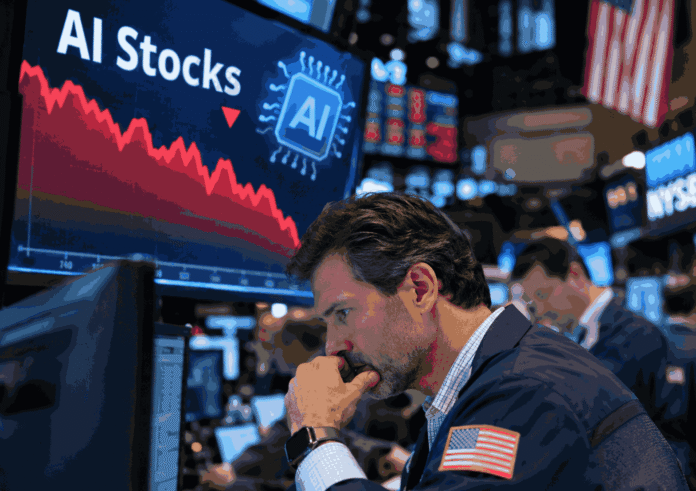
The artificial intelligence (AI) stock sell-off gathered pace on Wednesday, November 25, as investors grew increasingly concerned about the enormous costs of building AI infrastructure, mounting debt and whether technology companies can turn their massive investments into sustainable profits. However, a late afternoon recovery helped limit some of the damage after several major technology stocks suffered sharp early losses.
The latest market turbulence reflects a growing shift in investor sentiment. After months of enthusiasm surrounding artificial intelligence, Wall Street is beginning to scrutinise the financial commitments behind the industry’s rapid expansion. Companies that once benefited from aggressive spending plans are now facing tougher questions about profitability, borrowing costs and future demand.
Anthropic, the artificial intelligence company that recently went public, experienced a particularly volatile trading session. Its shares fell to $73.85 shortly after the opening bell, approximately 11% below their initial offering price. However, the stock recovered during the afternoon and finished the session 1% higher at $82.19.
Other major technology companies were less fortunate. Alphabet dropped 4.7% at its lowest point during the session, reaching a fresh 52 week low before recovering to close 2.1% lower. Broadcom also experienced significant selling pressure, falling 5.8% before recovering to finish the day broadly unchanged.
The Nasdaq Composite ended Wednesday down 0.6%, despite falling as much as 4.6% earlier in the session. The Nasdaq 100 followed a similar pattern, recovering from a decline that briefly brought it close to a 20% fall from its October record high.
AI Infrastructure Spending Raises Fresh Questions About Profitability
The latest decline highlights growing concerns about the financial foundations of the AI boom. Technology companies have committed enormous sums to data centres, advanced processors, cloud computing infrastructure and specialised hardware. While these investments are intended to support growing demand for AI services, investors are increasingly questioning how quickly companies can generate enough revenue to justify the spending.
A significant part of the concern centres on debt financing. Several companies involved in building AI infrastructure have relied heavily on borrowing to fund expansion plans. Although debt can accelerate growth, it also increases financial risk, particularly when interest costs remain high and expected returns take longer to materialise.
The pressure has become especially visible among neocloud providers. These companies rent specialised computing capacity to businesses developing and operating AI applications. Their business models depend on securing substantial funding to purchase equipment and expand data centre capacity.
However, investors are becoming less comfortable with the amount of capital required to sustain this growth.
Todd Schoenberger, chief investment officer at CrossCheck Management, highlighted the growing disconnect between aggressive corporate spending and the need to demonstrate meaningful returns.
He noted that companies appear increasingly focused on outspending their competitors, but investors want clearer evidence that these investments will generate sufficient financial benefits.
That uncertainty has contributed to selling pressure across several parts of the AI ecosystem, including semiconductor manufacturers, cloud providers and companies specialising in data centre infrastructure.
Nvidia, Alphabet and Semiconductor Stocks Face Heavy Selling
Nvidia was among the major companies affected by Wednesday’s sell-off. The chipmaker’s shares dropped as much as 8.5%, reaching a fresh low before recovering to close 3.9% lower.
Nvidia remains central to the AI infrastructure market through its processors and partnerships with major technology companies, including OpenAI. However, its share price has become increasingly sensitive to concerns about the sustainability of AI infrastructure spending.
Broadcom also faced considerable pressure during the session. The semiconductor company, which was one of the biggest beneficiaries of the industry’s earlier rally, experienced a steep intraday decline before recovering.
The Philadelphia Semiconductor Index fell approximately 7% at its lowest point, reaching a more than seven month low. Although it recovered towards the end of trading, the index still finished lower and has declined more than 43% from its record high in June.
Other major technology companies also remained under pressure.
Oracle shares declined 5%, while Amazon fell 3%. Both companies have significant exposure to cloud computing and AI infrastructure investments.
The weakness suggests that investors are increasingly looking beyond individual company earnings and focusing on the wider financial risks associated with the industry’s expansion.
Interestingly, even companies reporting positive financial results have struggled to escape the broader market decline.
Dell Technologies initially fell 5.7%, despite raising its annual revenue and profit forecasts for the third time this year. The company also approved an additional $25 billion share buyback programme.
Dell eventually recovered to finish 0.6% higher. Its shares have more than doubled during the year, demonstrating how strongly investor expectations had risen before the latest correction.
Hewlett Packard Enterprise experienced a much sharper setback on Tuesday, with shares falling 16.3% despite raising its full year revenue outlook.
These developments suggest that strong financial results alone may no longer be enough to support elevated valuations across the AI sector.
Rising Debt Risks Put Neocloud Companies Under Pressure
The financial challenges facing AI infrastructure companies have become another major source of market anxiety.
SoftBank, a major investor in OpenAI and chip designer Arm, fell 14% during overnight trading in Tokyo. The decline reflected concerns about the financial commitments associated with the AI industry and the possibility that OpenAI could face increasing resistance as it attempts to raise additional funding.
SoftBank’s shares have already fallen more than 40% this year, highlighting the pressure facing investors with substantial exposure to the AI sector.
Neocloud companies have also experienced significant volatility. CoreWeave and Nebius Group both dropped more than 10% during Wednesday’s session before recovering some of their losses. CoreWeave finished broadly unchanged, while Nebius closed 2.7% lower.
Other companies, including IREN, Applied Digital and Core Scientific, experienced more limited movements after early declines.
Credit markets are also showing signs of increasing stress. According to Tradeweb data, the yield on CoreWeave bonds maturing in 2031 climbed to almost 18%, while bond prices fell close to record lows.
Higher bond yields indicate that investors are demanding greater compensation for taking on the risk of lending money to the company.
The cost of protecting against potential defaults has also increased across several major technology companies. Five year credit default swap spreads for Oracle, Alphabet, SpaceX and CoreWeave reportedly reached record levels.
This development is particularly important because concerns about AI investment are no longer limited to stock market valuations. Investors are also reassessing the borrowing capacity and creditworthiness of companies financing the industry’s expansion.
Tariffs and Inflation Add to Market Uncertainty
The technology sell-off was also influenced by broader economic and political developments.
The Trump administration’s proposal to introduce additional tariffs on imports from 14 trading partners added another layer of uncertainty for investors. Higher import costs could affect technology manufacturers and companies that depend on international supply chains.
Meanwhile, US inflation increased further in October, according to the latest economic data. This raised additional concerns about the economic outlook and the potential impact of borrowing costs on businesses.
Political developments have also contributed to the changing investment environment. Democratic victories in US midterm elections have increased expectations of stronger regulation and potentially higher costs for parts of the AI industry.
Together, these factors have weakened the optimistic outlook that previously supported technology valuations.
The Nasdaq Composite reached a record closing high on October 6, but sentiment has deteriorated considerably since then. Selling accelerated during the second half of November as investors began reassessing the sustainability of the AI rally.
Despite Wednesday’s afternoon recovery, the broader market remains under pressure. The latest developments suggest that investors are becoming more selective about which AI companies deserve premium valuations.
The long term prospects for artificial intelligence remain significant, but the market’s expectations are changing. Companies will increasingly need to demonstrate that their infrastructure investments can translate into consistent revenue, stronger margins and sustainable cash flows.
For investors, the next phase of the AI market may depend less on ambitious spending announcements and more on tangible financial performance.
Follow TechBSB For More Updates