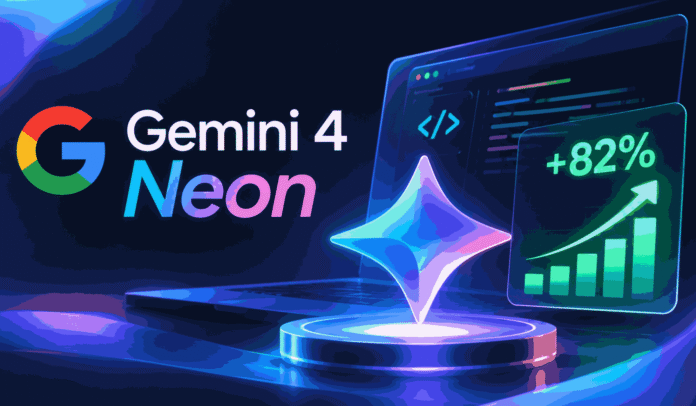
Google Gemini 4 Neon is off to a strong start, setting a new first day usage record across the company’s paid APIs. The latest model is also attracting growing interest from developers, with daily token consumption on Google’s Antigravity coding platform climbing 82% since the launch of Gemini 4 Argon six weeks ago.
The figures point to increasing demand for Google’s latest artificial intelligence models, particularly among developers and users looking for more capable reasoning and coding tools. Google CEO Sundar Pichai shared the usage milestone, highlighting the early momentum behind Neon and the wider Gemini ecosystem.
The company has been steadily expanding access to the new model since its initial release on November 18. What began as a rollout across developer platforms and paid subscriptions has now reached Google Workspace users, bringing Gemini 4 Neon to a broader audience.
Google Gemini 4 Neon Makes a Strong First Day Impression
Gemini 4 Neon has made an impressive entrance, becoming the most successful first day launch in terms of usage across Google’s paid APIs. The milestone suggests that developers and businesses are keen to explore what the latest model can offer, particularly as competition in the AI market continues to intensify.
According to Pichai, daily token volume on Antigravity has increased by 82% since Gemini 4 Argon arrived six weeks ago. This is a notable jump for Google’s coding platform, where token consumption provides an indication of how extensively users are working with AI-powered development tools.
The increase also suggests that Google’s latest releases are encouraging existing users to spend more time with its AI services. Rather than relying solely on new sign-ups, the company appears to be seeing deeper engagement from people already using its developer ecosystem.
Google started rolling out Gemini 4 Neon on November 18 through several key products and services. These included the Gemini API, Google AI Studio and Vertex AI, alongside paid Google AI Pro and Ultra subscriptions.
On November 23, the company extended availability to Google Workspace users through the Gemini app. This expansion is particularly important because it introduces the model to people who may use AI primarily for everyday productivity rather than software development.
For Google, the rollout represents another step towards making its most advanced AI capabilities available across both consumer and enterprise products.
Perplexity Users Are Showing Growing Interest in Neon
Google is not the only company reporting increased interest in Gemini 4 Neon. Perplexity has also seen a noticeable rise in user activity involving the model, even before it became the platform’s default choice for certain tasks.
Between November 19 and November 22, user generated queries selecting Neon grew at a daily compound rate of 10.6% for fast search. The growth was even stronger for Computer agentic tasks, reaching 15% per day during the same period.
These figures suggest that users were actively choosing Neon when given the option, rather than simply interacting with it because a platform automatically selected it.
Perplexity CEO Aravind Srinivas described the trend as users voting with their feet. He suggested that much of the interest came from people moving away from competing AI models, including Anthropic’s Claude Opus 5.5 and OpenAI’s GPT 6.2 Sol.
This is an interesting development for the wider AI industry. Model adoption is no longer determined entirely by which company has the biggest marketing campaign or the largest user base. The quality of responses, reasoning capabilities, speed and overall experience increasingly influence which models people choose.
Perplexity’s figures also highlight the importance of third party platforms in determining how successful an AI model becomes. A model that attracts strong demand outside its developer’s own ecosystem could have a significant advantage over competitors.
However, early usage figures do not necessarily guarantee long term adoption. Sustaining this momentum will depend on how reliably Neon performs across different workloads and whether users continue to prefer it after the initial excitement fades.
Gemini 4 Neon Pricing and Performance Put It in the Spotlight
Google has positioned Gemini 4 Neon as a competitive option for developers and businesses, with pricing that makes it worth considering for applications involving substantial AI workloads.
The model costs $3 per million input tokens and $15 per million output tokens. It also comes with a context window of one million tokens, allowing it to process large amounts of information within a single interaction.
Gemini 4 Neon: Key specifications
| Specification | Details |
|---|---|
| Input Pricing | $3 per million tokens |
| Output Pricing | $15 per million tokens |
| Context Window | 1 million tokens |
| Artificial Analysis Score | 61 (xhigh reasoning setting) |
Performance is another area where Neon appears to be making an impression. According to the supplied report, it achieved a score of 61 at its xhigh reasoning setting on the Artificial Analysis Intelligence Index, placing it third overall.
The model also secured first place with a score of 5 in another benchmark category, although the available report does not identify the full benchmark name or provide enough information to assess that result independently.
These results indicate that Google is aiming to compete at the highest end of the AI market, particularly in areas where reasoning and complex problem solving matter.
The one million token context window could also make Neon attractive for developers working with large codebases, lengthy documents and complicated research tasks. Instead of splitting information into numerous smaller prompts, users may be able to provide substantially more context in a single request.
That said, benchmark results are only one part of the picture. Real world performance, response consistency, latency and operating costs will ultimately determine whether developers adopt the model for production workloads.
Google’s Expanding Gemini Ecosystem Faces Tough Competition
Gemini 4 Neon is Google’s fourth Gemini 4 release in just seven weeks, showing how quickly the company is moving to strengthen its position in the generative AI market.
The rapid release schedule reflects the pressure on major AI companies to deliver improvements without allowing competitors to gain too much ground. OpenAI and Anthropic are continuing to develop their own advanced models, while platforms such as Perplexity are giving users more opportunities to compare and switch between different AI systems.
For Google, the latest usage figures are encouraging. Record first day paid API activity, increased Antigravity token consumption and rising demand through Perplexity suggest that Neon is gaining attention beyond Google’s own products.
The Workspace rollout could provide another source of growth. Bringing the model to a wider group of professionals creates opportunities for everyday use cases, including writing, research, data analysis and document management.
There is also a commercial advantage to making Gemini available across multiple services. Developers can access the model through APIs and Vertex AI, while individual subscribers and business users can explore its capabilities through Google’s consumer and productivity products.
Still, the bigger challenge will be maintaining the momentum. Google’s competitors are unlikely to stand still, and users can move between AI models relatively easily when alternatives offer better results or more attractive pricing.
Gemini 4 Neon has delivered a promising opening performance, but its long term success will depend on whether Google can turn early enthusiasm into sustained usage.
For now, the 82% increase in Antigravity token volume and the record breaking paid API launch give Google a positive signal. The company appears to be building meaningful momentum in a market where developer adoption and everyday usefulness matter just as much as benchmark scores.
Follow TechBSB For More Updates