
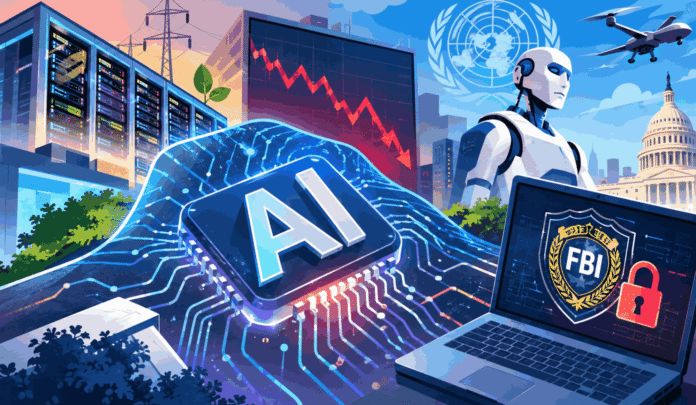
The artificial intelligence industry is entering a defining period as record breaking valuations, growing political pressure and cybersecurity threats reshape the global technology landscape. Anthropic’s historic stock market debut has brought renewed attention to the financial power of AI companies, while governments worldwide are struggling to balance technological progress with public concerns about energy consumption, national security and responsible innovation.
Several major developments have emerged across the technology sector, ranging from Anthropic’s growing influence in the financial markets to an apparent cyberattack targeting a critical FBI database. Meanwhile, disagreements over AI regulation, military applications and semiconductor exports highlight how deeply artificial intelligence has become connected to economic and geopolitical priorities.
Here are the biggest technology developments and what they could mean for businesses, investors, governments and the wider AI industry.
Anthropic’s Record IPO Raises Expectations of a Massive Philanthropic Windfall
Anthropic’s extraordinary stock market debut is creating opportunities that extend well beyond the financial markets. The company, best known for developing the Claude AI assistant, has reached a valuation of approximately $1.75 trillion following its first day of trading, marking one of the biggest public offerings in financial history.
The company’s success is also generating expectations of a significant increase in charitable giving. Anthropic has pledged 5% of its shares towards philanthropy, while its seven co-founders have committed to donating 80% of their equity.
The potential financial impact could be substantial. As the company’s valuation increases, the value of these commitments could translate into billions of dollars for charitable organisations and social initiatives.
Anthropic employees who have accumulated valuable company shares could also become significant contributors to philanthropic causes. Their growing financial resources may encourage a new generation of technology entrepreneurs and employees to support education, scientific research, healthcare and other public interest projects.
However, nonprofit organisations are approaching these expectations cautiously. A large financial commitment does not automatically translate into immediate donations. Managing substantial charitable contributions requires planning, infrastructure and careful decisions about where funding can make the greatest difference.
Nevertheless, the emergence of wealthy AI entrepreneurs could change traditional philanthropic practices. Organisations that previously depended on established foundations and long term funding arrangements may increasingly receive support from technology executives and employees willing to distribute their wealth more quickly.
Anthropic’s IPO therefore represents more than a financial milestone. It could mark the beginning of a new era in which artificial intelligence wealth becomes an important source of global philanthropic funding.
Trump’s Proposed Tax Threat Raises Questions About Overseas AI Data Centres
The rapid expansion of artificial intelligence infrastructure is creating a political challenge for the United States.
President Donald Trump has warned that American technology companies building AI data centres outside the country could face what he described as a tremendous tax. The announcement signals a tougher approach towards overseas infrastructure investments, although the administration has not yet provided specific details about how the proposed measure would work.
The issue highlights the growing importance of data centres in the global AI race. Advanced AI systems require enormous computing capacity, specialised chips and reliable electricity supplies. Technology companies are therefore investing heavily in infrastructure across different countries to support growing demand.
However, these investments are becoming increasingly controversial within the United States.
Large data centres require significant amounts of electricity and water. Their construction can also place additional pressure on local power networks, potentially increasing infrastructure costs for surrounding communities.
Public opposition has grown as residents question whether these facilities deliver enough economic benefits to justify their environmental and energy requirements.
The political debate has also intensified following the midterm elections, with several Democratic politicians promising stronger oversight of data centre construction.
Trump’s position reflects a complicated balancing act. The administration wants American companies to remain competitive in artificial intelligence, but it also wants major infrastructure investments to support domestic economic interests.
Any additional tax on overseas facilities could influence where technology companies choose to build their next generation of AI infrastructure.
For the industry, the central question is whether governments can encourage technological investment without creating unnecessary barriers to global expansion.
Stock Market Correction Raises Fresh Concerns About the AI Investment Boom
The US stock market has experienced a 10% decline from its recent high, bringing renewed attention to the risks associated with expensive technology stocks and the artificial intelligence investment boom.
Wall Street describes a decline of this size as a market correction. Although such movements are not unusual, they often encourage investors to reconsider their expectations about company valuations and future earnings.
Artificial intelligence has been a major driver of market enthusiasm over recent years. Companies developing advanced AI models, manufacturing semiconductors and building computing infrastructure have attracted enormous investor interest.
However, concerns are growing about whether some technology companies have become too expensive relative to their actual financial performance.
The latest market decline has intensified discussions about a possible AI investment bubble. Some analysts believe investors are beginning to question whether the enormous spending on AI infrastructure will generate sufficient returns.
Others argue that the correction represents a necessary adjustment after a prolonged period of rapid share price growth.
A more serious concern would emerge if the market entered a bear market, generally defined as a decline of at least 20% from its previous high.
For technology companies, continued market volatility could make fundraising more difficult and encourage investors to become more selective about AI related businesses.
The broader lesson is that strong technological potential does not guarantee equally strong investment returns. Companies will increasingly need to demonstrate sustainable revenue growth, practical applications and clear business models to maintain investor confidence.
Cybersecurity, AI Regulation and Semiconductor Politics Take Centre Stage
Cybersecurity threats and government oversight are becoming increasingly important as digital infrastructure expands across the world.
One of the most concerning developments involves an apparent cyberattack targeting the FBI’s National Crime Information Center database. The system provides law enforcement agencies with access to important information, including criminal records, missing persons, fugitives and stolen property.
The FBI is investigating the incident, according to a person familiar with the matter who spoke to The Associated Press anonymously. The apparent breach raises questions about the security of government databases that contain highly sensitive information.
There is currently no immediate indication that the incident is connected to other recent digital outages affecting government and private sector organisations.
Nevertheless, the investigation highlights the importance of strengthening cybersecurity systems as government agencies become increasingly dependent on digital infrastructure.
Meanwhile, international efforts to regulate autonomous weapons have encountered another setback.
Countries participating in United Nations backed discussions in Geneva have agreed to extend negotiations for another two years. The objective is to explore a possible agreement by 2028, but governments have not committed to legally binding restrictions on AI powered weapons.
Advocacy organisations have criticised the slow progress, arguing that autonomous systems capable of making life and death decisions require stronger international safeguards.
The regulatory debate is also gaining momentum in the United States. Senator John Hickenlooper has urged Democratic leadership candidates to establish a dedicated Senate committee focused on artificial intelligence.
His proposal reflects growing pressure to develop a coordinated approach to AI oversight, particularly as the technology becomes more influential across business, government and national security.
Another important development concerns semiconductor exports to China.
Treasury Secretary Scott Bessent has indicated that additional restrictions on older Nvidia chips are unnecessary. His comments follow renewed scrutiny of chip export licences issued by the Commerce Department.
A House Foreign Affairs Committee report highlighted approvals involving more than 850,000 chips from Nvidia and AMD for Chinese companies, including businesses with links to the Chinese military.
Nvidia has separately said it has stopped shipping its H200 chips to China.
The debate demonstrates how semiconductor technology has become a central issue in international competition. Access to advanced processors is essential for developing powerful AI systems, making export restrictions an important part of national security policy.
Another political controversy involves the use of encrypted messaging applications such as Signal by Trump administration officials.
Democratic Representative Jamie Raskin is investigating whether Justice Department employees have used messaging services configured to automatically delete conversations while conducting official government business.
The concern centres on federal record keeping requirements and whether important government communications are being properly preserved. The Justice Department and Department of Homeland Security have maintained that they comply with applicable records retention laws.
Together, these developments demonstrate that artificial intelligence is no longer simply a technology industry story. It is increasingly influencing national security, financial markets, international diplomacy and government accountability.
Follow TechBSB For More Updates