
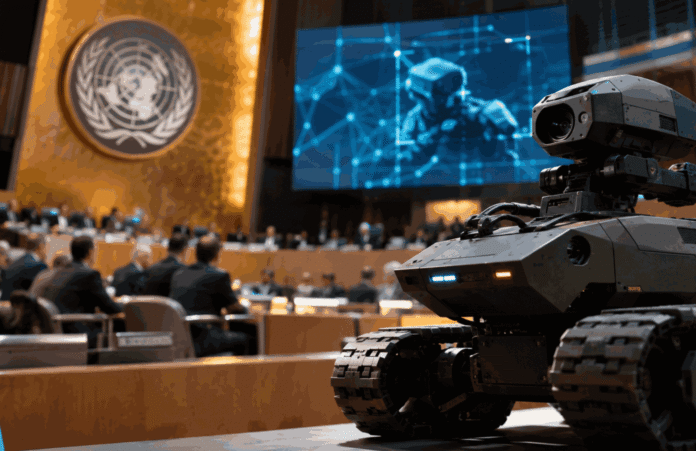
Efforts to establish international rules for AI-powered autonomous weapons have suffered another setback after countries failed to reach an agreement on legally binding restrictions during recent United Nations negotiations in Geneva.
Representatives from 128 countries attending discussions under the Convention on Certain Conventional Weapons agreed to continue working towards a possible international agreement by 2028. However, the decision stopped short of introducing the binding regulations that several governments, humanitarian organisations and campaign groups had been demanding.
The negotiations focused on lethal autonomous weapons systems, often described as killer robots. These technologies use artificial intelligence, sensors and automated decision-making systems to identify, select and engage potential targets. Depending on their capabilities, some systems can perform these tasks with limited human involvement.
The outcome is particularly significant because concerns about autonomous weapons have increased alongside rapid developments in military AI and drone technology. Governments are investing heavily in automated defence systems, while international organisations are increasingly questioning how much control machines should have over decisions involving human lives.
Although the latest agreement keeps diplomatic discussions moving, it does not establish a clear legal framework governing the development or deployment of these weapons.
Major military powers complicate efforts to introduce restrictions
One of the biggest obstacles during the negotiations was the lack of agreement among countries with significant military and defence technology capabilities.
Around 100 countries supported efforts to establish legally binding international rules. However, opposition from major arms-producing nations, including the United States, Russia and Israel, weakened proposals for stronger restrictions.
A group of seven countries, including Austria, Belgium, Brazil, Ireland, Mexico, New Zealand and Panama, had pushed for negotiations to begin on a new international rulebook. Their proposal aimed to introduce restrictions on weapons capable of making lethal decisions without meaningful human control.
However, the proposal failed to secure the necessary consensus.
The negotiations took place under the Convention on Certain Conventional Weapons, which requires decisions to be reached through consensus. This means individual countries can prevent stronger measures from moving forward, even when a large number of participating nations support them.
This requirement has repeatedly complicated international efforts to regulate emerging military technologies.
The final agreement instead gives countries another two years to develop a possible international instrument covering lethal autonomous weapons. Crucially, it does not guarantee that the eventual outcome will be legally binding.
For countries pushing for stronger protections, the decision represents a disappointing compromise rather than the progress they had hoped to achieve.
Why autonomous weapons are raising serious concerns
The growing use of artificial intelligence in military operations has created difficult questions about responsibility, safety and international humanitarian law.
Traditional military operations generally involve human decision-makers who assess targets and authorise the use of force. Autonomous weapons could change that relationship by allowing computer systems to make some of those decisions independently.
For example, an autonomous weapon could potentially analyse information from cameras, radar and other sensors, identify a target and initiate an attack without receiving a final instruction from a human operator.
While automation can improve reaction times and reduce the workload for military personnel, it also introduces serious risks.
AI systems can make mistakes when interpreting information, particularly in unpredictable environments. A system might incorrectly identify a civilian vehicle, misunderstand the situation on the ground or fail to distinguish between combatants and non-combatants.
There are also concerns about accountability. If an autonomous weapon causes civilian casualties because of a software error or incorrect identification, determining who should be held responsible could become complicated.
The responsibility might involve the manufacturer, software developer, military commander or government that authorised its deployment.
Humanitarian organisations argue that decisions involving life and death should not be left entirely to automated systems. They believe meaningful human control must remain a central requirement when military force is used.
These concerns are becoming more urgent as AI capabilities continue to develop and military organisations explore increasingly sophisticated autonomous systems.
Humanitarian groups warn that delays could have consequences
The latest diplomatic setback has disappointed organisations campaigning for international restrictions on autonomous weapons.
The United Nations Secretary-General António Guterres has previously called for legally binding rules, urging countries to make progress before these technologies become more widespread.
The International Committee of the Red Cross has also warned about the humanitarian and legal challenges associated with autonomous weapons. Its concerns include unpredictable behaviour, difficulties in controlling attacks and the potential consequences for civilians during armed conflicts.
Campaign groups argue that waiting until 2028 could give military developers additional time to advance these systems without a sufficiently clear international framework.
Autonomous drones and other AI-assisted military technologies have already attracted attention in conflicts involving Ukraine, Sudan and the Middle East. Although widespread deployment of fully autonomous lethal weapons has not been established, reports of limited use and continuing development have increased concerns about their future role.
The central issue is not simply whether countries should adopt AI in military operations. It is whether governments can establish clear boundaries around how these systems are developed, tested and used.
Supporters of stricter regulations believe international rules could help prevent accidental attacks, reduce civilian casualties and ensure that human beings remain accountable for decisions involving lethal force.
However, countries that oppose additional restrictions have raised concerns about limiting military development and the effectiveness of existing international laws.
What happens next for AI-powered military technology?
The extension of discussions until 2028 means the international community has more time to explore possible regulations, but it also leaves several important questions unanswered.
Countries will need to determine which autonomous weapons should be prohibited, which systems could be permitted under specific conditions and what level of human involvement should be required before an attack can take place.
Another major challenge will be enforcement. Even if governments eventually agree on a set of international rules, ensuring that every participating country follows them could prove difficult.
The next two years will therefore be important for determining whether diplomatic discussions can produce meaningful protections or simply result in another non-binding agreement.
For now, the Geneva negotiations have demonstrated how difficult it can be to regulate technologies that are developing faster than international agreements can keep pace with them.
Artificial intelligence is already changing the way modern militaries gather intelligence, operate drones and assess potential threats. As these capabilities become more advanced, the pressure to establish clear international standards is likely to grow.
The latest decision keeps the possibility of an international agreement alive, but it does little to address the immediate concerns surrounding machines making lethal decisions.
Ultimately, the challenge for governments will be finding a balance between technological development, national security and the fundamental need to protect human lives. Whether the next round of negotiations can deliver that balance remains uncertain.
Follow TechBSB For More Updates