
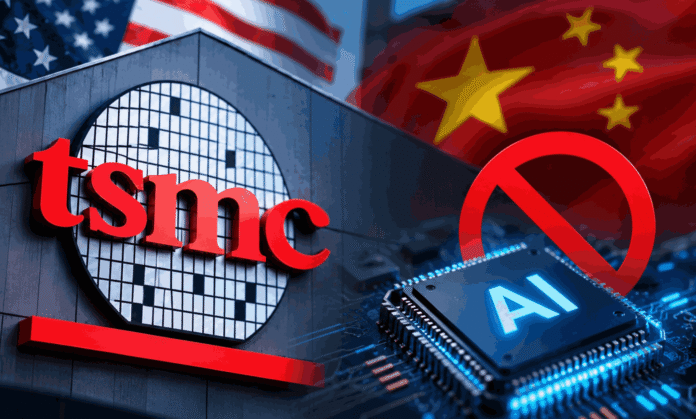
TSMC China AI chip restrictions are creating another major challenge for China’s semiconductor industry after new US export rules forced the world’s largest contract chipmaker to tighten its manufacturing policies. The Taiwanese company has reportedly suspended some previously approved orders from Chinese chip designers and introduced stricter requirements for customers seeking access to its advanced manufacturing technologies.
The move could significantly affect China’s ambitions to build its own artificial intelligence processors and reduce its dependence on US companies such as Nvidia. Chinese chipmakers have been working to develop domestic alternatives to Nvidia’s AI accelerators, but their reliance on advanced manufacturing services from companies such as TSMC remains a major obstacle.
According to people familiar with the situation, TSMC has instructed customers affected by the latest restrictions to stop orders involving manufacturing technologies at 16 nanometres and below unless they obtain the necessary US export licences.
This is a significant development because modern AI processors generally rely on much more advanced manufacturing processes. Smaller manufacturing nodes allow chipmakers to produce processors that deliver better performance while consuming less power.
TSMC Suspends Some Advanced Chip Orders From Chinese Customers
TSMC has reportedly tightened its screening procedures for Chinese semiconductor companies following the latest changes to US export regulations.
Under the revised guidance, affected Chinese chip designers will generally be restricted to older manufacturing technologies, particularly 28nm and 40nm processes. Even access to these manufacturing options comes with additional conditions.
Customers must ensure their chip designs do not involve high-bandwidth memory (HBM) or require advanced packaging technologies.
These restrictions matter because modern AI processors depend on more than just powerful computing cores. They also need fast memory systems and sophisticated packaging techniques to handle increasingly demanding workloads.
High-bandwidth memory allows processors to access large volumes of data quickly, making it particularly important for AI training and inference. Advanced packaging, meanwhile, helps integrate different chips and memory components into a single high-performance system.
Without these technologies, Chinese semiconductor companies could struggle to manufacture processors capable of competing with leading AI hardware from Nvidia and other international manufacturers.
The restrictions could also affect companies that had previously received permission to manufacture certain advanced chip designs through TSMC.
New US Export Rules Close an Important Manufacturing Loophole
The latest restrictions follow new regulations introduced by the US Commerce Department, which took effect on November 19.
Previously, TSMC could examine the technical specifications and computing capabilities of certain Chinese chip designs to determine whether they fell outside existing US export restrictions.
This verification process gave some Chinese semiconductor companies a route to access advanced manufacturing services without obtaining individual export licences.
However, the new regulations have removed that compliance option for affected customers.
Under the updated framework, advanced chips designed by these Chinese companies are now presumed to fall within the scope of US export controls. This means manufacturers must obtain the appropriate export licences unless a specific exemption applies.
TSMC has confirmed that it is aware of the regulatory changes and will comply with the new requirements where applicable.
The company declined to comment on market rumours but acknowledged the importance of following the latest Bureau of Industry and Security regulations.
The changes could have consequences beyond Taiwan. Reports have also indicated that South Korea’s Samsung Electronics has suspended certain chip shipments to Chinese customers following the introduction of the new restrictions.
This suggests that Washington’s latest move could affect multiple major semiconductor manufacturers rather than just TSMC.
China’s AI Chip Industry Faces Another Major Challenge
The restrictions could create additional problems for China’s growing AI semiconductor industry.
Several Chinese technology companies and independent chip designers are developing processors intended to compete with Nvidia’s products. These efforts form part of Beijing’s wider strategy to strengthen domestic semiconductor production and reduce reliance on foreign technology.
However, designing a competitive processor is only one part of the challenge. Manufacturers also need access to advanced fabrication facilities, high-performance memory and sophisticated packaging capabilities.
TSMC has been particularly important to the global AI hardware industry because it manufactures some of the world’s most advanced processors.
Before the latest restrictions took effect, some Chinese AI chip designers reportedly still had access to TSMC’s 7nm manufacturing technology.
The precise arrangements behind those manufacturing activities remain unclear, and Reuters said it could not independently verify how those chips were being produced.
The latest rules could make it considerably harder for Chinese companies to continue using similar manufacturing arrangements.
The impact could be particularly significant for businesses developing AI accelerators and data centre processors. These products require substantial computing power and efficient memory systems to support increasingly complex AI workloads.
With access to advanced overseas manufacturing becoming more difficult, Chinese chip designers may have to rely more heavily on domestic semiconductor production.
However, developing manufacturing capabilities that can consistently compete with the industry’s leading foundries remains a considerable technical and financial challenge.
TSMC Introduces Stricter Checks on Chinese Customers
The updated restrictions are not limited to the technical specifications of individual chip designs. TSMC is also reportedly expanding its checks on customers and their business relationships.
According to people familiar with the company’s guidance, the screening process now requires closer examination of several factors, including:
- Where customers operate their businesses.
- Their parent companies and major shareholders.
- The packaging providers involved in manufacturing.
- The destinations and routes used to ship finished chips.
These additional checks are intended to identify potential attempts to bypass export restrictions through overseas subsidiaries or third-party intermediaries.
Companies operating through entities in Taiwan, the United States, Europe, Japan and Southeast Asia could also face closer scrutiny.
This is an important development because semiconductor supply chains are spread across multiple countries. A chip designed in China might be manufactured, packaged and shipped through several different jurisdictions before reaching its final destination.
By examining the wider business structure and supply chain, TSMC can strengthen its compliance procedures and reduce the risk of restricted technology reaching customers through indirect arrangements.
For Chinese semiconductor companies, however, the additional scrutiny could make international manufacturing partnerships more complicated and expensive.
What This Means for the Global AI Chip Industry
TSMC’s latest move highlights how export controls are increasingly shaping the global semiconductor industry. The restrictions are no longer focused solely on limiting access to specific chip products. They are also affecting the manufacturing services, packaging technologies and supply chain arrangements needed to produce advanced processors.
For China, the challenge is becoming more difficult. Domestic companies can continue investing in AI chip development, but access to advanced manufacturing remains a critical factor in determining whether those products can compete globally.
For TSMC, the priority is to comply with US regulations while managing relationships across an increasingly divided semiconductor market.
The wider impact will depend on how effectively Chinese manufacturers can develop alternative production capabilities and whether additional export restrictions emerge.
For now, the latest US rules represent another setback for China’s efforts to build a competitive AI chip industry without depending on advanced foreign manufacturing technology.
Follow TechBSB For More Updates