
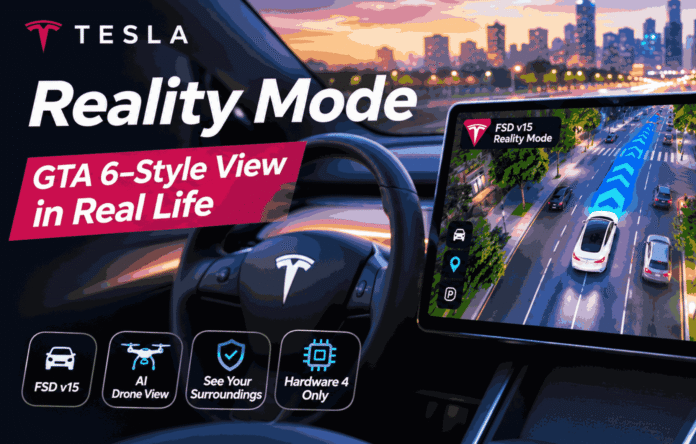
Tesla is giving its Full Self Driving technology a fresh visual upgrade, and it looks like something straight out of a futuristic video game. The company’s latest FSD v15 update introduces a feature called Reality View, which creates an aerial, drone style visualisation of the vehicle as it moves through real world traffic.
The feature has already caught the attention of Tesla owners, with videos showing the new interface appearing across social media. Instead of displaying only the usual driving information and camera feeds, the system presents a virtual view of the car from above, complete with surrounding vehicles, roads and other objects.
For anyone familiar with open world driving games, the experience has an unmistakable GTA feel. The difference is that this is not a simulated city or a video game environment. It is an AI generated representation of the actual road conditions around a moving Tesla.
Tesla began rolling out FSD v15 on November 21, with the new visualisation becoming one of the most talked about additions. Although the feature looks like a major step towards futuristic in car interfaces, its real purpose goes beyond making the driving display more entertaining.
Tesla Reality Mode turns everyday driving into a video game experience
The biggest attraction of Reality View is the way it changes how drivers see their surroundings on the central touchscreen.
Traditional driver assistance displays generally rely on relatively simple graphics to represent nearby cars, road markings and obstacles. Tesla’s new approach takes things further by creating a more detailed, three dimensional style view of the vehicle and its environment.
The result resembles drone footage captured from above the road. Drivers can watch a digital representation of their Tesla moving through traffic, while other vehicles and objects appear around it.
The interface also includes visual indicators such as pins, blue lines and chevron arrows. These graphics help communicate what the vehicle is detecting and where the system intends to move next.
It is easy to see why owners are comparing the experience to GTA 6. The combination of an overhead camera perspective, moving traffic and a constantly changing environment gives the display a distinctly video game inspired appearance.
However, Tesla is not simply adding a new camera angle to its existing driving interface. The technology behind Reality View is considerably more complicated.
AI generates the aerial view using Tesla’s driving data
One important detail about Reality View is that the images displayed on the touchscreen are not direct footage from an actual drone or a dedicated overhead camera.
Instead, Tesla uses information collected through the vehicle’s onboard sensors to generate a virtual representation of the surrounding environment.
The system processes this information using artificial intelligence, creating what Tesla describes as a live visualisation. This approach allows the software to build an overhead perspective that would otherwise be difficult to capture using the vehicle’s existing cameras.
Elon Musk has also offered some insight into the technology behind the feature. According to his explanation on X, Tesla uses a smaller version of its world model alongside a diffusion model to generate the visual feed.
In simple terms, the system uses AI to interpret information about the surrounding world and turn it into a moving visual representation.
There is, however, a noticeable limitation. Reality View currently has a delay of approximately one second compared with what drivers can see through the windscreen.
That means the display is not a perfectly synchronised window into the real world. The visualisation is generated through an AI process, which takes time to interpret the available information and produce the resulting images.
Musk has claimed that Tesla expects to reduce the visual delay by around 35% in a future improvement. If achieved, this could make the feature feel considerably more responsive.
Reality View could make FSD easier to understand, but it is not a driving breakthrough
At first glance, Reality View might seem like an elaborate visual gimmick. A digital aerial view of a Tesla navigating traffic certainly looks impressive, but drivers may reasonably wonder whether it actually makes their journeys safer or more convenient.
Tesla appears to have a more practical objective in mind.
One of the biggest challenges facing advanced driver assistance systems is helping drivers understand what the vehicle is detecting and what it plans to do next.
A conventional driving display can communicate basic information, but it does not always give drivers a clear picture of how the system interprets a complicated road environment.
Reality View attempts to address this by presenting that information in a more intuitive visual format.
Seeing nearby vehicles, road layouts and the car’s intended movements from an overhead perspective could make it easier to understand how FSD is responding to its surroundings.
The directional arrows and other interface indicators may also help drivers follow the vehicle’s planned movements.
Another interesting detail is the apparent ability to select a parking space using the arrows displayed on the screen. However, this functionality currently appears to be available when driving manually rather than while FSD is engaged.
That distinction is important. Reality View may improve the way Tesla communicates its driving decisions, but it does not automatically make the underlying autonomous driving technology more capable.
Drivers must continue to pay attention and remain prepared to take control whenever necessary.
Tesla’s autonomous driving ambitions face growing scrutiny
The launch of Reality View comes as Tesla continues to expand its ambitions around autonomous driving.
The company has invested heavily in artificial intelligence, vehicle software and automated driving systems. Its longer term plans include robotaxis and vehicles capable of handling more driving tasks without human intervention.
However, Tesla’s Full Self Driving branding has also attracted criticism, particularly in markets where regulators believe the name could give motorists an exaggerated impression of the system’s capabilities.
In Europe and the UK, Tesla has faced pressure to use the name Tesla Assisted Driving instead. German officials have argued that the Full Self Driving label could be misleading because the technology does not mean a vehicle can operate independently in every situation.
That concern is not simply about marketing language. Drivers need to understand the difference between an advanced driver assistance system and a genuinely autonomous vehicle.
There have also been safety concerns and reported incidents involving Tesla’s driver assistance technology. Critics argue that some motorists may place too much trust in the system, especially when its branding and presentation suggest a higher level of autonomy than it currently offers.
Reality View could help Tesla communicate its technology more clearly, but a sophisticated display is not a substitute for proven real world driving performance.
The feature also has limited hardware availability. It is designed for newer Tesla vehicles equipped with the company’s Hardware 4 architecture, meaning owners of older models may not get access to the same experience.
Ultimately, Reality View is an interesting example of how AI could change the way drivers interact with their vehicles. It makes complex sensor information easier to visualise and gives Tesla’s driving interface a distinctly futuristic feel.
But the bigger question remains whether Tesla can turn these impressive software demonstrations into consistently safe and reliable autonomous driving technology.
For now, Reality View looks like a clever addition to FSD v15, even if its biggest achievement is making an ordinary drive look a little like GTA 6.
Follow TechBSB For More Updates