
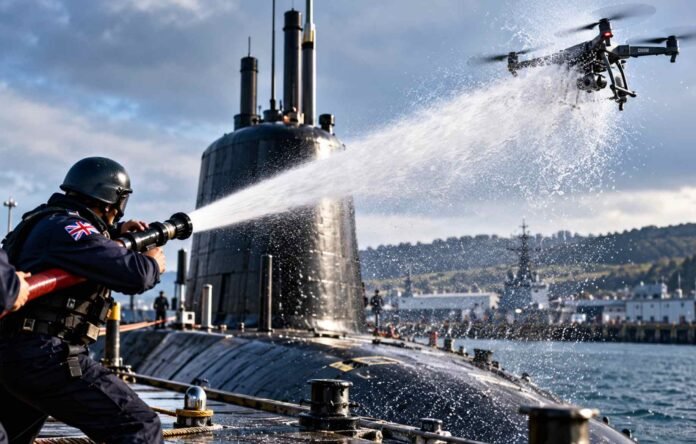
- The Royal Navy is reportedly training submarine crews to use high pressure firefighting hoses against nearby hostile drones.
- The water jets are intended as a last resort when conventional security measures fail, not as a replacement for dedicated counter drone systems.
- HMNB Clyde faces potential drone surveillance and security risks because nearby terrain and short approach distances may limit warning times.
- The technique is inexpensive and avoids conventional ammunition, but its effectiveness depends on range, accuracy, drone speed and the circumstances of an attack.
Britain’s Royal Navy is training submarine crews to use an unusual weapon against hostile drones: high pressure water jets. The low cost approach is intended to give sailors another way to respond if an unmanned aircraft manages to get past the security measures protecting the country’s nuclear submarine fleet.
The reported measure highlights a growing challenge for naval forces. Small drones are relatively inexpensive, easy to deploy and potentially capable of approaching sensitive military installations before defenders have enough time to respond. For the Royal Navy, even a limited threat near a nuclear armed submarine deserves serious attention.
According to the report, crews operating Britain’s Vanguard class submarines are being trained to direct powerful streams of water at approaching drones. The equipment consists of firefighting hoses fitted with handheld nozzles, allowing sailors to aim the water jets at nearby aerial threats.
The approach is not intended to replace dedicated counter drone technology. Instead, it offers a potential emergency option when other protective measures fail and sailors need to act quickly.
Fire Hoses Offer an Emergency Response to Drone Attacks
The reported training focuses on using existing firefighting equipment to disrupt small and medium sized drones, including first person view models. These aircraft can be operated remotely and may approach a target at close range, leaving defenders with little time to react.
Rather than relying on a purpose built weapon, sailors would use the force of the water jet in an attempt to knock a drone off course or bring it down. The technique is straightforward in principle, although its effectiveness would depend on several factors, including the drone’s distance, speed, flight path and the time available to respond.
The equipment also has important limitations. Fire hoses do not automatically detect, track or identify incoming aircraft. Sailors must first recognise the threat, position themselves and direct the nozzle towards a moving target.
Weather conditions, visibility and the type of drone involved could also affect the outcome. A fast moving aircraft may be difficult to hit, while a drone operating beyond the effective reach of the water stream would remain outside the system’s practical capabilities.
A Royal Navy source quoted in the reporting acknowledged that the equipment was a fallback measure, reflecting the need to use whatever resources are available during an emergency.
That distinction matters. The hoses are not a substitute for radar, electronic warfare equipment or other dedicated counter drone systems. Their purpose is to provide another possible response at very short range when more sophisticated defences have not prevented an aircraft from reaching the vessel.
Protecting Britain’s Vanguard Class Nuclear Submarines
The reported initiative concerns Britain’s Vanguard class submarines, which form a central part of the country’s nuclear deterrent. These vessels carry Trident II D5 ballistic missiles and operate as part of the UK’s continuous at sea deterrence mission.
Each submarine represents a major national security investment. The article puts the cost of an individual Vanguard class vessel at approximately £4 billion, underlining the importance of protecting the fleet against surveillance, sabotage and other potential threats.
The submarines are particularly exposed to different security challenges when they are alongside at a naval base or operating on the surface. In these circumstances, they may be more accessible to aerial observation than when submerged.
A drone does not necessarily need to inflict serious physical damage to create a security problem. It could potentially collect imagery, observe movements around a military installation or investigate sensitive areas without authorisation. Depending on its payload and purpose, an unmanned aircraft could also pose a more direct threat.
This is why the reported water jet training should be understood as one small element of a broader protective effort. It gives personnel an additional option during a close range incident, but it does not remove the need to detect threats before they reach the submarine.
The unusual nature of the approach also reflects the practical reality of military operations. Existing equipment can sometimes provide a useful emergency capability without requiring the immediate purchase or installation of a new weapons system.
HMNB Clyde Faces a Complex Drone Security Challenge
The training is reported to involve submarines based at HMNB Clyde in Scotland, the principal naval base associated with Britain’s nuclear deterrent.
The surrounding geography adds to the security challenge. Gare Loch is a relatively confined waterway, while nearby hills, roads and accessible terrain could offer potential launch positions for unauthorised drone operators.
In such an environment, the distance between a launch point and a sensitive military asset may be short. That can reduce the time available to identify an aircraft, determine whether it poses a threat and take appropriate action.
Protecting the base therefore requires more than a single defensive measure. Physical barriers, security patrols, surveillance systems and specialist counter drone technology can all contribute to a layered approach.
The UK Ministry of Defence has also announced additional spending intended to improve security at military installations. The report cites £470 million in extra expenditure over four years for this wider effort.
Separately, concerns have been raised about underwater sensors discovered near routes used by British submarines departing their Scottish headquarters. The devices were suspected of potentially being connected to Russian efforts to monitor submarine movements, although their precise origins remain unconfirmed in the supplied report.
These concerns illustrate that protecting a submarine fleet involves monitoring threats in several environments, from the air above a naval base to the waters surrounding it.
A Low Cost Option With Clear Limitations
The attraction of using firefighting hoses is easy to understand. They are already part of a vessel’s safety equipment, require no dedicated ammunition and use water rather than an explosive or chemical payload. This makes the approach relatively inexpensive and environmentally uncomplicated compared with some specialised defensive options.
However, describing the technique as eco friendly should not obscure its operational limitations. A water jet can only be useful if the drone is close enough, the crew can aim accurately and the force of the stream is sufficient to disrupt the aircraft.
There are also practical questions about deployment. Sailors would need to recognise the threat, access the equipment and use it without compromising other essential duties. The available information does not establish how effective the method has been in controlled trials or against real drone attacks.
For those reasons, the fire hoses are best viewed as a last resort rather than a complete counter drone solution.
The wider lesson is that the proliferation of inexpensive unmanned aircraft is forcing military organisations to consider threats that traditional security arrangements may not fully address. High end sensors and specialised weapons remain important, but improvised responses can also have a role when an incident develops faster than expected.
For the Royal Navy, the reported training provides another potential layer of protection around some of Britain’s most strategically important military assets. Whether it proves effective in practice will depend on the circumstances of an attack and how well it complements the fleet’s other defences.
Follow TechBSB For More Updates