
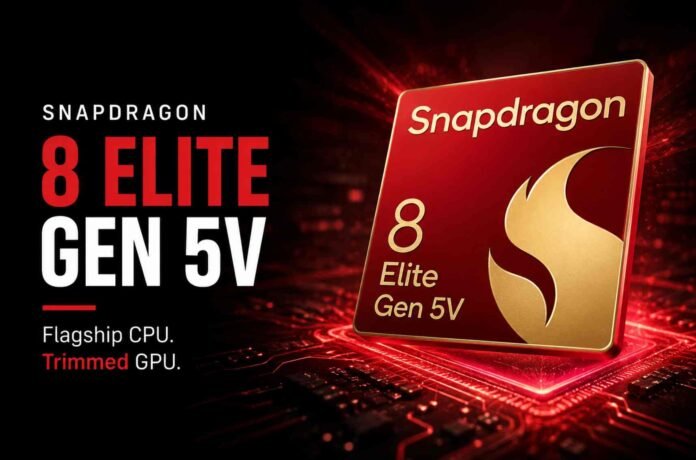
- Snapdragon 8 Elite Gen 5V retains the same Oryon CPU as the standard version but features a significantly weaker GPU.
- Qualcomm has reduced GPU compute units, graphics memory, and GPU slices to lower manufacturing costs.
- Casual games should run smoothly, but demanding titles such as Genshin Impact may experience lower frame rates.
- The chip could be a good option only if phones using it are priced well below devices powered by the standard Snapdragon 8 Elite Gen 5.
Qualcomm has quietly expanded its flagship mobile lineup with the Snapdragon 8 Elite Gen 5V, a new processor that targets lower priced premium smartphones without completely abandoning the flagship branding. The chip is expected to make its commercial debut in the Redmi K100 Pro when the device launches in China on August 11.
At first glance, the processor appears to offer nearly everything found in the regular Snapdragon 8 Elite Gen 5. It keeps the same custom Oryon CPU cores, identical peak clock speeds, support for LPDDR5X memory, UFS 4.1 storage, and the same modem platform. That specification sheet may lead buyers to believe they are getting a flagship experience for less money.
However, a closer look reveals where Qualcomm has made its compromises. The company has reduced the graphics hardware while keeping the Elite branding intact, creating a processor that is much stronger in CPU workloads than graphics intensive tasks.
GPU cuts define the real difference
The biggest change comes from the graphics subsystem.
While the standard Snapdragon 8 Elite Gen 5 includes an Adreno 840 GPU with 12 compute units, the new Snapdragon 8 Elite Gen 5V reduces that number to eight. Qualcomm has also lowered dedicated GPU memory from 18MB to 12MB and reduced GPU slices from three to two.
These changes are reflected in benchmark numbers as well. The standard version reportedly reaches AnTuTu scores of around 4.5 million, while the Gen 5V reaches approximately 4.1 million. Although that difference may appear modest in synthetic testing, benchmarks often reward CPU performance and overall system responsiveness more than sustained graphics workloads.
In day to day use, most users are unlikely to notice any slowdown when browsing, multitasking, or running productivity apps. The CPU remains just as capable as the flagship version. The compromises become much more visible during demanding gaming sessions where GPU performance plays the biggest role.
Gaming performance depends on what you play
Early information from well known tipster Digital Chat Station suggests that the Snapdragon 8 Elite Gen 5V performs comfortably in competitive multiplayer games such as Honor of Kings, Peacekeeper Elite, and Delta Force. These games are generally well optimized and place less pressure on the graphics hardware.
The story changes with heavier games.
Titles such as Genshin Impact demand far more from the GPU, particularly during complex combat scenes and large open world exploration. Reports indicate that the reduced graphics hardware struggles to maintain the same level of performance as the standard Snapdragon 8 Elite Gen 5, leading to more noticeable frame drops during extended gameplay.
Qualcomm and its hardware partners are also promoting advanced cooling solutions, including a three dimensional circulating cold pump system. While improved cooling certainly helps, lower temperatures alone do not automatically translate into higher gaming performance. A processor that generates less heat because it delivers less graphics performance is naturally easier to cool.
Thermal throttling also depends heavily on smartphone design. Factors such as internal space, cooling materials, battery size, and overall chassis construction can significantly influence sustained performance. Even a less demanding processor can throttle if heat builds up over long gaming sessions.
Battery life could improve thanks to the lower power requirements of the smaller GPU. However, that advantage may not always translate into a noticeably longer gaming session. If the device reduces graphics quality or dynamically lowers visual settings to maintain stable frame rates, users may simply be trading image quality for similar battery consumption.
Pricing will determine whether it succeeds
The Snapdragon 8 Elite Gen 5V is not necessarily a bad processor. Its CPU performance remains flagship class, making it more than capable for everyday tasks, productivity, photography, and general smartphone use. The graphics reductions mainly affect users who expect consistently high frame rates in the most demanding mobile games.
For casual gamers, the processor could offer a balanced combination of speed, efficiency, and lower cost. For enthusiasts who regularly play graphics heavy titles, the standard Snapdragon 8 Elite Gen 5 will remain the stronger choice.
Everything ultimately comes down to pricing.
If smartphones powered by the Snapdragon 8 Elite Gen 5V launch at meaningfully lower prices than devices using the full Snapdragon 8 Elite Gen 5, the compromise becomes much easier to justify. Buyers would be receiving flagship level CPU performance while accepting a predictable reduction in graphics capability.
On the other hand, if manufacturers price these devices close to full flagship models, the value proposition becomes far less convincing. In that scenario, consumers would effectively be paying premium prices for hardware that has been deliberately scaled back where gaming performance matters most.
With the Redmi K100 Pro and possible Poco variants expected to arrive soon, the market will quickly determine whether the Snapdragon 8 Elite Gen 5V represents smart cost optimization or simply premium branding attached to a reduced graphics package.
Follow TechBSB For More Updates