
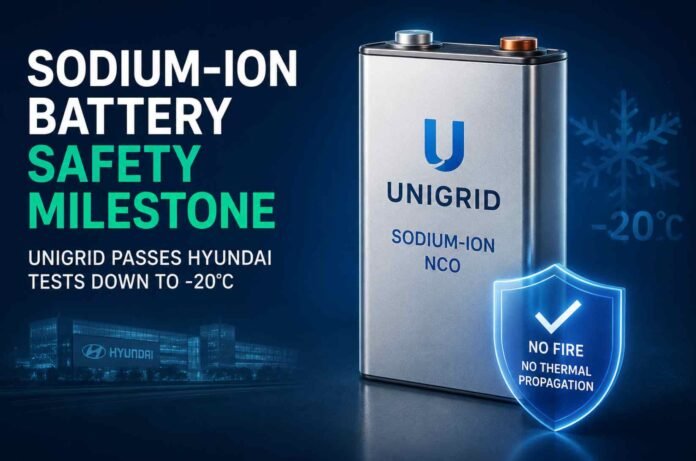
- Unigrid’s sodium-ion batteries passed demanding Hyundai safety and technology validation tests.
- The cells reportedly showed no fire or thermal propagation during key safety experiments.
- They operated from minus 20 degrees Celsius to 60 degrees Celsius with limited capacity degradation.
- Sodium-ion batteries could become especially important for grid storage and affordable mobility, though lithium-ion still leads in energy density.
Sodium-ion batteries are moving closer to becoming a serious alternative to lithium-ion technology, and a California startup has just cleared an important hurdle.
Unigrid says its sodium-ion battery technology has completed a series of technical validation tests conducted through Hyundai Motor Group. The results are particularly significant because they focus on one of the biggest concerns surrounding modern batteries: fire safety.
The company’s sodium chromium oxide, or NCO, battery cells reportedly showed no fire and no thermal propagation during demanding safety evaluations. They also continued operating across temperatures ranging from minus 20 degrees Celsius to 60 degrees Celsius, while showing limited capacity loss during extended cycling.
It is still early days, and one successful validation program does not mean sodium-ion batteries are about to replace lithium-ion everywhere. But the results add to growing evidence that sodium could play an increasingly important role in the future of electric vehicles, energy storage and other battery-powered technologies.
A safer answer to the battery fire problem?
Lithium-ion batteries dominate modern electronics for a simple reason: they pack a remarkable amount of energy into a relatively small and lightweight package.
That advantage has made them essential for smartphones, laptops, electric vehicles and large battery storage systems. However, lithium-ion technology also comes with challenges, including the possibility of thermal runaway.
Thermal runaway occurs when a battery cell overheats and triggers a destructive chain reaction. In serious cases, the result can be fire, rapid heat spread and damage to neighboring cells.
That is where Unigrid believes its sodium-ion chemistry could offer an advantage.
The company’s NCO cells were tested under Hyundai’s technology evaluation program and reportedly completed stringent safety experiments without catching fire or allowing heat-related failures to spread through the battery system.
For large battery installations, that distinction could be extremely important. A battery used in a grid storage facility or industrial environment may contain thousands of individual cells, so preventing one failed cell from triggering a wider event is a major engineering challenge.
Unigrid’s results do not eliminate every safety concern associated with batteries, but they suggest that sodium-ion chemistry could provide another route toward safer energy storage.
Cold weather performance is another encouraging sign
Battery performance can change dramatically when temperatures fall, making cold-weather operation one of the tougher tests for any new chemistry.
According to the reported results, Unigrid’s cells operated across a temperature range from minus 20 degrees Celsius to 60 degrees Celsius.
That broad operating window is noteworthy because batteries are increasingly expected to function in everything from freezing outdoor environments to extremely hot industrial locations.
The cells also reportedly experienced minimal capacity degradation during sustained cycling. Long-term durability remains one of the most important factors separating promising battery research from commercially useful technology.
A laboratory demonstration can look impressive, but batteries ultimately need to survive years of charging and discharging while maintaining acceptable performance and cost.
That is why real-world validation from a major automotive group carries more weight than a standalone announcement from a startup. Hyundai’s involvement does not guarantee commercialization, but it gives the technology a meaningful test of its potential.
Why sodium is becoming harder to ignore
The biggest difference between sodium-ion and lithium-ion batteries is, unsurprisingly, the material moving through the battery.
Instead of relying on lithium ions, sodium-ion batteries use sodium ions to transfer energy between the electrodes during charging and discharging.
Lithium has historically won the battery race because lithium-ion cells generally offer higher energy density. In simple terms, they can store more energy for their weight and size.
That matters enormously in smartphones, laptops and electric vehicles, where every kilogram and every millimeter of space counts.
Sodium has advantages of its own, however.
It is far more abundant than lithium and is widely available around the world. That could eventually reduce pressure on battery supply chains and provide manufacturers with access to less geographically concentrated raw materials.
The potential cost advantage is also attracting attention, particularly for applications where maximum energy density is less important.
Grid-scale storage is one obvious example. A battery system sitting beside a solar farm does not need to be as light as the battery inside a smartphone.
For those applications, lower material costs, strong safety performance and long cycle life could matter more than squeezing every possible watt-hour into a compact package.
Sodium-ion is unlikely to replace lithium overnight
Despite the latest progress, sodium-ion batteries still have a major challenge: energy density.
That limitation means they are currently better suited to some applications than others. Stationary energy storage, affordable mobility and other cost-sensitive uses may be among the first areas where sodium-ion technology becomes competitive.
Lithium-ion is unlikely to disappear anytime soon. The technology has decades of development behind it, an enormous manufacturing ecosystem and a major performance advantage in applications requiring compact, lightweight batteries.
The more likely future is one where several battery chemistries coexist.
Lithium-ion may remain the preferred choice for premium electric vehicles and portable electronics, while sodium-ion finds a growing role in grid storage, lower-cost vehicles and industrial systems.
That future is already beginning to take shape. Major battery manufacturers are investing heavily in sodium-ion production, while researchers continue experimenting with different materials and cell designs.
CATL, the world’s largest battery manufacturer, has also announced plans to move toward mass production of sodium-ion batteries, using a different chemistry based on Prussian white materials.
Unigrid’s NCO approach shows that there may not be one single formula for the future of sodium-ion batteries.
Different chemistries could eventually serve different markets, much like different types of lithium-ion batteries are already used for different purposes.
For now, Unigrid’s Hyundai validation is another encouraging sign that sodium-ion technology is leaving the experimental stage and moving closer to commercial reality.
Lithium-ion batteries still have the advantage, but sodium is starting to look less like a distant possibility and more like a practical part of the next generation of energy storage.
Follow TechBSB For More Updates

