
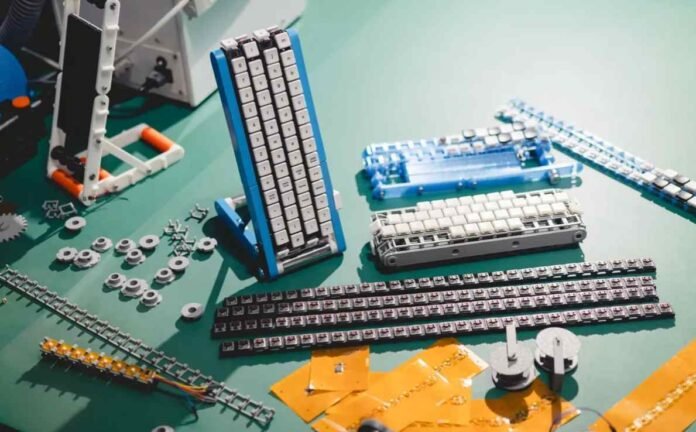
Google has introduced a keyboard concept that turns the familiar typing experience on its head. Instead of asking users to move their fingers across a fixed layout, the new Gboard Conveyor Belt Version brings the keys towards the user on four continuously looping belts.
Developed by Google Japan’s Gboard team, the unconventional device features 116 keys arranged across four moving belts. The idea is simple but unusual: users wait for the character they need to reach their finger and then press it to enter text.
The design challenges a basic assumption behind conventional keyboards. Most layouts are built around two handed typing, with users moving their fingers between different rows and reaching for individual keys. Google’s alternative explores whether moving the keyboard itself could make typing more convenient, particularly for people who prefer to use one hand or a single finger.
Google describes this approach as a fundamental shift in how people interact with keyboards. Rather than requiring the user to navigate a stationary arrangement of keys, the device changes the layout’s movement to bring the desired character closer.
It is certainly a different way to approach text input. However, whether the design makes everyday typing genuinely easier will depend on how comfortably users can recognise, follow and press the moving keys.
How the Moving Key Design Works
The conveyor belt keyboard features four looping belts, each carrying 29 keys. Together, they provide 116 keys that move continuously towards the user’s hand.
When the required character appears, the user presses the corresponding key as it passes by. This creates a typing experience that differs considerably from the familiar QWERTY layout, where each key stays in a fixed position.
One of the more interesting decisions concerns uppercase and lowercase letters. Google has given them separate keys, removing the need to hold Shift or switch between letter cases in the conventional way.
In theory, this could make certain typing tasks more straightforward. Users would not have to move their fingers between distant keys as often, and the moving belts could offer an alternative for people who find traditional keyboard layouts awkward to navigate.
Google’s concept also considers situations where one hand is occupied. For example, someone could potentially type with one finger while holding a cup of tea or operating a mouse with the other hand.
The company even suggests that using two conveyor belt keyboards could allow two handed typing. That possibility adds another layer to the experiment, although it also raises a practical question: would two moving keyboards offer enough of an advantage to justify their additional complexity?
For now, the concept is better understood as an experiment in keyboard design than a proven replacement for conventional typing.
A DIY Project, Not a Commercial Keyboard
Despite the attention grabbing design, Google has no plans to sell the conveyor belt keyboard as a mainstream consumer product. Instead, the company has made its project files available for people interested in building the device themselves.
The project uses an open source approach, with design files released under the Apache 2.0 licence. The available materials include KiCad schematics, printed circuit board layouts and firmware, giving electronics enthusiasts a starting point for recreating the device.
However, building one is unlikely to be a simple weekend project for most people. A 3D printer is only part of what is needed. Anyone attempting the build would also need to work through the electronics, mechanical assembly and software required to make the moving keys function as intended.
There is another important distinction between the documented versions. According to the project information described in the announcement, the motorised Moving Keys edition is documented, while the Bluetooth version intended for actual typing and its associated board files are still marked as coming soon.
That means interested builders should check which components and files are available before committing time or money to the project.
The open source release nevertheless gives the idea a life beyond Google’s own demonstrations. Developers, makers and keyboard enthusiasts can explore the design, experiment with its mechanics and potentially develop their own improvements.
Google’s Long History of Unconventional Keyboard Ideas
The conveyor belt keyboard is not an isolated experiment. It is the 15th entry in Google’s long running series of unusual keyboard concepts, which began in 2010 with a drum kit inspired input system.
Many of the early ideas were presented as April Fools’ Day jokes. Over time, however, the project developed into a recurring opportunity for the Gboard team to explore unusual approaches to text entry.
The series returned in October 2021 after a break in 2020. The timing was a playful reference to the 101 keys found on a conventional keyboard, and subsequent releases continued the tradition of unexpected designs.
Previous concepts have included a keyboard with all its keys arranged in a single row, a keyboard worn like a hat, a double sided keyboard and a design based around a rotary dial.
These projects are not necessarily intended to become commercial products. Instead, they give Google’s developers room to question familiar design choices and explore alternative ways of interacting with devices.
The conveyor belt concept follows that same philosophy. It takes a straightforward observation about traditional typing and pushes it to an unusual extreme: if moving your hand across the keyboard is inconvenient, why not make the keys move instead?
That question is interesting from an accessibility perspective, even if the resulting hardware looks more like an experimental machine than something most people would want on their desks.
Can a Conveyor Belt Keyboard Really Make Typing Easier?
The biggest challenge for Google’s design is whether moving keys can deliver a meaningful improvement in everyday use. The concept offers an alternative to fixed key positions, but it also introduces movement that users must follow before pressing the correct character.
People would need to become familiar with the belts’ layout and timing. Depending on how quickly the keys move and how reliably users can press them, the design could make some tasks easier while making others slower.
Accessibility is another important consideration. A keyboard designed around one finger input could be useful for some users, but a moving layout will not automatically suit everyone. Its real value would depend on individual needs, physical comfort, accuracy and typing speed.
There is also a difference between demonstrating that a device works and proving that it improves productivity. Without detailed performance testing or evidence from a broad range of users, it is too early to conclude that Google’s approach is better than a standard keyboard.
Still, the project shows how even an everyday piece of technology can be reconsidered from the ground up. By making the keys move rather than the user’s hand, Google has created a design that is playful, technically ambitious and potentially useful as a starting point for accessibility focused experimentation.
The Gboard Conveyor Belt Version may never appear in shops, but that is not necessarily the point. Its open source design gives curious builders an opportunity to test an idea that conventional keyboard manufacturers rarely explore.
Follow TechBSB For More Updates

