
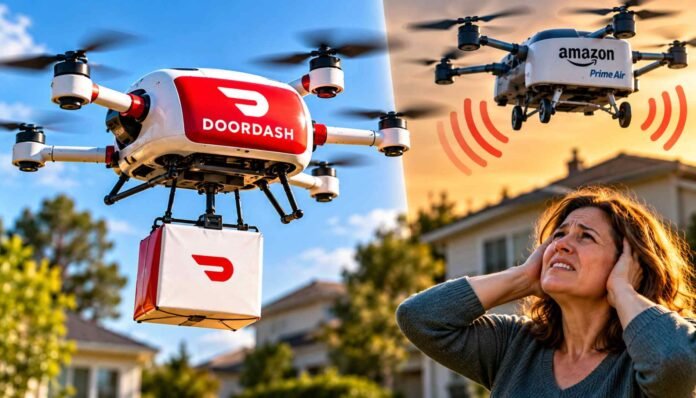
- DoorDash is testing a six propeller drone designed to deliver eligible food orders in under five minutes on average.
- The trial is planned for Northern California with restaurant partners including Chipotle and Popeyes Louisiana Kitchen.
- The drones will lower orders to customers instead of landing, while built in safety systems are intended to handle emergencies.
- Noise could become a major issue after residents in Richardson, Texas raised concerns about the sound of Amazon delivery drones.
DoorDash is taking another step toward bringing drone delivery into everyday food orders, unveiling a new aircraft designed to carry meals from restaurants to customers in minutes.
The company says its new drone could deliver eligible orders in less than five minutes on average. The technology is expected to enter a limited trial in Northern California, where DoorDash plans to work with restaurant brands including Chipotle and Popeyes Louisiana Kitchen.
The idea is straightforward. Instead of waiting for a driver to collect an order, navigate traffic and reach a customer’s home, a drone can travel directly through the air. DoorDash believes that could make short distance food deliveries considerably faster, particularly for smaller orders.
The company estimates that roughly 80 percent of customer orders are light enough to be transported by drone. That does not mean every order will be eligible, however. Weight, distance, weather and operational conditions will all affect whether a drone can be used.
DoorDash has also designed the system around the way the drone handles the final part of a delivery. Rather than landing at the customer’s property, the aircraft will hover above the destination and lower the food to the ground using a delivery mechanism. It can then fly away without requiring a landing area.
According to DoorDash, the aircraft has six propellers and includes safety systems designed to deal with emergencies. The company also says the drone’s cruising noise should be comparable to that of a passing car when it is flying at delivery height.
That claim could become one of the most important parts of the trial.
Speed may not matter if neighborhoods dislike the noise
DoorDash is entering the drone delivery market at a time when another major technology company is dealing with concerns about the sound produced by its aircraft.
Amazon has been operating its Prime Air drone delivery service in Richardson, Texas, since last December. Residents in the area have reportedly raised concerns about the repeated buzzing from drones flying over their homes.
Some residents have compared the sound to a flying lawnmower. People living in affected areas say drones can pass overhead dozens of times during the day, turning what might seem like an occasional delivery into a recurring source of noise.
Amazon’s drones are permitted to operate between 7am and 8pm. The company has said noise complaints represent only a small portion of the feedback it has received from customers.
Still, the experience in Texas highlights an issue that could prove difficult for the wider drone delivery industry.
Getting a meal to someone’s doorstep in five minutes sounds impressive on paper. Getting dozens or hundreds of drones to make those deliveries every day without becoming a nuisance is a much bigger challenge.
For companies developing these services, speed is only one part of the equation. Noise, safety, privacy, weather conditions and the reliability of the delivery mechanism could all determine whether communities accept drones flying regularly over residential areas.
DoorDash is trying to solve more than the flight itself
The aircraft may be the most visible part of DoorDash’s plan, but the company has also been developing the infrastructure needed to make drone delivery practical.
That includes the process for preparing an order, transferring it to the drone and releasing it safely at the destination. The ordering system also needs to determine which deliveries can be handled by air and which still require a conventional driver.
The final delivery presents its own engineering challenge. A drone cannot simply land at every customer’s home because many properties do not have a suitable landing area. Lowering the package from the aircraft gives DoorDash more flexibility and allows the drone to remain airborne.
Weather will also be an important test. Rain, strong winds and other conditions can affect flight operations, while food quality introduces another concern. A delivery that arrives quickly is not necessarily useful if the meal has been exposed to unsuitable conditions during the flight.
There are also practical questions around unexpected situations. DoorDash says its aircraft will have failsafe systems that allow them to land safely during an emergency.
The company now has an opportunity to test how all of those pieces work together in a real environment.
The future of delivery could depend on public acceptance
Drone delivery has been discussed for years as a way to reduce delivery times and potentially make short trips more efficient. DoorDash’s latest test suggests the technology is moving closer to regular commercial use.
But the reaction to Amazon’s service in Texas shows that technical capability is only part of the challenge.
People may appreciate receiving food within minutes, but they may feel differently if the service means hearing aircraft repeatedly passing above their homes. That makes noise management particularly important for any company hoping to expand drone delivery into densely populated communities.
DoorDash says it wants local businesses to be able to reach customers by air without disrupting how those businesses operate. Whether the same principle applies to the neighborhoods beneath those flight paths will become clearer as testing expands.
For now, DoorDash’s Northern California trial will provide an important real world test. If the company can combine fast delivery with safe operations and relatively unobtrusive flights, drones could become a more familiar part of food delivery.
If noise becomes a recurring problem, however, the industry may discover that the hardest part of drone delivery is not getting food into the sky. It may be convincing people on the ground that the convenience is worth having aircraft regularly pass overhead.
Follow TechBSB For More Updates