
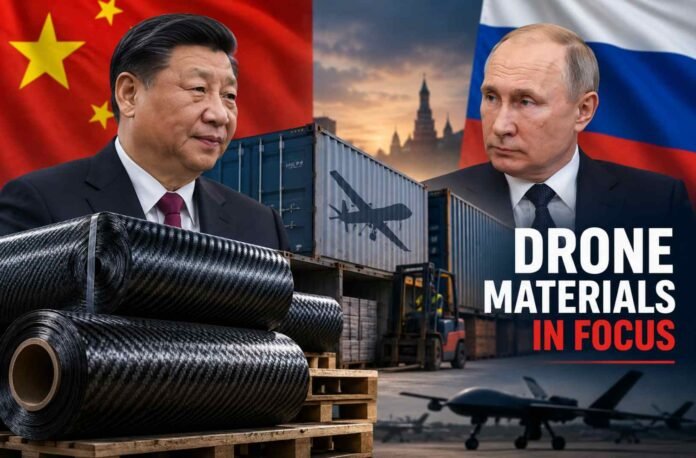
- A Chinese state owned company allegedly shipped 46 tons of carbon fiber precursor material to a sanctioned Russian company.
- The shipment was reportedly classified under a civilian customs code instead of a dual use category.
- An expert estimated that the material could potentially support production of up to 1,300 long range attack drones.
- China and Rosatom deny wrongdoing, while Ukraine is calling for tougher sanctions and export controls.
A Chinese state owned company allegedly shipped 46 tons of material used in advanced drone manufacturing to a sanctioned Russian producer earlier this year, according to internal shipping records reviewed by US and UK officials.
The shipment reportedly involved Jilin Chemical Fiber Group in China and Alabuga Volokno, a Russian company connected to the state owned nuclear corporation Rosatom. The material was transported in two large containers and was recorded under a customs classification generally associated with civilian synthetic fiber.
That classification is now at the center of the allegations.
Investigators believe the material should have been identified as a dual use product because carbon fiber can be used in both civilian manufacturing and military systems. Using a civilian customs code could therefore have made the shipment less likely to attract scrutiny from export control authorities.
The reported transaction is significant because Alabuga Volokno is not simply a conventional industrial supplier. Its manufacturing capabilities include carbon fiber products designed for sectors such as aviation, aerospace, shipbuilding, armor and unmanned systems.
Weapons expert David Albright has estimated that the quantity involved could be enough to produce components for as many as 1,300 long range attack drones.
That estimate does not mean 1,300 drones were actually built from the shipment. Rather, it highlights the potential military value of the amount of material involved.
A supply chain with growing military importance
The alleged shipment also fits into a broader pattern that Ukraine and Western officials have been warning about for years.
The Ukrainian Security and Cooperation Centre says it has identified at least eight tenders involving similar transactions between the Chinese and Russian companies since 2022. If those claims are accurate, the latest shipment would not be an isolated commercial transaction but part of a longer running supply relationship.
Carbon fiber is particularly valuable for modern unmanned aircraft because it can provide high strength while keeping structures relatively light. Those characteristics are useful when manufacturers need drones capable of carrying larger payloads or travelling longer distances.
For Russia, maintaining access to such materials has become increasingly important as Western sanctions have restricted its access to many advanced industrial products.
China has become one of Russia’s most important external suppliers of industrial components and technologies. Analysts have repeatedly pointed to Chinese manufacturing as an important source of equipment that can keep parts of Russia’s defense production running despite sanctions.
A Kiel Institute analysis cited in the report estimated that China provides more than 60% of the components supporting Russia’s military production.
That does not mean every Chinese export to Russia has a military purpose. China continues to have substantial legitimate commercial trade with Russia. The concern from Western governments is that some civilian supply chains may also be supporting military production.
Beijing rejects the allegations
Chinese officials have rejected the accusation that the country is supplying military equipment to either side of the Russia Ukraine war.
The Chinese embassy in Washington said Beijing maintains strict controls on dual use products and has not provided weapons to either Russia or Ukraine.
Rosatom also rejected accusations involving Alabuga Volokno. The Russian state corporation said its companies comply with applicable laws and regulations and dismissed claims that its subsidiary had acted improperly.
The disagreement highlights one of the central problems surrounding sanctions enforcement. A product can have an entirely legitimate civilian application while also being essential to military manufacturing.
That makes it much harder for governments to distinguish ordinary commercial trade from deliberate support for defense production.
Former US officials quoted in the report have also questioned whether Chinese state owned companies could conduct significant transactions of this kind without government awareness.
The allegations are particularly sensitive because they come at a time when Washington and Beijing are attempting to manage wider tensions over trade, technology and national security.
What the shipment could mean for Russia’s drone industry
Russia has significantly expanded its use and production of drones during the war in Ukraine. Long range attack drones have become an important part of its ability to strike targets deep inside Ukrainian territory.
Access to foreign components and raw materials can therefore have an impact far beyond the value of an individual shipment.
For Ukraine, the concern is that continued access to Chinese industrial materials could allow Russia to expand its production capacity even as Western sanctions attempt to limit that growth.
Kyiv has called for stronger action against companies and intermediaries involved in such supply networks. Proposed measures include secondary sanctions, tighter controls on dual use exports and greater coordination with Asian countries that could help disrupt the flow of restricted materials.
The latest allegations also underline a broader shift in the Russia China relationship. While Beijing continues to insist that it is not a participant in the war, its enormous manufacturing base makes China an increasingly important part of the supply chains that support Russia’s wider economy.
Whether the reported shipment represents intentional sanctions evasion or a disputed interpretation of customs rules remains contested.
What is less disputed is the strategic importance of materials such as carbon fiber. As drone warfare becomes more sophisticated, seemingly ordinary industrial products can become critical parts of a modern weapons supply chain.
Follow TechBSB For More Updates