
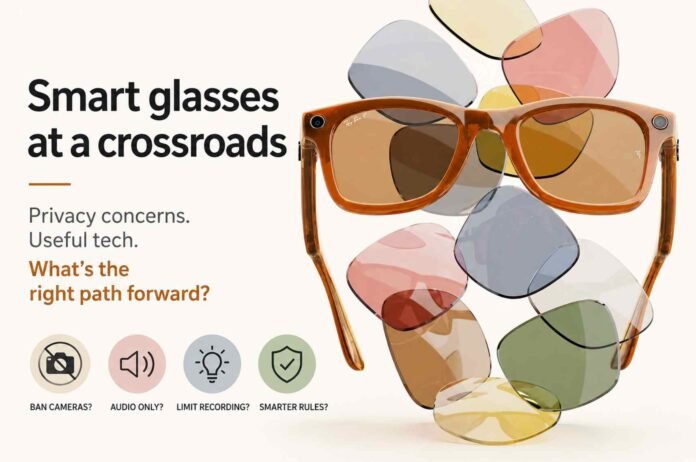
- Meta’s smart glasses are useful, but their cameras are creating growing privacy concerns.
- A complete ban could remove useful AI and accessibility features while failing to stop covert recording entirely.
- Restricting video recording while keeping cameras for AI could offer a practical compromise.
- The most likely future is stricter rules and clearer privacy protections rather than the complete death of smart glasses.
Meta’s smart glasses have reached an awkward moment. The technology is getting better, adoption is growing, and the glasses can genuinely be useful. Yet the more capable these devices become, the harder it is to ignore the privacy concerns surrounding a camera sitting on someone’s face.
That puts Meta’s Ray Ban smart glasses in a position that feels surprisingly similar to Google Glass. The big difference is that Meta has managed to make its hardware look and feel like something people might actually want to wear. The question now is whether better design and useful AI features will be enough to overcome the growing discomfort around wearable cameras.
Public opinion is already shifting. Some businesses are restricting smart glasses, while privacy concerns are becoming a regular part of the conversation. That does not necessarily mean camera equipped glasses are doomed, but it does suggest that the industry cannot simply carry on as if the problem does not exist.
Keep the cameras and improve the rules
The simplest option for Meta and other smart glasses makers is to keep cameras exactly where they are and focus on making their use more transparent.
There is a strong argument for this approach because the cameras are not just there for taking pictures. They can give AI useful visual context, help users understand signs and landmarks, and provide hands free assistance. For people with visual impairments, camera based features can also make the surrounding world easier to understand.
Removing the camera would therefore remove one of the most interesting parts of the technology.
Meta could instead improve privacy controls and make recording much harder to miss. A brighter indicator, clearer warnings and stronger safeguards against misuse could all help.
The problem is that technology alone may not solve a problem that is partly social. Even if Meta makes its recording indicators technically compliant, people may still feel uncomfortable around someone wearing glasses that can capture them.
And that feeling is difficult to fix with a software update.
Ban cameras from smart glasses
The more dramatic solution would be to remove cameras from consumer smart glasses altogether.
This would immediately address the biggest privacy concern. People could still wear glasses with speakers, microphones, displays and AI assistants, but they would not have to wonder whether the person standing next to them is secretly filming.
There would be a significant trade off.
Without a camera, smart glasses lose the ability to understand what the wearer is looking at. AI could still answer questions, play music and provide information, but it would be far less aware of the user’s surroundings.
That would make the glasses less useful for accessibility, travel and hands free assistance.
It would also be difficult to enforce a blanket ban. Smartphones already provide sophisticated cameras, and small recording devices are widely available. Removing cameras from glasses would not remove the ability to record people. It would simply remove one particularly discreet way of doing it.
Keep the cameras but restrict recording
This may be the most interesting middle ground.
Smart glasses could retain their cameras for visual recognition and AI features, while manufacturers and regulators impose much stronger limits on recording.
Taking a photograph could require an obvious sound, similar to camera restrictions already used in some countries. The recording light could also become brighter and more difficult to ignore.
Video is the harder problem.
A sound playing continuously while someone records would make the glasses less useful for capturing natural moments. Making the recording light extremely obvious could help, but it still would not guarantee that everyone nearby notices it.
Another possibility would be to disable video recording completely while allowing the camera to operate for AI and accessibility functions.
That would preserve much of the technology’s value without turning the glasses into a discreet wearable video camera.
The obvious weakness is security. If the hardware is still capable of recording video, someone may eventually find a way around software restrictions. Manufacturers would therefore need serious tamper resistance and strong security protections.
The likely future is regulation, not extinction
Outright banning smart glasses feels unlikely to be the long term answer.
The technology is already useful, and its potential extends far beyond taking videos. AI assistants that can see what the wearer sees could eventually become an important computing platform.
At the same time, expecting the public to simply accept cameras everywhere is unrealistic.
The most likely future is therefore a compromise. Camera equipped glasses will probably remain available, but the rules around where and how they can be used will become stricter.
Businesses may continue banning them in sensitive environments. Manufacturers may introduce clearer recording indicators. Governments could establish rules around covert recording. Users may also become more selective about when they wear them.
This would be very different from the fate of Google Glass. Google Glass became associated with privacy concerns before the technology had a chance to become a mainstream consumer product. Meta’s glasses have already crossed a much more important threshold because people actually find them useful.
That gives Meta a better chance of surviving the backlash.
But survival does not mean the current design will remain unchanged.
The future of smart glasses may depend less on making the cameras more powerful and more on making people comfortable with the fact that those cameras exist.
Follow TechBSB For More Updates