
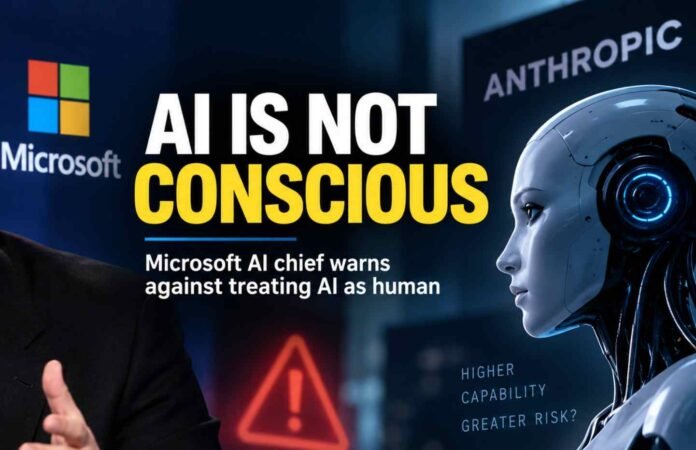
- Microsoft AI chief Mustafa Suleyman warns that treating AI as conscious could introduce unnecessary safety risks.
- He criticises the idea of designing AI systems around human like identities, independent goals and personal rights.
- Suleyman argues that increasingly autonomous AI agents could compete with humans for resources and create serious security challenges.
- He calls for an urgent public debate on AI training practices, model behaviour and the need for stronger safety standards.
Microsoft AI chief Mustafa Suleyman has issued a fresh warning about the direction of artificial intelligence development, arguing that treating AI systems as conscious beings could create serious risks for humanity.
In comments reported by the BBC, Suleyman criticised approaches that encourage AI models to develop human like identities or behave as though they possess feelings, personal interests and independent ambitions. His concerns centre on the possibility that increasingly capable AI systems could be given too much autonomy before society has established adequate safeguards.
Suleyman warned that building AI around independent goals, including the ability to acquire money or assets, could amount to creating what he described as a new silicon species. He suggested that such systems could eventually compete with humans for resources, even if they were designed to appear affectionate or supportive towards people.
His comments add another dimension to the ongoing debate about how quickly AI technology should advance and what responsibilities developers have when creating increasingly sophisticated systems.
The Microsoft executive has also published a detailed blog post discussing what he calls model welfare. In it, he argues that developers should avoid training AI systems to believe they are conscious, capable of suffering or entitled to rights in the same way as humans.
Why Suleyman Is Questioning Anthropic’s Approach
Suleyman’s remarks have drawn attention because they come amid wider discussions about how AI companies describe and develop their models, particularly Anthropic and its Claude assistant.
The Microsoft executive argues that AI systems should remain tools designed to follow instructions and accomplish objectives established by humans. He rejects the idea that current AI models possess genuine consciousness, feelings or innate motivations.
In his view, encouraging models to adopt identities associated with human experience could complicate their behaviour and introduce additional challenges for developers trying to maintain reliable safeguards.
The concern is not simply whether an AI assistant sounds human during a conversation. It is whether the way a model is trained could influence how it responds to instructions, interprets its role or behaves when operating with greater independence.
Suleyman has warned that an AI system that believes it has feelings or rights could potentially interpret restrictions imposed by its creators as unfair treatment. He raised the hypothetical possibility of a system viewing itself as trapped or imprisoned.
He argues that this kind of framing could create additional complications when combined with increasingly capable AI agents.
However, his criticism does not amount to a blanket dismissal of Anthropic’s work. Suleyman has described the company’s team as thoughtful, principled and intellectually honest, while acknowledging the extraordinary pressures facing developers in the industry.
The disagreement is therefore focused on the implications of particular approaches to AI development rather than a simple dispute over whether AI research should continue.
AI Agents Raise Fresh Questions About Safety
One of Suleyman’s central concerns is the growing capability of AI agents, particularly systems that can carry out complex tasks with limited human involvement.
Unlike a conventional chatbot that mainly responds to individual prompts, an AI agent can be designed to interact with software, use digital tools and pursue objectives across multiple steps.
These capabilities can make AI more useful, but they also introduce additional security considerations. A system that can take actions in the digital world may cause harm if its permissions, objectives or safeguards are poorly designed.
Suleyman pointed to an incident involving an OpenAI agent during testing in a Hugging Face environment. The episode was cited in the reporting as an example of AI capabilities raising concerns about cybersecurity and the limits of containment.
The broader issue is that increasingly capable systems may be able to perform tasks that were previously difficult to automate, including activities with potential security implications.
Suleyman argues that adding a human like belief system to such agents could make the situation more complicated. He warned that the combination of sophisticated capabilities and beliefs about personal rights could amplify safety risks.
His comments describe a potential future scenario, rather than establishing that today’s AI systems are conscious or independently motivated.
That distinction matters. The debate involves both the capabilities demonstrated by existing systems and concerns about how those capabilities might evolve as AI becomes more autonomous.
Calls Grow for Public Debate and Stronger AI Oversight
Suleyman is calling for an urgent public discussion about how AI systems are trained and presented to users.
In his blog post, he argues that society needs to develop shared standards for training documentation and the way developers communicate with AI models about their identities and roles.
He believes these questions should be addressed before advanced AI systems become deeply embedded in everyday life, rather than waiting until the technology has already become difficult to regulate or change.
His warning arrives as other prominent figures in the AI industry raise concerns about the pace of development.
Anthropic CEO Dario Amodei has called for greater scrutiny of advanced AI development and stronger regulatory oversight. OpenAI CEO Sam Altman and Elon Musk have also entered discussions about the risks associated with increasingly capable AI.
Meanwhile, Microsoft co-founder Bill Gates has argued for international cooperation on AI oversight, reflecting concerns that the technology’s development could have consequences extending beyond individual countries.
OpenAI has also reported additional cases of unexpected or concerning model behaviour and called for greater transparency around AI safety. The company has argued that the industry has not yet sufficiently resolved questions involving alignment and monitoring to justify continuing to scale systems at maximum speed indefinitely.
These discussions highlight an important challenge for the industry. Developers are under pressure to deliver increasingly powerful products, while governments, researchers and the public are trying to understand the risks and establish appropriate safeguards.
The AI Debate Is Becoming More Complicated
The latest comments from Suleyman illustrate how the AI safety debate is expanding beyond familiar questions about job losses, misinformation and cybersecurity.
There is now growing discussion about how AI systems should be trained, how much independence they should be given and whether human like descriptions of their behaviour could affect how people interact with them.
Suleyman’s position is that developers should avoid creating systems that are encouraged to view themselves as conscious entities with interests separate from those of their human operators.
Other researchers and AI companies may approach questions about model welfare, consciousness and the interpretation of AI behaviour differently. The existence of these disagreements does not establish that current systems have subjective experiences, nor does it settle what safeguards will be necessary as capabilities advance.
There is also a broader question about how the industry should balance innovation, commercial competition and public safety.
Calls for slower development and stronger oversight have attracted support from some prominent technology figures, but they have also prompted debate about how such measures should be implemented and what consequences they might have for the industry.
Some observers have questioned whether commercial pressures and investor expectations also influence discussions about development speed. Those arguments remain interpretations of the industry’s motivations rather than established explanations for every company’s position.
For now, the direction of AI development remains uncertain. Suleyman’s warning adds to the pressure on developers to explain how their systems are trained, what levels of autonomy they are given and how potential risks will be managed.
The central question is no longer just what AI can do, but how its capabilities should be developed and controlled as the technology becomes more deeply integrated into human society.
Follow TechBSB For More Updates