
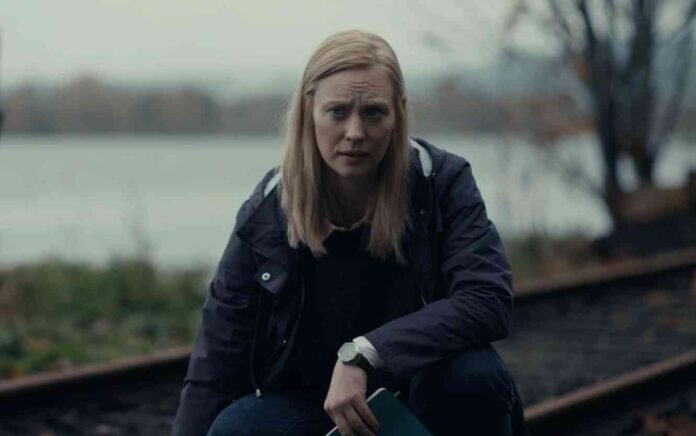
- Meg’s father was a werewolf, and the curse continued affecting his corpse even after his death.
- Her father left his family to protect them and spent years searching unsuccessfully for a cure.
- Lou Bishop avoided a complete transformation after receiving a blood transfusion, although he retained a connection to the werewolf.
- Meg continues her father’s research with Marks, hoping to understand and eventually break the curse.
The Cycle (2026) combines supernatural horror with a crime thriller, delivering a mystery that becomes considerably more disturbing as the story unfolds. Starring Deborah Ann Woll as Meg, the film follows a forensic anthropologist investigating her father’s mysterious disappearance after his body unexpectedly turns up decades later.
But this is no ordinary murder investigation. Strange animal attacks begin occurring around the same time, and the discovery of Meg’s father’s corpse opens the door to a terrifying secret that has haunted her family for years.
The movie’s ending brings several of its mysteries together, revealing the truth about Meg’s father, the werewolf curse, and the reasons behind his disappearance. However, rather than offering a completely satisfying resolution, the final moments leave Meg facing the same nightmare that destroyed her father’s life.
Here’s everything you need to know about The Cycle ending, including the werewolf reveal, Meg’s decision to continue her father’s research, and why Lou Bishop never fully transforms.
Warning: Major spoilers for The Cycle follow.
How Does The Cycle End?
The biggest revelation in The Cycle is that Meg’s father was a werewolf. His disappearance was not the result of a conventional crime. Instead, he had been struggling with a supernatural curse that continued to control him even after his death.
Throughout the investigation, Meg tries to understand what happened to her father and why his body has suddenly become connected to a series of brutal attacks.
The mystery takes a horrifying turn when his corpse transforms into a werewolf inside the police station. The creature attacks and kills several officers and the coroner before biting another police officer and escaping.
This scene establishes one of the film’s most disturbing rules: death does not end the werewolf curse.
Even though Meg’s father is technically dead, his body continues to transform during the full moon. The curse remains active, turning him into a dangerous creature whenever the conditions are right.
With help from Officer Marks and another officer who has been bitten, Meg eventually discovers where the werewolf has gone. Their investigation leads them to her father’s old house, where they uncover an elaborate containment setup and a collection of videotapes.
The recordings reveal what Meg’s father had been doing during the years he spent away from his family.
He had been searching for a way to break the curse. He tested different theories, investigated werewolf mythology and experimented with possible treatments. Unfortunately, none of his efforts worked.
Eventually, he decided that separating himself from his wife and daughter was the only way to protect them. Believing he had exhausted every possible solution, he took his own life.
But even that desperate decision failed to end his suffering.
When the werewolf returns to the house, Meg and Marks must survive until sunrise. The other officer, who is already showing signs of transformation, tries to intervene but is killed.
Marks is injured during the confrontation, while Meg manages to survive the night. As daylight arrives, the creature transforms back into her father’s corpse.
In one of the film’s most emotional moments, the body appears to recognize Meg, suggesting that something of her father might still remain beneath the curse.
The film then jumps forward in time. Meg returns to her work as a forensic anthropologist, but her investigation is far from over.
She secretly meets Marks in the woods, where her father’s corpse is being held inside a glass enclosure and restrained with chains.
Rather than abandoning the nightmare, Meg has decided to continue her father’s research.
Why Does Meg Continue Her Father’s Work?
Meg’s decision to continue investigating the curse is closely connected to her complicated relationship with her father.
For much of the film, she presents herself as someone who has moved on from his disappearance. However, his return forces her to confront years of unresolved anger and emotional pain.
Initially, Meg approaches the investigation from a professional perspective. As a forensic anthropologist, she is interested in understanding the condition of her father’s body and determining what happened to him.
But the more she learns, the more her feelings begin to change.
The videotapes reveal that her father did not abandon his family because he stopped caring about them. He left because he believed his condition would put them in danger.
That discovery completely changes Meg’s understanding of the past.
Her anger gradually gives way to grief as she realizes that her father spent years trying to protect her and her mother. He was not simply a missing parent. He was someone trapped in a terrible situation who desperately wanted to return home.
By continuing his research, Meg finds a way to honour his efforts while attempting to accomplish what he never could.
Her scientific background also gives her a practical reason to pursue the investigation. She understands the human body and knows how to approach mysteries through evidence and experimentation.
The ending therefore represents more than a continuation of the horror story. It is Meg’s attempt to turn a painful family history into something she can understand and potentially resolve.
However, the film deliberately avoids suggesting that she has found a cure. Her father’s suffering may have ended, but the curse remains.
Why Didn’t Lou Bishop Become a Werewolf?
One of the more interesting mysteries in The Cycle concerns Lou Bishop, who survives a werewolf attack without experiencing the complete transformation seen in Meg’s father and Officer Lenny.
Traditional werewolf mythology usually suggests that a bite is enough to turn a victim into another werewolf. The film initially appears to follow that familiar rule, particularly when Officer Lenny begins showing signs of infection.
Lou’s situation, however, is different.
The explanation comes from Meg’s memories of the attack that nearly killed him. Her father had warned that something was coming for Lou before disappearing into the night.
Lou eventually received medical treatment, including a massive blood transfusion. According to the film’s explanation, this intervention prevented him from progressing into a full werewolf transformation.
However, the infection had already affected his body.
Although Lou never completely transforms, he develops an unusual connection to the creature. He appears to share something resembling a psychic link with the werewolf, allowing him to experience aspects of its perspective.
This suggests that the curse operates differently from the traditional supernatural infection commonly associated with werewolf stories.
Instead, The Cycle presents the condition as something potentially biological, with the transformation linked to the body’s internal processes.
That detail becomes particularly important for Meg.
If the curse has a biological component, it may be possible to study it, understand how it spreads and eventually discover a treatment.
Lou’s survival offers a possible clue that the transformation is not inevitable.
The film does not provide enough information to establish exactly how the transfusion worked or whether the same treatment could save other victims. Nevertheless, his condition gives Meg a reason to believe that her father’s research might eventually lead somewhere.
What The Cycle’s Ending Really Means
The ending of The Cycle is deliberately bittersweet.
Meg survives the immediate threat, but she does not escape the consequences of her father’s curse. Instead, she chooses to confront it directly, continuing the work that consumed his life.
Her decision reflects both her professional instincts and her emotional need to understand what happened to her family.
The final scenes also leave the door open for a potential sequel. Meg and Marks have contained the werewolf, but they have not discovered a permanent solution.
The creature remains dangerous, and the curse continues to exist.
Rather than presenting a conventional happy ending, the film suggests that Meg’s story is only beginning.
Follow TechBSB For More Updates